Thank you for visiting SNEWPapers!
Sign up free
National Gazette
Philadelphia, Philadelphia County, Pennsylvania
What is this article about?
Report of Mr. Mercer's speech in the U.S. House of Representatives on March 28, proposing an amendment to the public debt subscription terms. He argues against the funding system's irredeemable features, claiming they violate natural rights and the Constitution by binding future generations without repeal power.
Merged-components note: These components are parts of the same full narrative: Mr. Mercer's speech on the public debt. The first is the beginning on page 1, and the latter two continue it on page 4. Label changed from 'editorial' for the continuations to 'story' as it is a reported political speech/article.
Clippings
1 of 2
OCR Quality
Full Text
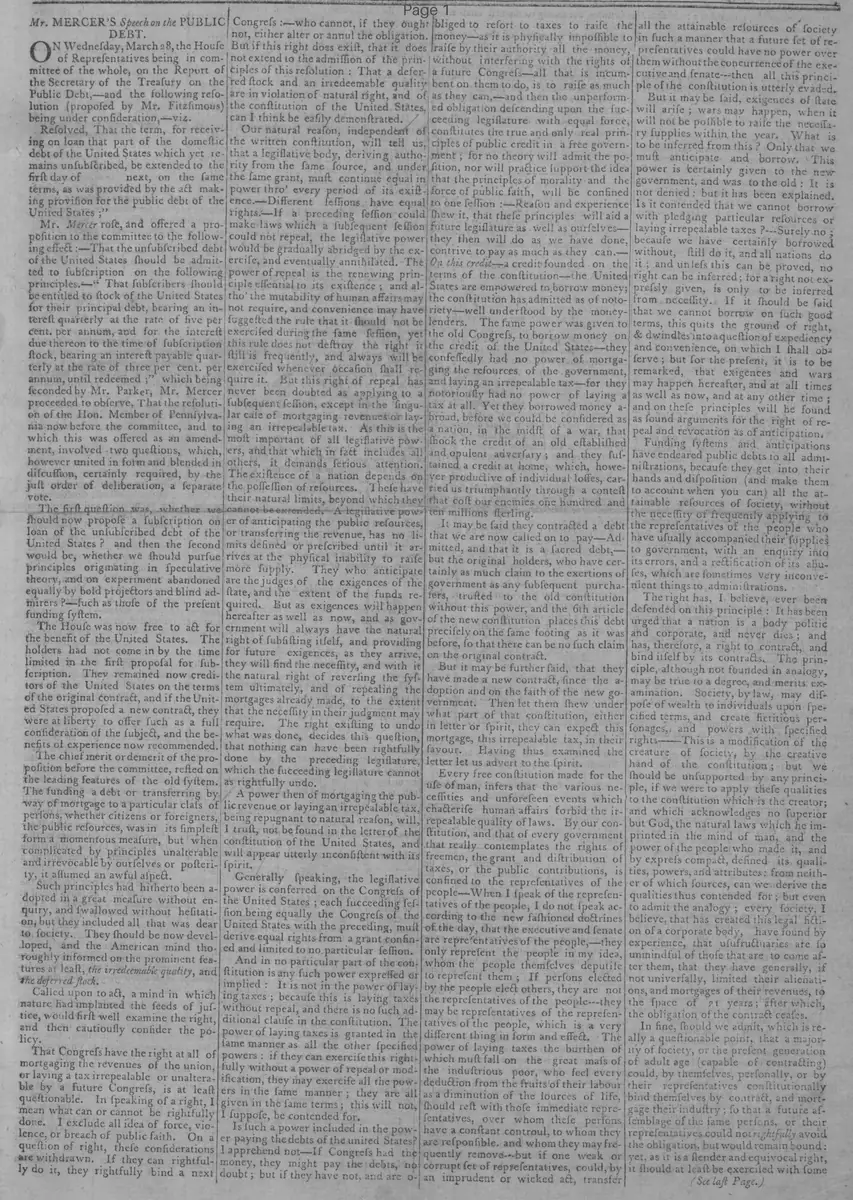
On Wednesday, March 28, the House of Representatives being in committee of the whole, on the Report of the Secretary of the Treasury on the Public Debt,—and the following resolution (proposed by Mr. Fitzsimons) being under consideration,—viz.
Resolved, That the term, for receiving on loan that part of the domestic debt of the United States which yet remains unsubscribed, be extended to the first day of next, on the same terms, as was provided by the act making provision for the public debt of the United States ;"
Mr. Mercer rose, and offered a proposition to the committee to the following effect :-That the unsubscribed debt of the United States should be admitted to subscription on the following principles.-" That subscribers should be entitled to stock of the United States for their principal debt, bearing an interest quarterly at the rate of five per cent. per annum, and for the interest due thereon to the time of subscription stock, bearing an interest payable quarterly at the rate of three per cent. per annum, until redeemed ;" which being seconded by Mr. Parker, Mr. Mercer proceeded to observe, That the resolution of the Hon. Member of Pennsylvania now before the committee, and to which this was offered as an amendment, involved two questions, which, however united in form and blended in discussion, certainly required, by the just order of deliberation, a separate vote.
The first question was, whether we should now propose a subscription on loan of the unsubscribed debt of the United States ? and then the second would be, whether we should pursue principles originating in speculative theory, and on experiment abandoned equally by bold projectors and blind admirers—such as those of the present funding system.
The House was now free to act for the benefit of the United States. The holders had not come in by the time limited in the first proposal for subscription. They remained now creditors of the United States on the terms of the original contract, and if the United States proposed a new contract, they were at liberty to offer such as a full consideration of the subject, and the benefits of experience now recommended.
The chief merit or demerit of the proposition before the committee, rested on the leading features of the old system. The funding a debt or transferring by way of mortgage to a particular class of persons, whether citizens or foreigners, the public resources, was in its simplest form a momentous measure, but when complicated by principles unalterable and irrevocable by ourselves or posterity, it assumed an awful aspect.
Such principles had hitherto been adopted in a great measure without enquiry, and swallowed without hesitation, but they included all that was dear to society. They should be now developed, and the American mind thoroughly informed on the prominent features at least, the irredeemable quality, and the deferred stock.
Called upon to act, a mind in which nature had implanted the seeds of justice, would first well examine the right, and then cautiously consider the policy.
That Congress have the right at all of mortgaging the revenues of the union, or laying a tax irrepealable or unalterable by a future Congress, is at least questionable. In speaking of a right, I mean what can or cannot be rightfully done. I exclude all idea of force, violence, or breach of public faith. On a question of right, these considerations are withdrawn. If they can rightfully do it, they rightfully bind a next
Congress :-who cannot, if they ought not, either alter or annul the obligation. But if this right does exist, that it does not extend to the admission of the principles of this resolution : That a deferred stock and an irredeemable quality are in violation of natural right, and of the constitution of the United States can I think be easily demonstrated.
Our natural reason, independent of the written constitution, will tell us, that a legislative body, deriving authority from the same source, and under the same grant, must continue equal in power thro' every period of its existence.-Different sessions have equal rights.-If a preceding session could make laws which a subsequent session could not repeal, the legislative power would be gradually abridged by the exercise, and eventually annihilated. The power of repeal is the renewing principle essential to its existence ; and altho' the mutability of human affairs may not require, and convenience may have suggested the rule that it should not be exercised during the same session, yet this rule does not destroy the right it still is frequently, and always will be exercised whenever occasion shall require it. But this right of repeal has never been doubted as applying to a subsequent session, except in the singular case of mortgaging revenues or laying an irrepealable tax. As this is the most important of all legislative powers, and that which in fact includes all others, it demands serious attention.
The existence of a nation depends on the possession of resources. These have their natural limits, beyond which they cannot be extended. A legislative power of anticipating the public resources, or transferring the revenue, has no limits defined or prescribed until it arrives at the physical inability to raise more supply. They who anticipate are the judges of the exigences of the state. and the extent of the funds required. But as exigences will happen hereafter as well as now, and as government will always have the natural right of subsisting itself, and providing for future exigences. as they arrive, they will find the necessity, and with it the natural right of reversing the system ultimately, and of repealing the mortgages already made, to the extent that the necessity in their judgment may require. The right existing to undo what was done, decides this question, that nothing can have been rightfully done by the preceding legislature, which the succeeding legislature cannot as rightfully undo.
A power then of mortgaging the public revenue or laying an irrepealable tax, being repugnant to natural reason, will, I trust, not be found in the letter of the constitution of the United States, and will appear utterly inconsistent with its spirit.
Generally speaking, the legislative power is conferred on the Congress of the United States ; each succeeding session being equally the Congress of the United States with the preceding, must derive equal rights from a grant confined and limited to no particular session. And in no particular part of the constitution is any such power expressed or implied : It is not in the power of laying taxes ; because this is laying taxes without repeal, and there is no such additional clause in the constitution. The power of laying taxes is granted in the same manner as all the other specified powers : if they can exercise this rightfully without a power of repeal or modification, they may exercise all the powers in the same manner : they are all given in the same terms; this will not, I suppose, be contended for.
Is such a power included in the power paying the debts of the united States? I apprehend not. If Congress had the money, they might pay the debts, no doubt; but if they have not, and are obliged to resort to taxes to raise the money—as it is physically impossible to raise by their authority all the money. without interfering with the rights of a future Congress all that is incumbent on them to do, is to raise as much as they can,—and then the unperformed obligation descending upon the succeeding legislature. with equal force, constitutes the true and only real principles of public credit in a free government; for no theory will admit the position, nor will practice support the idea that the principles of morality and the force of public faith, will be confined to one session :-Reason and experience shew it, that these principles will aid a future legislature as well as ourselves- they then will do as we have done, contrive to pay as much as they can.—
On this credit—a credit founded on the terms of the constitution—the United States are empowered to borrow money; the constitution has admitted as of notoriety—well understood by the money-lenders. The same power was given to the old Congress, to borrow money on the credit of the United States—they confessedly had no power of mortgaging the resources of the government, and laying an irrepealable tax—for they notoriously had no power of laying a tax at all. Yet they borrowed money abroad, before we could be considered as a nation, in the midst of a war, that shook the credit of an old established and opulent adversary; and they sustained a credit at home, which, however productive of individual loss, carried us triumphantly through a contest that cost our enemies one hundred and ten millions sterling.
It may be said they contracted a debt that we are now called on to pay—Admitted, and that it is a sacred debt,— but the original holders, who have certainly as much claim to the exertions of government as any subsequent purchasers, trusted to the old constitution without this power, and the 6th article of the new constitution places this debt precisely on the same footing as it was before, so that there can be no such claim on the original contract.
But it may be further said, that they have made a new contract, since the adoption and on the faith of the new government. Then let them shew under what part of that constitution. either in letter or spirit, they can expect this mortgage, this irrepealable tax, in their favour. Having thus examined the letter let us advert to the spirit.
Every free constitution made for the use of man, infers that the various necessities and unforeseen events which characterize human affairs forbid the irrepealable quality of laws. By our constitution, and that of every government that really contemplates the rights of freemen, the grant and distribution of taxes, or the public contributions, is confined to the representatives of the people. When I speak of the representatives of the people, I do not speak according to the new fashioned doctrines of the day, that the executive and senate are representatives of the people,—they only represent the people in my idea, whom the people themselves depute to represent them; If persons elected by the people elect others, they are not the representatives of the people—they may be representatives of the representatives of the people, which is a very different thing in form and effect. The power of laying taxes the burthen of which must fall on the great mass of the industrious poor, who feel every deduction from the fruits of their labour as a diminution of the sources of life. should rest with those immediate representatives, over whom these persons have a constant controul, to whom they are responsible. and whom they may frequently remove—but if one weak or corrupt set of representatives, could, by an imprudent or wicked act, transfer
all the attainable resources of society to such a manner that a future set of representatives could have no power over them without the concurrence of the executive and senate—then all this principle of the constitution is utterly evaded.
But it may be said. exigences of state will arise; wars may happen, when it will not be possible to raise the necessary supplies within the year. What is to be inferred from this ? Only that we must anticipate and borrow. This power is certainly given to the new government, and was to the old: It is not denied: but it has been explained. Is it contended that we cannot borrow without pledging particular resources or laying irrepealable taxes ?—Surely no ; because we have certainly borrowed without, still do it, and all nations do it; and unless this can be proved, no right can be inferred; for a right not expressly given, is only to be inferred from necessity. If it should be said that we cannot borrow on such good terms, this quits the ground of right, & dwindles into a question of expediency and convenience, on which I shall observe; but for the present, it is to be remarked, that exigences and wars may happen hereafter, and at all times as well as now, and at any other time ; and on these principles will be found as sound arguments for the right of repeal and revocation as of anticipation.
Funding systems and anticipations have endeared public debts to all administrations, because they get into their hands and disposition (and make them to account when you can) all the attainable resources of society, without the necessity of frequently applying to the representatives of the people who have usually accompanied their supplies to government, with an enquiry into its errors, and a rectification of its abuses, which are sometimes very inconvenient things to administrations.
The right has, I believe, ever been defended on this principle : It has been urged that a nation is a body politic and corporate, and never dies; and has, therefore, a right to contract, and bind itself by its contracts. The principle, although not founded in analogy, may be true to a degree, and merits examination. Society, by law, may dispose of wealth to individuals upon specified terms, and create fictitious personages,, and powers with specified rights— This is a modification of the creature of society, by the creative hand of the constitution; but we should be unsupported by any principle, if we were to apply these qualities to the constitution which is the creator; and which acknowledges no superior but God, the natural laws which he imprinted in the mind of man, and the power of the people who made it, and by express compact, defined its qualities, powers, and attributes: from neither of which sources, can we derive the qualities thus contended for; but even to admit the analogy ; every society, I believe, that has created this legal fiction of a corporate body, have found by experience, that usufructuaries are so unmindful of those that are to come after them, that they have generally, if not universally, limited their alienations, and mortgages of their revenues, to the space of 21 years; after which, the obligation of the contract ceases.
In fine, should we admit, which is really a questionable point, that a majority of society, or the present generation of adult age (capable of contracting) could, by themselves, personally, or by their representatives constitutionally bind themselves by contract. and mortgage their industry; so that a future assemblage of the same persons, or their representatives could not rightfully avoid the obligation, but would remain bound: yet, as it is a lender and equivocal right, it should at least be exercised with some
With regard to decency and respect to such future assemblage. For a government at its commencement to contract debts greatly beyond their immediate resources, to dispose of almost the whole of the attainable revenue; in a manner to create, by assuming debts from governments, who were sinking them fast, and were altogether opposed to such assumption; and thus opening a door for the revival of liquidated claims, and make it the interest of states to make out as large a debt as possible to get a greater share of the general plunder, is certainly covering the weakness of the right by the boldness of the exercise. And then to say to such future assemblage, that they shall not pay when they are able, is subjecting them to conditions that none but a lunatic in private life would submit to, and this in direct violation of the constitution which gives to Congress the express power of paying the debts of the United States. Can this power of Congress be abridged or destroyed by any contract with a creditor? Such a principle could never bind; it would not be upheld in a private case; it was arbitrary in adoption; shameful in continuance, and would be criminal perhaps in imitation.
But should we admit that a majority of the present generation may so bind themselves and mortgage their own industry; yet the extent of this power is to be defined. The grand and important question yet remains to be discussed; a question that never has been, and perhaps never will be, fairly met. Can they sell or mortgage the labor and industry of another generation---of posterity? Are they the judges of the extent and conditions? That they cannot, and are not, is as demonstrable as any proposition in Euclid.
The God of nature has given the earth to the living. That he will make our children and our children's children as free as he made us, is what no parent, I trust, will deny. Under the divine impression, the voice of United America, has declared---that we cannot deprive posterity of their natural rights; which, from generation to generation, must continue the same as we came into the world with; we have a right to the fruits of our own industry---they to theirs.
The infringements of this sacred law, I believe more often arise from a want of accuracy and precision of reflection, than a desertion of moral principle.
Were all men born on one day, and died on another, the separate rights of posterity would then be as distinctly visible, as the line that would divide the one generation from another, but although the human race flows like a constant stream, in an uninterrupted course of renewal and decay, the rights of the separate parts are the same in reality, as if they could be readily and easily distinguished in practice.
That there is a period at which the majority of adults, capable of contracting, now living, will give place to a majority of adults equally capable, of the succeeding generation, is as certain as the great principle of mortality itself---this period may be ascertained with sufficient precision for every practical purpose, by the recorded bills of mortality---they are admitted in municipal legislation, and constitute its leading and distinguishing traits.
By the calculations of Mr. Buffon, it does not extend beyond nineteen years; but to give the present the ultimatum of their pretensions over the future, would not carry it beyond twenty years: the period limited by the English law, after which, even a private debt ceases to exist.
And surely these bounds, which nature has established, afforded ample scope for any reasonable anticipations. Can we figure any exigencies of state, that ought, or can require, from their termination, an anticipation of the resources of government, for a greater length than 20 years; or that a mortgage of the labour of society should be sold by any contract irrepealable for a greater term. Go beyond this, and you seize on the rights of posterity---pass this bound, there is none other that nature or reason can assign. The great mass of the industry and labour of all future generations becomes then yours to the extent, and on what conditions you please to prescribe---no other line can be drawn.
Such a principle is against the laws of God and Man---it inverts the whole order of society---it sweeps away in a torrent every check and safeguard of government, and arms any despot, any administration with means not sanctioned by nature, to bind in chains their fellow-men.
In the first place, it destroys that great principle, which alone was the cause of the war with Great Britain; which cost us the blood of our heroic countrymen, and which involved us in the debt---That taxation and representation should go hand in hand. We have no one quality of the representatives of posterity not elected by them, and not responsible to them.
It establishes a principle that those are to spend, who are not to pay---this lets loose extravagance in defiance of justice from its only natural restraints. Posterity whom we injure, have no power over us---we are not responsible to them---the order of nature renders the grave an asylum from their vengeance.
It destroys one great check of free legislation---that the legislator should feel, in his own property, the burthen of the tax he lays, and the contract he makes for society.
It avoids that still greater check that the constituents should feel the burthens their representatives impose---the people never act but from feelings; so long, therefore, as their deputies contract for and at the expense of posterity, they act in perfect safety. If they have a right to say they will only pay a part of the debt, they may diminish that part at pleasure, and finally they may say they will pay no part; and this, which, in theory would be considered as an argument from hyperbole, is precisely in practice, the very principle we have adopted, with respect to the deferred stock, and that not sparingly, as it is almost half our debt. Let any man examine the principles of this novelty of finance---and see where it leads to. Administration on this ground, would be perfectly safe in assuming the debt of Great Britain. The honour, if I may abuse the term, of this bold violation of natural law, was reserved for us. The extravagance of veteran corruption
in old exhausted nations has never, as I have heard, hazarded this principle. It appears as a frontispiece, to adorn the annals of an infant republic.
And who will impeach? the people feel nothing---the beings whose rights we thus trample on, will not burst into existence, until we retire from the scene, exercising such powers with rapidity, and to the extent already effected. Any administration might become masters of a mass of corruption---and attracting hardly observation, go on to bribe the present with the means of future generations, to do any thing that gold can tempt the weak, the wicked, and the necessitous to do.
All constitutions, all forms of government disappear before such a system of finance.
And what is the defence that ingenious and interested sophistry has yet invented? That as posterity are to partake of the benefit, they should pay part of the price. We have gone a little further with our deferred stock. Or that we pay nothing, but make them pay the whole; but is it not natural justice that they who are to pay should have some hand in the bargain? have they not a natural right to judge whether it is a benefit? and whether it is worth the money? Does any man suppose, that a government that admits such principles, will be really a benefit to posterity, or so considered by them.
The case has indeed been likened to that of an individual in society, who leaves an estate to an heir, burthened with debts---but it can bear no analogy. Society may say to an individual, by its laws, that we will prevent the intrusion of any other occupant into the property you hold, provided you leave it to your son, or to your creditor. This property the individual had no right to but by law. It is a right which society has secured to him, to the labour of others, which by nature he could not pretend to. But different generations of men bear no relation to each other but by the natural law and the terms of the constitution they adopt, and even this last is limited by the former.
But in what society upon earth has a contract of an individual ever been upheld, by the municipal tribunals, by which a parent has burthened property with a debt bearing no immediate interest, but to be paid by posterity, or by a contract prohibiting his posterity from paying it off when they are able. I must doubt, whether any courts would countenance such principles.
If one generation has a right to sell the produce of the soil for any extent of years, the next generation must quit it. If a nation was to borrow of foreigners to such extent, which is not only possible, but, I believe was nearly the case in Lewis the XIVth's time, they must break or quit.
But no principle has ever been admitted with respect to an individual, much less an American parent, that he has a right to dispose of the labour of his child. The child may relinquish the property, and then he has his hands free as nature made them, to labour for himself, so there is no injury to natural right. But where one generation sells the industry of another, they cannot get free unless they go into voluntary exile; and even then, by some modern doctrine, the contract will bind, let them go where they will, whilst they continue in the social bond; they must disperse like the Jews, to get rid of it.
The iniquity of the principle will be more clear and striking, when we contemplate that all public revenue or private income, is a contribution mediate or immediate of the labour of the industrious farmer and mechanic. If the rich pay any thing, it is only mediate, a part of what they first received from these classes. They are the drones of society, which, (however essential to its well-being) are fed by the bees. Money is a representation of industry---a representation of that residuum of labour which the poor either can or must spare, after sustaining life. If they only worked to maintain themselves, money would have no value; there could be no public revenue or private income. It follows then, that any transfers of public resources to any persons, citizens or foreigners, is a transfer of such a portion of the labour of the farmer and mechanic, and their posterity. No money-lender would lend one farthing to be paid out of the labour of the rich, to all eternity. It is true that the rich are by such transfers diminished in their comforts and conveniences, by withdrawing from them and giving to others that part of the labour of the industrious and productive classes, which they before enjoyed under contracts and the laws of society; but they are no objects to the money-lender. It is also true, that all public burthens fall, in great measure, on the land, so as to diminish its value and price, as I shall observe, but then to the men who lend to government, lands have no value but from the hands that are to work it.
That country is happy and free, in proportion as its political institutions and public oeconomy leave to the industrious the greater portion of the fruits of their industry. On the contrary, that country is wretched, and its people slaves, whatever they may be called, whose labour and industry, by any mechanism or conduct of society, belongs to others---as this evil proceeds, such country must decline; and when arrived to a certain extent, it must be deserted.
Contemplate a public debt as a mortgage on industry and labour---extend its effects to posterity; exempt ourselves from the burthen, and put it wholly on them, on the principle of the deferred stock; and then say, that they shall not free themselves by payment; and what does it amount to? That a free man, born now, has a right to the labour of a freeman, born twenty or thirty years hence; and that, because he will be then dead and gone, and cannot enjoy it, he may sell it now to a third person, and spend the money---thus truly simplified: Is any American prepared to avow the principle?
[To be continued.]
What sub-type of article is it?
What themes does it cover?
What keywords are associated?
What entities or persons were involved?
Where did it happen?
Story Details
Key Persons
Location
House Of Representatives
Event Date
March 28
Story Details
Mr. Mercer proposes an amendment to the public debt subscription, arguing that the current funding system with irredeemable taxes and deferred stock violates natural rights and the Constitution by binding future generations without the power of repeal.