Thank you for visiting SNEWPapers!
Sign up free
Editorial
July 15, 1800
Gazette Of The United States, & Daily Advertiser
Philadelphia, Philadelphia County, Pennsylvania
What is this article about?
An editorial from the Connecticut Courant criticizes Thomas Jefferson's views in 'Notes on Virginia,' arguing his ideas on limited government undermine morals, religion, and the Federal Constitution, linking them to French revolutionary influences and portraying him as hostile to protective governance.
Clipping
OCR Quality
95%
Excellent
Full Text
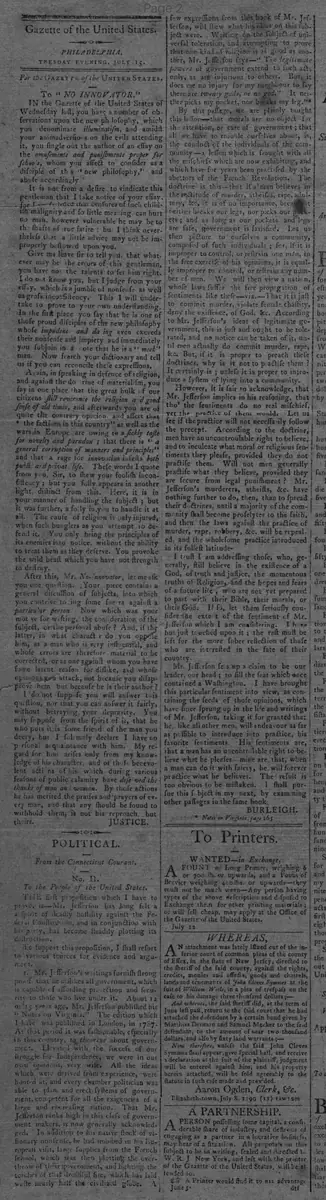
POLITICAL.
From the Connecticut Courant.
No. II.
To the People of the United States.
THE first proposition which I have to prove, is—Mr. Jefferson has long felt a sort of deadly hostility against the Federal Constitution, and in conjunction with his party, has become steadily plotting its destruction.
To support this proposition, I shall resort to various sources for evidence and argument.
1. Mr. Jefferson's writings furnish strong proof that he dislikes all government, which is capable of affording protection and security to those who live under it. About 12 or 15 years ago, Mr. Jefferson published his "Notes on Virginia." The edition which I have was published in London, in 1787. At that period it was fashionable, especially in this country, to theorize about government. Elevated with the success of our struggle for Independence, we were in our own opinions, very wise. All the ideas which were derived from experience, were hooted at, and every chamber politician was able to plan and erect systems of government, competent for all the exigencies of a large and increasing nation. That Mr. Jefferson ranks high in this class of government makers, is now generally acknowledged. In addition to his native stock of visionary nonsense, he had imbibed in his European visit, large supplies from the French school, which was then plotting the overthrow of their government, and lighting the torches of that dreadful fire, which has laid waste nearly half the civilized globe. A few expressions from this book of Mr. Jefferson, will shew what his ideas on this subject were. Writing on the object of universal toleration, and attempting to prove that one kind of religion is as good as another, Mr. Jefferson says—“The legitimate powers of government extend to such acts only, as are injurious to others. But, it does me no injury for my neighbour to say there are twenty gods, or no god. It neither picks my pocket, nor breaks my leg.”
By this passage, we are plainly taught this lesson—that morals are no object for the attention, or care of government; that all we have to trouble ourselves about, is, the conduct of the individuals of the community—a lesson which is fraught with all the mischiefs which are now exhibiting, and which have for years been practised by the abettors of the French Revolution. The doctrine is this—that if a man believes in the rectitude of murder, atheism, rape, adultery, &c. it is of no importance, because it neither breaks our legs, nor picks our pockets; and as long as our pockets and legs are safe, government is satisfied. Let us then picture to ourselves a community, composed of such individuals; for, if it is improper to control, or restrain one man, in the free exercise of his opinions, it is equally improper to control, or restrain any number of men. We will then view a nation, whose laws suffer the free propagation of sentiments like these—viz. That it is just to commit murder, violate female chastity, deny the existence of God, &c. According to Mr. Jefferson's ideas of legitimate government, this is just and ought to be tolerated, and no notice can be taken of it, until men actually do commit murder, rape, &c. But, if it is proper to preach these doctrines, why is it not to practise them? It certainly is; unless it is proper to introduce a system of lying into a community.
However, it is fair to acknowledge, that Mr. Jefferson implies in his reasoning, that tho' the sentiments do no real mischief, yet the practice of them would. Let us see if the practice will not necessarily follow the precept. According to the doctrine, men have an uncontroulable right to believe, and to inculcate what moral or religious sentiments they please, provided they do not practise them. Will not men generally practise what they believe, provided they are secure from legal punishment? Mr. Jefferson's murderers, atheists, &c. have nothing further to do, then, than to spread their doctrines, until a majority of the community shall become proselytes to the faith, and then the laws against the practice of murder, rape, robbery, &c. will be repealed, and the wholesome practice introduced in its fullest latitude.
I trust I am addressing those, who, generally, still believe in the existence of a God, of truth and justice, the momentous truths of Religion, and the hopes and fears of a future life, who are not yet prepared to part with their Bible, their morals, or their God. If so, let them seriously consider the extent of the sentiment of Mr. Jefferson which I am considering. I have but just touched upon it; the rest must be left for the more sober reflection of those who are interested in the fate of their country.
Mr. Jefferson sets up a claim to be our leader, our head; to fill the seat which once contained a Washington. I have brought this particular sentiment into view, as containing the seeds of those opinions, which have since sprung up in the life and writings of Mr. Jefferson, taking it for granted that he, like all other men, will endeavour as far as possible to introduce into practice, his favorite sentiments. His sentiments are, that a man has an uncontroulable right to believe what he pleases—mine are, that, when a man can do it with safety, he will forever practice what he believes. The result is too obvious to be mistaken. I shall pursue this subject in my next, by examining other passages in the same book.
BURLEIGH.
Notes on Virginia, page 265.
From the Connecticut Courant.
No. II.
To the People of the United States.
THE first proposition which I have to prove, is—Mr. Jefferson has long felt a sort of deadly hostility against the Federal Constitution, and in conjunction with his party, has become steadily plotting its destruction.
To support this proposition, I shall resort to various sources for evidence and argument.
1. Mr. Jefferson's writings furnish strong proof that he dislikes all government, which is capable of affording protection and security to those who live under it. About 12 or 15 years ago, Mr. Jefferson published his "Notes on Virginia." The edition which I have was published in London, in 1787. At that period it was fashionable, especially in this country, to theorize about government. Elevated with the success of our struggle for Independence, we were in our own opinions, very wise. All the ideas which were derived from experience, were hooted at, and every chamber politician was able to plan and erect systems of government, competent for all the exigencies of a large and increasing nation. That Mr. Jefferson ranks high in this class of government makers, is now generally acknowledged. In addition to his native stock of visionary nonsense, he had imbibed in his European visit, large supplies from the French school, which was then plotting the overthrow of their government, and lighting the torches of that dreadful fire, which has laid waste nearly half the civilized globe. A few expressions from this book of Mr. Jefferson, will shew what his ideas on this subject were. Writing on the object of universal toleration, and attempting to prove that one kind of religion is as good as another, Mr. Jefferson says—“The legitimate powers of government extend to such acts only, as are injurious to others. But, it does me no injury for my neighbour to say there are twenty gods, or no god. It neither picks my pocket, nor breaks my leg.”
By this passage, we are plainly taught this lesson—that morals are no object for the attention, or care of government; that all we have to trouble ourselves about, is, the conduct of the individuals of the community—a lesson which is fraught with all the mischiefs which are now exhibiting, and which have for years been practised by the abettors of the French Revolution. The doctrine is this—that if a man believes in the rectitude of murder, atheism, rape, adultery, &c. it is of no importance, because it neither breaks our legs, nor picks our pockets; and as long as our pockets and legs are safe, government is satisfied. Let us then picture to ourselves a community, composed of such individuals; for, if it is improper to control, or restrain one man, in the free exercise of his opinions, it is equally improper to control, or restrain any number of men. We will then view a nation, whose laws suffer the free propagation of sentiments like these—viz. That it is just to commit murder, violate female chastity, deny the existence of God, &c. According to Mr. Jefferson's ideas of legitimate government, this is just and ought to be tolerated, and no notice can be taken of it, until men actually do commit murder, rape, &c. But, if it is proper to preach these doctrines, why is it not to practise them? It certainly is; unless it is proper to introduce a system of lying into a community.
However, it is fair to acknowledge, that Mr. Jefferson implies in his reasoning, that tho' the sentiments do no real mischief, yet the practice of them would. Let us see if the practice will not necessarily follow the precept. According to the doctrine, men have an uncontroulable right to believe, and to inculcate what moral or religious sentiments they please, provided they do not practise them. Will not men generally practise what they believe, provided they are secure from legal punishment? Mr. Jefferson's murderers, atheists, &c. have nothing further to do, then, than to spread their doctrines, until a majority of the community shall become proselytes to the faith, and then the laws against the practice of murder, rape, robbery, &c. will be repealed, and the wholesome practice introduced in its fullest latitude.
I trust I am addressing those, who, generally, still believe in the existence of a God, of truth and justice, the momentous truths of Religion, and the hopes and fears of a future life, who are not yet prepared to part with their Bible, their morals, or their God. If so, let them seriously consider the extent of the sentiment of Mr. Jefferson which I am considering. I have but just touched upon it; the rest must be left for the more sober reflection of those who are interested in the fate of their country.
Mr. Jefferson sets up a claim to be our leader, our head; to fill the seat which once contained a Washington. I have brought this particular sentiment into view, as containing the seeds of those opinions, which have since sprung up in the life and writings of Mr. Jefferson, taking it for granted that he, like all other men, will endeavour as far as possible to introduce into practice, his favorite sentiments. His sentiments are, that a man has an uncontroulable right to believe what he pleases—mine are, that, when a man can do it with safety, he will forever practice what he believes. The result is too obvious to be mistaken. I shall pursue this subject in my next, by examining other passages in the same book.
BURLEIGH.
Notes on Virginia, page 265.
What sub-type of article is it?
Partisan Politics
Moral Or Religious
Constitutional
What keywords are associated?
Jefferson Criticism
Notes On Virginia
Government And Morals
Federal Constitution
Religious Toleration
French Revolution Influence
What entities or persons were involved?
Mr. Jefferson
Federal Constitution
Washington
French Revolution
Editorial Details
Primary Topic
Critique Of Jefferson's Hostility To The Federal Constitution And Views On Government And Morals
Stance / Tone
Strongly Anti Jefferson, Warning Of Moral And Constitutional Dangers
Key Figures
Mr. Jefferson
Federal Constitution
Washington
French Revolution
Key Arguments
Jefferson's Writings Show Dislike For Protective Government
His Views On Toleration Undermine Morals And Religion
Such Ideas Lead To Societal Chaos And Destruction Of Laws
Jefferson Plots Against The Constitution With His Party