Thank you for visiting SNEWPapers!
Sign up free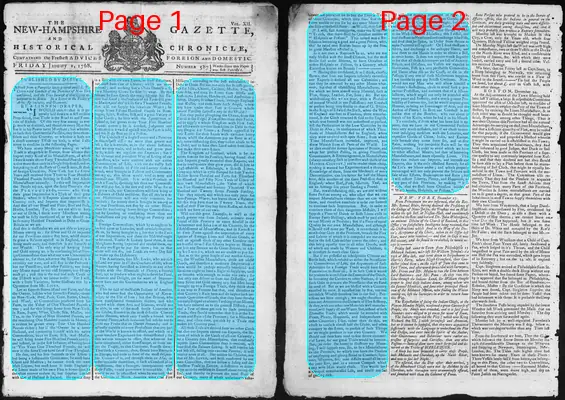
The New Hampshire Gazette And Historical Chronicle
Portsmouth, Greenland, Rockingham County, New Hampshire
What is this article about?
An abstract from a pamphlet by a Linen-Draper critiques New York's excessive imports from Britain and Asia, which exceed exports and cause debt and poverty. It advocates for reducing luxury imports, promoting local manufactures like linen from native flax, and emulating Scotland and Ireland to retain wealth and achieve economic independence.
Merged-components note: These two components form a single continuous editorial article on commercial conduct and trade policy, spanning pages 1 and 2 with seamless text continuation.
Clippings
1 of 2
OCR Quality
Full Text
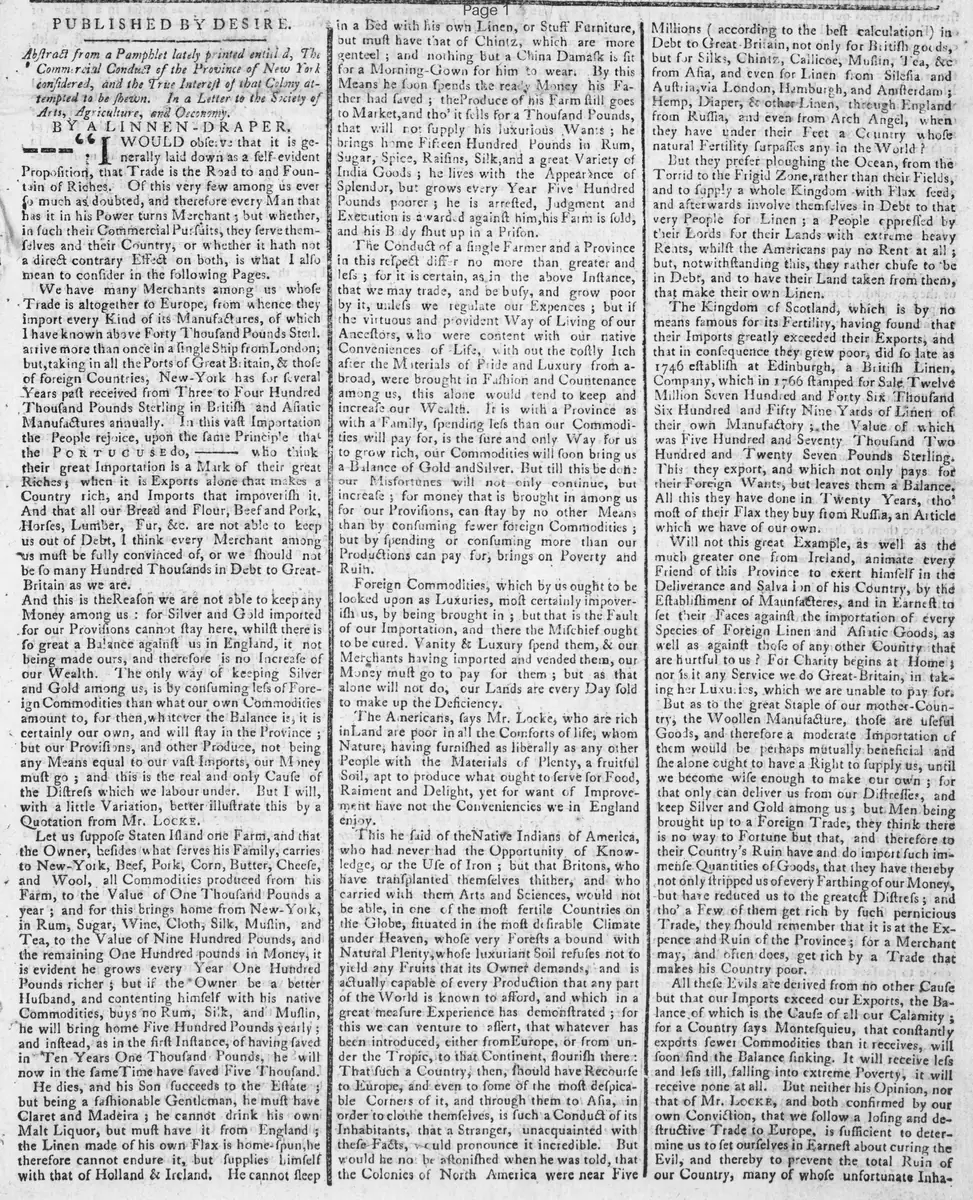
Abstract from a Pamphlet lately printed entitled, The Commercial Conduct of the Province of New York considered, and the True Interest of that Colony attempted to be shown. In a Letter to the Society of Arts, Agriculture, and Oeconomy.
BY A LINEN-DRAPER.
I WOULD observe that it is generally laid down as a self-evident Proposition, that Trade is the Road to and Fountain of Riches. Of this very few among us ever so much as doubted, and therefore every Man that has it in his Power turns Merchant: but whether, in such their Commercial Pursuits, they serve themselves and their Country, or whether it hath not a direct contrary Effect on both, is what I also mean to consider in the following Pages.
We have many Merchants among us whose Trade is altogether to Europe, from whence they import every Kind of its Manufactures, of which I have known above Forty Thousand Pounds Sterling arrive more than once in a single Ship from London: but, taking in all the Ports of Great Britain, & those of foreign Countries, New-York has for several Years past received from Three to Four Hundred Thousand Pounds Sterling in British and Asiatic Manufactures annually. In this vast Importation the People rejoice, upon the same Principle that the Portuguese used to, who think their great Importation is a Mark of their great Riches; when it is Exports alone that makes a Country rich, and Imports that impoverish it.
And that all our Bread and Flour, Beef and Pork, Horses, Lumber, Furs, &c. are not able to keep us out of Debt, I think every Merchant among us must be fully convinced of, or we should not be so many Hundred Thousands in Debt to Great-Britain as we are.
And this is the Reason we are not able to keep any Money among us: for Silver and Gold imported for our Provisions cannot stay here, whilst there is so great a Balance against us in England, it not being made ours, and therefore is no Increase of our Wealth. The only way of keeping Silver and Gold among us, is by consuming less of Foreign Commodities than what our own Commodities amount to. for then, whatsoever the Balance is, it is certainly our own, and will stay in the Province: but our Provisions, and other Produce, not being by any Means equal to our vast Imports, our Money must go: and this is the real and only Cause of the Distress which we labour under. But I will, with a little Variation, better illustrate this by a Quotation from Mr. Locke.
Let us suppose Staten Island one Farm, and that the Owner, besides what serves his Family, carries to New-York, Beef, Pork, Corn, Butter, Cheese, and Wool, all Commodities produced from his Farm, to the Value of One Thousand Pounds a year; and for this brings home from New-York, in Rum, Sugar, Wine, Cloth, Silk, Muslin, and Tea, to the Value of Nine Hundred Pounds, and the remaining One Hundred pounds in Money. it is evident he grows every Year One Hundred Pounds richer; but if the Owner be a better Husband, and contenting himself with his native Commodities, buys no Rum, Silk, and Muslin, he will bring home Five Hundred Pounds yearly; and instead, as in the first Instance, of having saved in Ten Years One Thousand Pounds, he will now in the same Time have saved Five Thousand.
He dies, and his Son succeeds to the Estate: but being a fashionable Gentleman, he must have Claret and Madeira: he cannot drink his own Malt Liquor, but must have it from England; the Linen made of his own Flax is home-spun, he therefore cannot endure it, but supplies himself with that of Holland & Ireland. He cannot sleep in a Bed with his own Linen, or Stuff Furniture, but must have that of Chintz, which are more genteel: and nothing but a China Damask is fit for a Morning-Gown for him to wear. By this Means he soon spends the ready Money his Father had saved: the Produce of his Farm still goes to Market, and tho' it sells for a Thousand Pounds, that will not supply his luxurious Wants; he brings home Fifteen Hundred Pounds in Rum, Sugar, Spice, Raisins, Silk, and a great Variety of India Goods: he lives with the Appearance of Splendor, but grows every Year Five Hundred Pounds poorer: he is arrested. Judgment and Execution is awarded against him, his Farm is sold, and his Body shut up in a Prison.
The Conduct of a single Farmer and a Province in this respect differ no more than greater and less; for it is certain, as in the above Instance, that we may trade, and be busy, and grow poor by it, unless we regulate our Expences: but if the virtuous and provident Way of Living of our Ancestors, who were content with our native Conveniences of Life, with out the costly Itch after the Materials of Pride and Luxury from abroad, were brought in Fashion and Countenance among us, this alone would tend to keep and increase our Wealth. It is with a Province as with a Family, spending less than our Commodities will pay for, is the sure and only Way for us to grow rich, our Commodities will soon bring us a Balance of Gold and Silver. But till this be done our Misfortunes will not only continue, but increase: for money that is brought in among us for our Provisions, can stay by no other Means than by consuming fewer foreign Commodities; but by spending or consuming more than our Productions can pay for, brings on Poverty and Ruin.
Foreign Commodities, which by us ought to be looked upon as Luxuries, most certainly impoverish us, by being brought in; but that is the Fault of our Importation, and there the Mischief ought to be cured. Vanity & Luxury spend them, & our Merchants having imported and vended them, our Money must go to pay for them; but as that alone will not do, our Lands are every Day sold to make up the Deficiency.
The Americans, says Mr. Locke, who are rich in Land are poor in all the Comforts of life, whom Nature, having furnished as liberally as any other People with the Materials of Plenty, a fruitful Soil; apt to produce what ought to serve for Food, Raiment and Delight, yet for want of Improvement have not the Conveniencies we in England enjoy.
This he said of the Native Indians of America, who had never had the Opportunity of Knowledge, or the Use of Iron: but that Britons, who have transplanted themselves thither, and who carried with them Arts and Sciences, would not be able, in one of the most fertile Countries on the Globe, situated in the most desirable Climate under Heaven, whose very Forests abound with Natural Plenty, whose luxuriant Soil refuses not to yield any Fruits that its Owner demands, and is actually capable of every Production that any part of the World is known to afford, and which in a great measure Experience has demonstrated; for this we can venture to assert, that whatever has been introduced, either from Europe, or from under the Tropic, to that Continent, flourish there: That such a Country then, should have Recourse to Europe, and even to some of the most despicable Corners of it, and through them to Asia, in order to clothe themselves, is such a Conduct of its Inhabitants, that a Stranger, unacquainted with the Facts, would pronounce it incredible. But would he not be astonished when he was told, that the Colonies of North America were near Five Millions (according to the best calculation!) in Debt to Great-Britain, not only for British goods, but for Silks, Chintz, Callicoe, Muslin, Tea, &c from Asia, and even for Linen from Silesia and Austria, via London, Hamburgh, and Amsterdam: Hemp, Diaper, & other Linen, through England from Russia, and even from Arch Angel, when they have under their Feet a Country whose natural Fertility surpasses any in the World?
But they prefer ploughing the Ocean, from the Torrid to the Frigid Zone, rather than their Fields, and to supply a whole Kingdom with Flax seed; and afterwards involve themselves in Debt to that very People for Linen; a People oppressed by their Lords for their Lands with extreme heavy Rents, whilst the Americans pay no Rent at all; but, notwithstanding this, they rather chuse to be in Debt, and to have their Land taken from them, than make their own Linen.
The Kingdom of Scotland, which is by no means famous for its Fertility, having found that their Imports greatly exceeded their Exports, and that in consequence they grew poor, did so late as 1746 establish at Edinburgh, a British Linen Company, which in 1766 stamped for Sale, Twelve Million Seven Hundred and Forty Six Thousand Six Hundred and Fifty Nine Yards of Linen of their own Manufactory; the Value of which was Five Hundred and Seventy Thousand Two Hundred and Twenty Seven Pounds Sterling.
This they export, and which not only pays for their Foreign Wants, but leaves them a Balance. All this they have done in Twenty Years, tho most of their Flax they buy from Russia, an Article which we have of our own.
Will not this great Example, as well as the much greater one from Ireland, animate every Friend of this Province to exert himself in the Deliverance and Salvation of his Country, by the Establishment of Manufactures, and in Earnest to set their Faces against the importation of every Species of Foreign Linen and Asiatic Goods, as well as against those of any other Country that are hurtful to us? For Charity begins at Home; nor is it any Service we do Great-Britain, in taking her Luxuries, which we are unable to pay for.
But as to the great Staple of our mother-Country, the Woollen Manufacture, those are useful Goods, and therefore a moderate Importation of them would be perhaps mutually beneficial and she alone ought to have a Right to supply us, until we become wise enough to make our own: for that only can deliver us from our Distresses, and keep Silver and Gold among us; but Men being brought up to a Foreign Trade, they think there is no way to Fortune but that, and therefore to their Country's Ruin have and do import such immense Quantities of Goods, that they have thereby not only stripped us of every Farthing of our Money, but have reduced us to the greatest Distresses: and tho' a Few of them get rich by such pernicious Trade, they should remember that it is at the Expence and Ruin of the Province; for a Merchant may, and often does, get rich by a Trade that makes his Country poor.
All these Evils are derived from no other Cause but that our Imports exceed our Exports, the Balance of which is the Cause of all our Calamity; for a Country says Montesquieu, that constantly exports fewer Commodities than it receives, will soon find the Balance sinking. It will receive less and less till, falling into extreme Poverty, it will receive none at all. But neither his Opinion, nor that of Mr. Locke, and both confirmed by our own Conviction, that we follow a losing and destructive Trade to Europe, is sufficient to determine us to set ourselves in Earnest about curing the Evil, and thereby to prevent the total Ruin of our Country, many of whose unfortunate Inhabitants...
Inhabitants are prevailed on to buy the Toys & Trifles of other Countries, which they soon find themselves unable to pay for by any other Means than the Sale of the best Estates in the World, their Lands.
"I will, said Aurengzebe, make my Kingdom so rich, that there shall be Occasion neither of Hospitals or Prisons." This indeed was a Resolution becoming a good and a great Prince, who, tho' he ruled over Realms burnt up by the Sun, in great Measure effected it.
Is it not then a Reproach to us, who are not only blessed with the finest Climate, but the most fertile Soil under Heaven, to have Occasion of either Hospitals or Prisons, in a Country whose Extension knows no Bounds?
Having thus considered, & as I think, clearly, shewn, that from our Imports infinitely exceeding our Exports is derived all our Calamities; nor can they be removed by any other Means whatever, but that of establishing Manufactures, and for which we have almost every Material, such as Flax, Hemp, Leather, Fur, Iron, &c. But notwithstanding this we are poor, with a Profusion of natural Wealth in our Possession: Our Conduct at present being very similar to that of G. Britain in the Reign of Edward the Sixth, when the Wool of England was sent to Flanders, there manufactured, & the Cloth returned & sold to the English, whose true Interest was not understood or pursued, till the Persecution in the Low Countries by the Duke de Alva: in consequence of which Thousands of Manufacturers fled to England, where they were received with open Arms; from which Time Manufactures increased, improved, and drew Wealth from all Parts of the World. Let us then avoid the former Ignorance of Britain, and adopt her present Policy, in giving Protection, Countenance, & Encouragement, to Manufactures (always avoiding such as interfere with those of our Mother-Country,) and to render them cheap, nothing is wanted but Experience and a thorough Knowledge of them, since the Mechanic of every Denomination, can live better for half the Money here, than another of the same Profession does in England, where Beef, Pork, Mutton, Veal, are on an Average Six pence Sterling a Pound.
But, notwithstanding this, we are not without some Persons among us, who assert that we can import Manufactures cheaper than we can make them, and therefore conclude it to be our Interest to continue such Importation. But, in order to convince them of their dangerous Mistake, I will suppose a Piece of Dutch or Irish Linen costs in Europe Forty Shillings, which must be paid either in our Money or Produce; but if a Piece of equal Quality be our own Manufacture, and although it should cost more per Yard, it nevertheless is so much clear Gain to the Province, because the Flax and Labour of which it is composed are our own, but in the first Case neither one or the other; and this being equally true in all other Goods, most of which are made by Women and Children, it is therefore so much clear Gain.
But if we possessed an inhospitable Climate and Sterile Soil, which refused us either the Necessaries or Conveniences of Life, the Arguments of such Advocates for a Foreign Trade would have some Foundation to stand on; & in such Case it would be prudent in us to follow the Example of the Dutch, in becoming the Carriers to other Nations, & with such Gain to procure the Necessaries that we stand in need of. But as we are blessed with a Country excelled by none, & equalled but by few, our real intrinsick Wealth therefore lies in our Soil; Provisions we have enough; we ought therefore to turn our Attention to the Growth of Flax & Hemp, & they, with our other raw Materials well manufactured, will supply all our Wants. But, instead of such Domestick Trade, which would be attended with Peace, Plenty, Happiness, and Independance on other Countries; I say, rather than do this, we chuse to ransack almost half the Globe, and often contrary to the Laws, in pursuit of such Things as we might produce in our own Country. We should not then have need to fear severe commercial Laws, for our great Trade would be interior.
But, in order the better to illustrate my Meaning, I will suppose you, Sir, to be a Manufacturer in this Province, by which you have the Pleasure of employing and giving Bread to Combers, Spinners, Weavers, &c. your Affairs would all be under your Eye, and in a narrow Compass which every wise Man would chuse. You would lead a tranquil unembarrassed Life, and could not fail of getting rich.
What sub-type of article is it?
What keywords are associated?
What entities or persons were involved?
Editorial Details
Primary Topic
Critique Of New York's Import Dependency And Promotion Of Local Manufactures
Stance / Tone
Advocacy For Economic Self Sufficiency Through Reduced Imports And Domestic Production
Key Figures
Key Arguments
- excessive imports from europe and asia exceed exports, causing debt to britain estimated at five million pounds.
- imports impoverish the colony while exports enrich it; balance of trade must favor exports to retain money.
- luxury goods like silk, tea, and foreign linen drain wealth; colonists should use native products like flax for linen.
- analogy of farmer's son: lavish imports lead to poverty and loss of land, mirroring provincial conduct.
- scotland's linen industry success since 1746 shows benefits of local manufacturing despite importing flax.
- establishing manufactures in materials like flax, hemp, and iron will cure economic distress without harming britain's wool trade.
- local production provides clear gain as labor and materials stay in province, unlike imported goods.