Thank you for visiting SNEWPapers!
Sign up free
Editorial
December 14, 1866
Abbeville Press
Abbeville, Abbeville County, South Carolina
What is this article about?
Editorial correspondence from Columbia, SC, Dec. 10-11, 1866, reports on South Carolina General Assembly's activities amid fears of Radical Congress reducing state to territorial status. Covers adjournment debates, judicial reforms, debtor relief bills like Homestead Law, taxation plans, poor relief appropriations, and other legislative matters.
Clipping
OCR Quality
95%
Excellent
Full Text
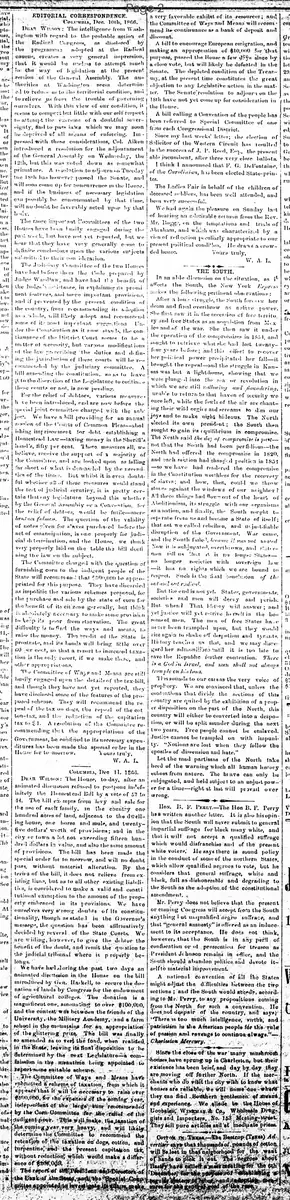
EDITORIAL CORRESPONDENCE.
COLUMBIA, Dec. 10th, 1866.
Dear Wilson: The intelligence from Washington with regard to the probable action of the Radical Congress, as disclosed by the programme adopted at the Radical caucus, creates a very general impression, that it would be useless to attempt much in the way of legislation at the present session of the General Assembly. The authorities at Washington seem determined to reduce us to the territorial condition, and to relieve us from the trouble of governing ourselves. With this view of our condition, it seems to comport but little with our self respect to attempt the exercise of a doubtful sovereignty, and to pass laws which we may soon be deprived of all means of enforcing. Impressed with these considerations, Col. Aiken introduced a resolution for the adjournment of the General Assembly on Wednesday, the 12th, but this was voted down as somewhat premature. A resolution to adjourn on Tuesday the 18th has however passed the Senate, and will soon come up for concurrence in the House, and if the business of necessary legislation can possibly be consummated by that time, will no doubt be favorably acted upon by that body.
The more important Committees of the two Houses have been busily engaged during the past week, but have not yet reported, but we hope that they have very generally come to definite conclusions upon the various subjects submitted to their consideration.
The Judicial Committee of the two Houses have had before them the code prepared by Judge Wardlaw, and have had the benefit of the Judge's arguments, in explaining its main features, and more important provisions, and if prevented by the present condition of the country, from recommending its adoption, will likely adopt and recommend some of its most important suggestions. For the reorganization of the District Courts seems to be a matter of necessity, but various modifications of the law prescribing the duties and defining the jurisdiction of these courts will be proposed by the judiciary committee. A bill amending the constitution, so as to leave it to the discretion of the Legislature to continue them or not, is now pending.
For the relief of debtors, various measures have been introduced, and are now before the special joint committee charged with the subject. We have a bill providing for an annual session of the Courts of Common Pleas—abolishing imprisonment for debt—establishing a Homestead Law—taxing money in the Sheriff's hands, fifty per cent. These measures all, we believe, receive the support of a majority of the Committee, and are looked upon as falling far short of what is demanded by the necessities of the times. But whilst it is even doubtful whether all these measures would stand the test of judicial scrutiny, it is pretty certain that any legislation beyond this whether by the General assembly or a Convention, for the relief of debtors, would be futile—mere brutum fulmen. The question of the validity of notes given for slaves purchased before the act of emancipation, is one properly for judicial determination, and the House, we think very properly laid on the table the bill declaring the law on the subject.
The Committee charged with the question of furnishing corn to the indigent people of the State will recommend that $50,000 be appropriated for this purpose. They have discarded as impolitic the various schemes proposed, for the purchase and sale by the State of corn for the benefit of its citizens generally, but think it is absolutely necessary to make some provision to keep its poor from starvation. The great difficulty is to find the ways and means, to raise the money. The credit of the State is prostrate, and its bonds will bring little over 60 per cent, so that a resort to increased taxation is the only resort, if we make these, and other appropriations.
The Committee of Ways and Means are still busily engaged upon the details of the tax-bill, and though they have not yet reported, they have disclosed some of the features of the proposed scheme. They will recommend the repeal of the tax on dogs, the repeal of the cotton-tax, and the reduction of the capitation tax to $1. A resolution of the Committee recommending that the appropriations of the Government, be confined to its necessary expenditures has been made the special order in the House for to-morrow.
COLUMBIA, Dec. 11, 1866.
Dear Wilson: The House, to-day, after an animated discussion refused to postpone indefinitely the Homestead Bill by a vote of 57 to 14. The bill exempts from levy and sale for the use of each family, in the country one hundred acres of land, adjacent to the dwelling house, one horse and mule, and twenty-five dollars' worth of provisions; and in the city or town a lot not exceeding fifteen hundred dollars in value, and also the same amount of provisions. The bill has been made the special order for to-morrow, and will no doubt pass, without material alteration. By the terms of the bill, it does not relieve from existing liens, but as to all other existing liabilities, is considered to make a valid and constitutional exemption to the amount of the property embraced in its provisions. We have ourselves very strong doubts of its constitutionality, though as stated in the Governor's message, the question has been affirmatively decided by several of the State Courts. We are willing, however, to give the debtor the benefit of the doubt, and remit the question to the judicial tribunal where it properly belongs.
We have had, during the past two days an animated discussion in the House on the bill introduced by Gen. Haskell, to secure the donation of lands by Congress for the endowment of agricultural colleges. The donation is a magnificent one, amounting to over $300,000, and the contest was between the friends of the University, the Military Academy, and farm school in the mountains for an appropriation of the glittering prize. The bill was finally so amended as to vest the fund, when realized in the State, leaving its final disposition to be determined by the next Legislature a commission in the meantime being appointed to report some suitable scheme.
The Committee of Ways and Means have submitted a scheme of taxation, from which it appears that it will be necessary to raise over $500,000, for the expenses of the coming year, independent of the large sum recommended by the Corn Committee for the relief of the indigent poor. This will make the taxation of the coming year very heavy, and will likely determine the Committee to recommend the retention of the taxation on dogs, cotton, and turpentine, and the present capitation without reduction, which would make a difference of $200,000.
The report of the Presidential and Directors of the Bank of the State, and the Special Committee appointed to ascertain its condition, present a very favorable exhibit of its resources; and the Committee of Ways and Means will recommend its continuance as a bank of deposit and discount.
A bill to encourage European emigration, and making an appropriation of $10,000 for that purpose, passed the House a few days since by a close vote, but will likely be defeated in the Senate. The depleted condition of the Treasury, at the present time constitutes the great objection to any Legislative action in the matter. The Senate resolution to adjourn on the 18th have not yet come up for consideration in the House.
A bill calling a Convention of the people has been referred to Special Committee of one from each Congressional District.
Since my last week's letter; the election of Solicitor of the Western Circuit has resulted in the success of J. P. Reed, Esq., the present able incumbent, after three very close ballots.
I think I announced that F. G. DeFontaine, of the Carolinian, has been elected State-printer.
The Ladies Fair in behalf of the children of deceased soldiers, has been well attended, and been very successful.
We had again the pleasure on Sunday last of hearing an admirable sermon from the Rev. Mr. Boggs, on the temptations and trials of Abraham, and which was characterized by a vein of reflection peculiarly appropriate to our present political condition. He drew a crowded house.
Yours truly,
W. A. L.
COLUMBIA, Dec. 10th, 1866.
Dear Wilson: The intelligence from Washington with regard to the probable action of the Radical Congress, as disclosed by the programme adopted at the Radical caucus, creates a very general impression, that it would be useless to attempt much in the way of legislation at the present session of the General Assembly. The authorities at Washington seem determined to reduce us to the territorial condition, and to relieve us from the trouble of governing ourselves. With this view of our condition, it seems to comport but little with our self respect to attempt the exercise of a doubtful sovereignty, and to pass laws which we may soon be deprived of all means of enforcing. Impressed with these considerations, Col. Aiken introduced a resolution for the adjournment of the General Assembly on Wednesday, the 12th, but this was voted down as somewhat premature. A resolution to adjourn on Tuesday the 18th has however passed the Senate, and will soon come up for concurrence in the House, and if the business of necessary legislation can possibly be consummated by that time, will no doubt be favorably acted upon by that body.
The more important Committees of the two Houses have been busily engaged during the past week, but have not yet reported, but we hope that they have very generally come to definite conclusions upon the various subjects submitted to their consideration.
The Judicial Committee of the two Houses have had before them the code prepared by Judge Wardlaw, and have had the benefit of the Judge's arguments, in explaining its main features, and more important provisions, and if prevented by the present condition of the country, from recommending its adoption, will likely adopt and recommend some of its most important suggestions. For the reorganization of the District Courts seems to be a matter of necessity, but various modifications of the law prescribing the duties and defining the jurisdiction of these courts will be proposed by the judiciary committee. A bill amending the constitution, so as to leave it to the discretion of the Legislature to continue them or not, is now pending.
For the relief of debtors, various measures have been introduced, and are now before the special joint committee charged with the subject. We have a bill providing for an annual session of the Courts of Common Pleas—abolishing imprisonment for debt—establishing a Homestead Law—taxing money in the Sheriff's hands, fifty per cent. These measures all, we believe, receive the support of a majority of the Committee, and are looked upon as falling far short of what is demanded by the necessities of the times. But whilst it is even doubtful whether all these measures would stand the test of judicial scrutiny, it is pretty certain that any legislation beyond this whether by the General assembly or a Convention, for the relief of debtors, would be futile—mere brutum fulmen. The question of the validity of notes given for slaves purchased before the act of emancipation, is one properly for judicial determination, and the House, we think very properly laid on the table the bill declaring the law on the subject.
The Committee charged with the question of furnishing corn to the indigent people of the State will recommend that $50,000 be appropriated for this purpose. They have discarded as impolitic the various schemes proposed, for the purchase and sale by the State of corn for the benefit of its citizens generally, but think it is absolutely necessary to make some provision to keep its poor from starvation. The great difficulty is to find the ways and means, to raise the money. The credit of the State is prostrate, and its bonds will bring little over 60 per cent, so that a resort to increased taxation is the only resort, if we make these, and other appropriations.
The Committee of Ways and Means are still busily engaged upon the details of the tax-bill, and though they have not yet reported, they have disclosed some of the features of the proposed scheme. They will recommend the repeal of the tax on dogs, the repeal of the cotton-tax, and the reduction of the capitation tax to $1. A resolution of the Committee recommending that the appropriations of the Government, be confined to its necessary expenditures has been made the special order in the House for to-morrow.
COLUMBIA, Dec. 11, 1866.
Dear Wilson: The House, to-day, after an animated discussion refused to postpone indefinitely the Homestead Bill by a vote of 57 to 14. The bill exempts from levy and sale for the use of each family, in the country one hundred acres of land, adjacent to the dwelling house, one horse and mule, and twenty-five dollars' worth of provisions; and in the city or town a lot not exceeding fifteen hundred dollars in value, and also the same amount of provisions. The bill has been made the special order for to-morrow, and will no doubt pass, without material alteration. By the terms of the bill, it does not relieve from existing liens, but as to all other existing liabilities, is considered to make a valid and constitutional exemption to the amount of the property embraced in its provisions. We have ourselves very strong doubts of its constitutionality, though as stated in the Governor's message, the question has been affirmatively decided by several of the State Courts. We are willing, however, to give the debtor the benefit of the doubt, and remit the question to the judicial tribunal where it properly belongs.
We have had, during the past two days an animated discussion in the House on the bill introduced by Gen. Haskell, to secure the donation of lands by Congress for the endowment of agricultural colleges. The donation is a magnificent one, amounting to over $300,000, and the contest was between the friends of the University, the Military Academy, and farm school in the mountains for an appropriation of the glittering prize. The bill was finally so amended as to vest the fund, when realized in the State, leaving its final disposition to be determined by the next Legislature a commission in the meantime being appointed to report some suitable scheme.
The Committee of Ways and Means have submitted a scheme of taxation, from which it appears that it will be necessary to raise over $500,000, for the expenses of the coming year, independent of the large sum recommended by the Corn Committee for the relief of the indigent poor. This will make the taxation of the coming year very heavy, and will likely determine the Committee to recommend the retention of the taxation on dogs, cotton, and turpentine, and the present capitation without reduction, which would make a difference of $200,000.
The report of the Presidential and Directors of the Bank of the State, and the Special Committee appointed to ascertain its condition, present a very favorable exhibit of its resources; and the Committee of Ways and Means will recommend its continuance as a bank of deposit and discount.
A bill to encourage European emigration, and making an appropriation of $10,000 for that purpose, passed the House a few days since by a close vote, but will likely be defeated in the Senate. The depleted condition of the Treasury, at the present time constitutes the great objection to any Legislative action in the matter. The Senate resolution to adjourn on the 18th have not yet come up for consideration in the House.
A bill calling a Convention of the people has been referred to Special Committee of one from each Congressional District.
Since my last week's letter; the election of Solicitor of the Western Circuit has resulted in the success of J. P. Reed, Esq., the present able incumbent, after three very close ballots.
I think I announced that F. G. DeFontaine, of the Carolinian, has been elected State-printer.
The Ladies Fair in behalf of the children of deceased soldiers, has been well attended, and been very successful.
We had again the pleasure on Sunday last of hearing an admirable sermon from the Rev. Mr. Boggs, on the temptations and trials of Abraham, and which was characterized by a vein of reflection peculiarly appropriate to our present political condition. He drew a crowded house.
Yours truly,
W. A. L.
What sub-type of article is it?
Partisan Politics
Economic Policy
Legal Reform
What keywords are associated?
Reconstruction Politics
General Assembly
Debtor Relief
Homestead Bill
Taxation
Judicial Reform
Indigent Relief
Radical Congress
What entities or persons were involved?
Radical Congress
Col. Aiken
Judge Wardlaw
Gen. Haskell
General Assembly
House
Senate
Committee Of Ways And Means
Editorial Details
Primary Topic
South Carolina General Assembly Proceedings Amid Radical Congress Threats
Stance / Tone
Neutral Reporting With Cautious Support For Debtor Relief Measures
Key Figures
Radical Congress
Col. Aiken
Judge Wardlaw
Gen. Haskell
General Assembly
House
Senate
Committee Of Ways And Means
Key Arguments
Federal Intervention May Render State Legislation Ineffective
Adjournment Considered Due To Uncertain Sovereignty
Support For Judicial Code Modifications And Court Reorganization
Debtor Relief Measures Like Homestead Bill And Abolition Of Imprisonment For Debt Are Necessary But Limited
Appropriation Of $50,000 For Indigent Corn Relief
Taxation Scheme To Raise Over $500,000 With Possible Retention Of Certain Taxes
Continuation Of Bank Of The State
Encouragement Of European Emigration Proposed But Likely Defeated