Thank you for visiting SNEWPapers!
Sign up free
Editorial
May 29, 1819
Edwardsville Spectator
Edwardsville, Madison County, Illinois
What is this article about?
An editorial from 'The Friend' critiques novels for corrupting youth, promoting unrealistic expectations, and undermining moral sensibilities. It argues that novels dazzle with idealized fantasies, leading to discontent with real life and blunting natural sympathies.
Clipping
OCR Quality
95%
Excellent
Full Text
FROM THE FRIEND.
NOVELS.
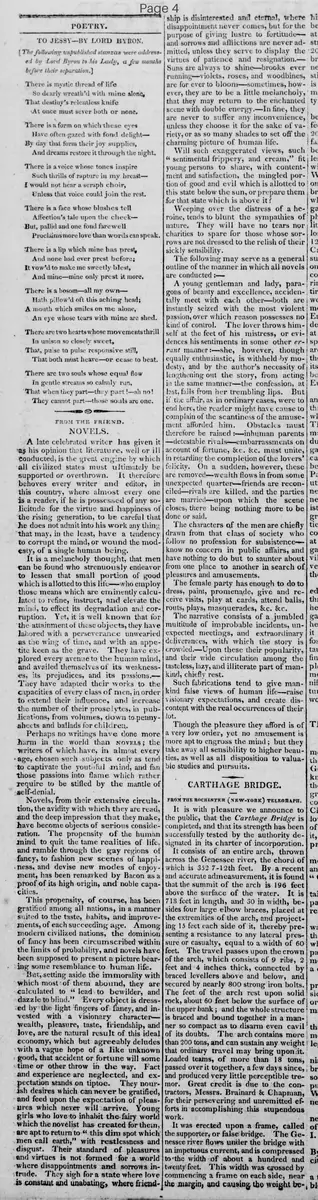
A late celebrated writer has given it as his opinion that literature, well or ill conducted, is the great engine by which all civilized states must ultimately be supported or overthrown. It therefore behoves every writer and editor, in this country, where almost every one is a reader, if he is possessed of any solicitude for the virtue and happiness of the rising generation, to be careful that he does not admit into his work any thing that may, in the least, have a tendency to corrupt the mind, or wound the modesty, of a single human being.
It is a melancholy thought, that men can be found who strenuously endeavor to lessen that small portion of good which is allotted to this life—who employ those means which are eminently calculated to refine, instruct, and elevate the mind, to effect its degradation and corruption. Yet, it is well known that for the attainment of these objects, they have labored with a perseverance unwearied as the wing of time, and with an appetite keen as the grave. They have explored every avenue to the human mind, and availed themselves of its weaknesses, its prejudices, and its passions. They have adapted their works to the capacities of every class of men, in order to extend their influence, and increase the number of their proselytes, in publications, from volumes, down to penny-sheets and ballads for children.
Perhaps no writings have done more harm in the world than Novels; the writers of which have, in almost every age, chosen such subjects only as tend to captivate the youthful mind, and fan those passions into flame which rather require to be stifled by the mantle of self-denial.
Novels, from their extensive circulation, the avidity with which they are read, and the deep impression that they make, have become objects of serious consideration. The propensity of the human mind to quit the tame realities of life, and ramble through the gay regions of fancy, to fashion new scenes of happiness, and devise new modes of enjoyment, has been remarked by Bacon as a proof of its high origin, and noble capacities.
This propensity, of course, has been gratified among all nations, in a manner suited to the taste, habits, and improvements, of each succeeding age. Among modern civilized nations, the dominion of fancy has been circumscribed within the limits of probability, and novels have been supposed to present a picture bearing some resemblance to human life.
But, setting aside the immorality with which most of them abound, they are calculated to "lead to bewilder, and dazzle to blind." Every object is dressed by the light fingers of fancy, and invested with a visionary character—wealth, pleasure, taste, friendship, and love, are the natural result of this ideal economy, which but agreeably deludes with a vague hope of a like unknown good, that accident or fortune will some time or other throw in the way. Fact and experience are neglected, and expectation stands on tiptoe. They nourish desires which can never be gratified, and feed upon the expectation of pleasures which never will arrive. Young girls who love to inhabit the fairy world which the novelist has created for them, are apt to return to "this dim spot which men call earth," with restlessness and disgust. Their standard of pleasures and virtues is not formed for a world where disappointments and sorrows intrude. They sigh for a state where love is constant and unabating, where friendship is disinterested and eternal, where disappointment never comes, but for the purpose of giving lustre to fortitude—and sorrows and afflictions are never admitted, unless they serve to display the virtues of patience and resignation.
Suns are always to shine—brooks ever running—violets, roses, and woodbines, are for ever to bloom—sometimes, however, they are to be a little melancholy, that they may return to the enchanted scene with double energy.—In fine, they are never to suffer any inconvenience, unless they choose it for the sake of variety, or as so many shades to set off the charming picture of human life.
Will such exaggerated views, such "sentimental frippery, and cream," fit young persons to share, with contentment and satisfaction, the mingled portion of good and evil which is allotted to this state below the sun, or prepare them for that state which is above it?
Weeping over the distress of a heroine, tends to blunt the sympathies of nature. They will have no tears nor charities to spare for those whose sorrows are not dressed to the relish of their sickly sensibility.
The following may serve as a general outline of the manner in which all novels are conducted:—
A young gentleman and lady, paragons of beauty and excellence, accidentally meet with each other—both are instantly seized with the most violent passion, over which reason possesses no kind of control. The lover throws himself at the feet of his mistress, or evidences his sentiments in some other errant manner:—she, however, though equally enthusiastic, is withheld by modesty, and by the author's necessity of lengthening out the story, from acting in the same manner—the confession, at last, falls from her trembling lips. But if the affair, as in ordinary cases, were to end here, the reader might have cause to complain of the scantiness of the amusement afforded him. Obstacles must therefore be raised:—inhuman parents—detestable rivals—embarrassments on account of fortune, &c. &c. must unite, in retarding the completion of the lovers felicity. On a sudden, however, these are removed—wealth flows in from some unexpected quarter—friends are reconciled—rivals are killed, and the parties are married—upon which the scene closes, there being nothing more to be done or said.
The characters of the men are chiefly drawn from that class of society who follow no profession for subsistence, know no concern in public affairs, and have nothing to do but to saunter about from one place to another in search of pleasures and amusements. The female party has enough to do to dress, paint, promenade, give and receive visits, play at cards, attend balls, routs, plays, masquerades, &c. &c.
The narrative consists of a jumbled multitude of improbable incidents, unexpected meetings, and extraordinary deliverances, with which the story is crowded. Upon these their popularity, and their wide circulation among the tasteless, lazy, and illiterate part of mankind, chiefly rest.
Such fabrications tend to give mankind false views of human life—raise visionary expectations, and create discontent with the real occurrences of their lot.
Though the pleasure they afford is of a very low order, yet no amusement is more apt to engross the mind; but they take away all sensibility to higher beauties, as well as all disposition to valuable studies and pursuits.
NOVELS.
A late celebrated writer has given it as his opinion that literature, well or ill conducted, is the great engine by which all civilized states must ultimately be supported or overthrown. It therefore behoves every writer and editor, in this country, where almost every one is a reader, if he is possessed of any solicitude for the virtue and happiness of the rising generation, to be careful that he does not admit into his work any thing that may, in the least, have a tendency to corrupt the mind, or wound the modesty, of a single human being.
It is a melancholy thought, that men can be found who strenuously endeavor to lessen that small portion of good which is allotted to this life—who employ those means which are eminently calculated to refine, instruct, and elevate the mind, to effect its degradation and corruption. Yet, it is well known that for the attainment of these objects, they have labored with a perseverance unwearied as the wing of time, and with an appetite keen as the grave. They have explored every avenue to the human mind, and availed themselves of its weaknesses, its prejudices, and its passions. They have adapted their works to the capacities of every class of men, in order to extend their influence, and increase the number of their proselytes, in publications, from volumes, down to penny-sheets and ballads for children.
Perhaps no writings have done more harm in the world than Novels; the writers of which have, in almost every age, chosen such subjects only as tend to captivate the youthful mind, and fan those passions into flame which rather require to be stifled by the mantle of self-denial.
Novels, from their extensive circulation, the avidity with which they are read, and the deep impression that they make, have become objects of serious consideration. The propensity of the human mind to quit the tame realities of life, and ramble through the gay regions of fancy, to fashion new scenes of happiness, and devise new modes of enjoyment, has been remarked by Bacon as a proof of its high origin, and noble capacities.
This propensity, of course, has been gratified among all nations, in a manner suited to the taste, habits, and improvements, of each succeeding age. Among modern civilized nations, the dominion of fancy has been circumscribed within the limits of probability, and novels have been supposed to present a picture bearing some resemblance to human life.
But, setting aside the immorality with which most of them abound, they are calculated to "lead to bewilder, and dazzle to blind." Every object is dressed by the light fingers of fancy, and invested with a visionary character—wealth, pleasure, taste, friendship, and love, are the natural result of this ideal economy, which but agreeably deludes with a vague hope of a like unknown good, that accident or fortune will some time or other throw in the way. Fact and experience are neglected, and expectation stands on tiptoe. They nourish desires which can never be gratified, and feed upon the expectation of pleasures which never will arrive. Young girls who love to inhabit the fairy world which the novelist has created for them, are apt to return to "this dim spot which men call earth," with restlessness and disgust. Their standard of pleasures and virtues is not formed for a world where disappointments and sorrows intrude. They sigh for a state where love is constant and unabating, where friendship is disinterested and eternal, where disappointment never comes, but for the purpose of giving lustre to fortitude—and sorrows and afflictions are never admitted, unless they serve to display the virtues of patience and resignation.
Suns are always to shine—brooks ever running—violets, roses, and woodbines, are for ever to bloom—sometimes, however, they are to be a little melancholy, that they may return to the enchanted scene with double energy.—In fine, they are never to suffer any inconvenience, unless they choose it for the sake of variety, or as so many shades to set off the charming picture of human life.
Will such exaggerated views, such "sentimental frippery, and cream," fit young persons to share, with contentment and satisfaction, the mingled portion of good and evil which is allotted to this state below the sun, or prepare them for that state which is above it?
Weeping over the distress of a heroine, tends to blunt the sympathies of nature. They will have no tears nor charities to spare for those whose sorrows are not dressed to the relish of their sickly sensibility.
The following may serve as a general outline of the manner in which all novels are conducted:—
A young gentleman and lady, paragons of beauty and excellence, accidentally meet with each other—both are instantly seized with the most violent passion, over which reason possesses no kind of control. The lover throws himself at the feet of his mistress, or evidences his sentiments in some other errant manner:—she, however, though equally enthusiastic, is withheld by modesty, and by the author's necessity of lengthening out the story, from acting in the same manner—the confession, at last, falls from her trembling lips. But if the affair, as in ordinary cases, were to end here, the reader might have cause to complain of the scantiness of the amusement afforded him. Obstacles must therefore be raised:—inhuman parents—detestable rivals—embarrassments on account of fortune, &c. &c. must unite, in retarding the completion of the lovers felicity. On a sudden, however, these are removed—wealth flows in from some unexpected quarter—friends are reconciled—rivals are killed, and the parties are married—upon which the scene closes, there being nothing more to be done or said.
The characters of the men are chiefly drawn from that class of society who follow no profession for subsistence, know no concern in public affairs, and have nothing to do but to saunter about from one place to another in search of pleasures and amusements. The female party has enough to do to dress, paint, promenade, give and receive visits, play at cards, attend balls, routs, plays, masquerades, &c. &c.
The narrative consists of a jumbled multitude of improbable incidents, unexpected meetings, and extraordinary deliverances, with which the story is crowded. Upon these their popularity, and their wide circulation among the tasteless, lazy, and illiterate part of mankind, chiefly rest.
Such fabrications tend to give mankind false views of human life—raise visionary expectations, and create discontent with the real occurrences of their lot.
Though the pleasure they afford is of a very low order, yet no amusement is more apt to engross the mind; but they take away all sensibility to higher beauties, as well as all disposition to valuable studies and pursuits.
What sub-type of article is it?
Moral Or Religious
Social Reform
What keywords are associated?
Novels
Moral Corruption
Youthful Minds
Unrealistic Expectations
Literary Influence
Fictional Delusions
Social Discontent
What entities or persons were involved?
Novel Writers
Young Girls
Rising Generation
Editorial Details
Primary Topic
Dangers Of Novel Reading To Youth And Morality
Stance / Tone
Strongly Critical Of Novels As Corrupting Influences
Key Figures
Novel Writers
Young Girls
Rising Generation
Key Arguments
- literature can support or overthrow states
- writers should avoid corrupting content
- novels captivate and inflame youthful passions
- novels create unrealistic expectations of life
- they blunt natural sympathies and moral sensibilities
- novels promote immorality and visionary delusions
- typical plot involves instant passion and contrived obstacles
- characters represent idle, pleasure-seeking society
- novels foster discontent with real life
- they engross the mind away from valuable pursuits