Thank you for visiting SNEWPapers!
Sign up free
Editorial
December 15, 1774
The Virginia Gazette
Williamsburg, Virginia
What is this article about?
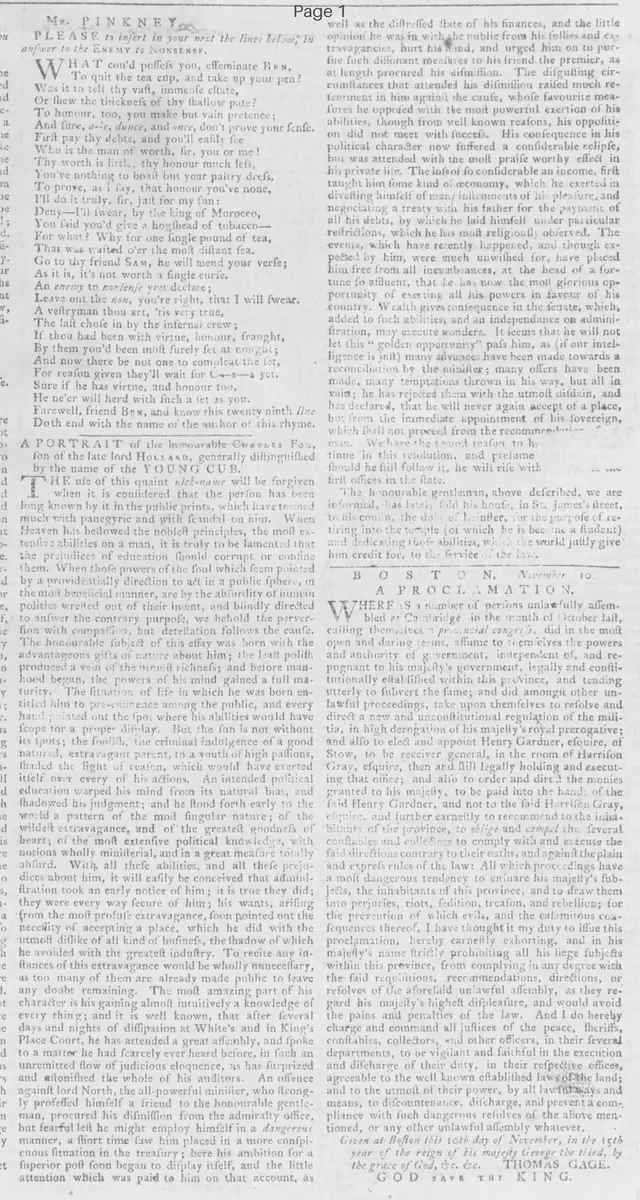
Biographical essay on Charles Fox, son of Lord Holland, known as the 'Young Cub.' It praises his innate talents and eloquence, laments his early extravagance and ministerial prejudices, details his political career under Lord North, dismissals, financial reforms, and recent independence after inheritance, now studying law to serve his country.
Clipping
OCR Quality
95%
Excellent
Full Text
A PORTRAIT of the honourable Charles Fox,
son of the late lord Holland, generally distinguished
by the name of the YOUNG CUB.
The use of this quaint nick-name will be forgiven
when it is considered that the person has been
long known by it in the public prints, which have teemed
much with panegyric and with scandal on him. When
Heaven has bestowed the noblest principles, the most
extensive abilities on a man, it is truly to be lamented that
the prejudices of education should corrupt or confine
them. When those powers of the soul which seem pointed
by a providential direction to act in a public sphere, in
the most beneficial manner, are by the absurdity of human
politics wrested out of their intent, and blindly directed
to answer the contrary purpose, we behold the
perversion with compassion, but detestation follows the cause.
The honourable subject of this essay was born with the
advantageous gifts of nature about him: the least polish
produced a vein of the most richness; and before
manhood began, the powers of his mind gained a full
maturity. The situation of life in which he was born
entitled him to pre-eminence among the public, and every
hand pointed out the spot where his abilities would have
scope for a proper display. But the sun is not without
its spots; the foolish, the criminal indulgence of a good
natured, extravagant parent, to a youth of high passions,
shaded the light of reason, which would have exerted
itself over every of his actions. An intended political
education warped his mind from its natural bias, and
shadowed his judgment; and he stood forth early to the
world a pattern of the most singular nature; of the
wildest extravagance, and of the greatest goodness of
heart; of the most extensive political knowledge, with
notions wholly ministerial, and in a great measure totally
absurd. With all these abilities, and all these
prejudices about him, it will easily be conceived that
administration took an early notice of him; it is true they did;
they were every way secure of him; his wants, arising
from the most profuse extravagance, soon pointed out the
necessity of accepting a place, which he did with the
utmost dislike of all kind of business, the shadow of which
he avoided with the greatest industry. To recite any
instances of this extravagance would be wholly unnecessary,
as too many of them are already made public to leave
any doubt remaining. The most amazing part of his
character is his gaining almost intuitively a knowledge of
every thing: and it is well known, that after several
days and nights of dissipation at White's and in King's
Place Court, he has attended a great assembly, and spoke
to a matter he had scarcely ever heard before, in such an
unremitted flow of judicious eloquence, as has surprised
and astonished the whole of his auditors. An offence
against lord North, the all-powerful minister, who
strongly professed himself a friend to the honourable
gentleman, procured his dismission from the admiralty office,
but fearful lest he might employ himself in a dangerous
manner, a short time saw him placed in a more
conspicuous situation in the treasury; here his ambition for a
superior post soon began to display itself, and the little
attention which was paid to him on that account, as
well as the distressed state of his finances, and the little
opinion he was in with the public from his follies and
extravagancies, hurt his mind, and urged him on to
pursue such dissonant measures to his friend the premier, as
at length procured his dismission. The disgusting
circumstances that attended his dismission raised much
resentment in him against the cause, whose favourite
measures he opposed with the most powerful exertion of his
abilities, though from well known reasons, his
opposition did not meet with success. His consequence in his
political character now suffered a considerable eclipse,
but was attended with the most praise worthy effect in
his private life. The loss of so considerable an income first
taught him some kind of economy, which he exerted in
divesting himself of many instruments of his pleasure, and
negotiating a treaty with his father for the payment of
all his debts, by which he laid himself under particular
restrictions, which he has most religiously observed. The
events, which have recently happened, and though
expected by him, were much unwished for, have placed
him free from all incumbrances, at the head of a
fortune so affluent, that he has now the most glorious
opportunity of exerting all his powers in favour of his
country. Wealth gives consequence in the senate, which,
added to such abilities, and an independance on
administration, may execute wonders. It seems that he will not
let this 'golden opportunity' pass him, as (if our
intelligence is just) many advances have been made towards a
reconciliation by the minister; many offers have been
made, many temptations thrown in his way, but all in
vain; he has rejected them with the utmost disdain, and
has declared, that he will never again accept of a place,
but from the immediate appointment of his sovereign,
which shall not proceed from the
recommendation of the minister.
We have the greatest reason to hope he will
continue in this resolution, and presume
should he still follow it, he will rise with the
first offices in the state.
The honourable gentleman, above described, we are
informed, has lately sold his house, in St. James's street,
to his cousin, the duke of Leinster, for the purpose of
retiring into the Temple (of which he is become a student)
and dedicating those abilities, which the world justly give
him credit for, to the service of the law.
son of the late lord Holland, generally distinguished
by the name of the YOUNG CUB.
The use of this quaint nick-name will be forgiven
when it is considered that the person has been
long known by it in the public prints, which have teemed
much with panegyric and with scandal on him. When
Heaven has bestowed the noblest principles, the most
extensive abilities on a man, it is truly to be lamented that
the prejudices of education should corrupt or confine
them. When those powers of the soul which seem pointed
by a providential direction to act in a public sphere, in
the most beneficial manner, are by the absurdity of human
politics wrested out of their intent, and blindly directed
to answer the contrary purpose, we behold the
perversion with compassion, but detestation follows the cause.
The honourable subject of this essay was born with the
advantageous gifts of nature about him: the least polish
produced a vein of the most richness; and before
manhood began, the powers of his mind gained a full
maturity. The situation of life in which he was born
entitled him to pre-eminence among the public, and every
hand pointed out the spot where his abilities would have
scope for a proper display. But the sun is not without
its spots; the foolish, the criminal indulgence of a good
natured, extravagant parent, to a youth of high passions,
shaded the light of reason, which would have exerted
itself over every of his actions. An intended political
education warped his mind from its natural bias, and
shadowed his judgment; and he stood forth early to the
world a pattern of the most singular nature; of the
wildest extravagance, and of the greatest goodness of
heart; of the most extensive political knowledge, with
notions wholly ministerial, and in a great measure totally
absurd. With all these abilities, and all these
prejudices about him, it will easily be conceived that
administration took an early notice of him; it is true they did;
they were every way secure of him; his wants, arising
from the most profuse extravagance, soon pointed out the
necessity of accepting a place, which he did with the
utmost dislike of all kind of business, the shadow of which
he avoided with the greatest industry. To recite any
instances of this extravagance would be wholly unnecessary,
as too many of them are already made public to leave
any doubt remaining. The most amazing part of his
character is his gaining almost intuitively a knowledge of
every thing: and it is well known, that after several
days and nights of dissipation at White's and in King's
Place Court, he has attended a great assembly, and spoke
to a matter he had scarcely ever heard before, in such an
unremitted flow of judicious eloquence, as has surprised
and astonished the whole of his auditors. An offence
against lord North, the all-powerful minister, who
strongly professed himself a friend to the honourable
gentleman, procured his dismission from the admiralty office,
but fearful lest he might employ himself in a dangerous
manner, a short time saw him placed in a more
conspicuous situation in the treasury; here his ambition for a
superior post soon began to display itself, and the little
attention which was paid to him on that account, as
well as the distressed state of his finances, and the little
opinion he was in with the public from his follies and
extravagancies, hurt his mind, and urged him on to
pursue such dissonant measures to his friend the premier, as
at length procured his dismission. The disgusting
circumstances that attended his dismission raised much
resentment in him against the cause, whose favourite
measures he opposed with the most powerful exertion of his
abilities, though from well known reasons, his
opposition did not meet with success. His consequence in his
political character now suffered a considerable eclipse,
but was attended with the most praise worthy effect in
his private life. The loss of so considerable an income first
taught him some kind of economy, which he exerted in
divesting himself of many instruments of his pleasure, and
negotiating a treaty with his father for the payment of
all his debts, by which he laid himself under particular
restrictions, which he has most religiously observed. The
events, which have recently happened, and though
expected by him, were much unwished for, have placed
him free from all incumbrances, at the head of a
fortune so affluent, that he has now the most glorious
opportunity of exerting all his powers in favour of his
country. Wealth gives consequence in the senate, which,
added to such abilities, and an independance on
administration, may execute wonders. It seems that he will not
let this 'golden opportunity' pass him, as (if our
intelligence is just) many advances have been made towards a
reconciliation by the minister; many offers have been
made, many temptations thrown in his way, but all in
vain; he has rejected them with the utmost disdain, and
has declared, that he will never again accept of a place,
but from the immediate appointment of his sovereign,
which shall not proceed from the
recommendation of the minister.
We have the greatest reason to hope he will
continue in this resolution, and presume
should he still follow it, he will rise with the
first offices in the state.
The honourable gentleman, above described, we are
informed, has lately sold his house, in St. James's street,
to his cousin, the duke of Leinster, for the purpose of
retiring into the Temple (of which he is become a student)
and dedicating those abilities, which the world justly give
him credit for, to the service of the law.
What sub-type of article is it?
Partisan Politics
Moral Or Religious
What keywords are associated?
Charles Fox
Young Cub
Political Career
Extravagance
Lord North
Administration Opposition
Law Study
What entities or persons were involved?
Charles Fox
Lord Holland
Lord North
Duke Of Leinster
Administration
Premier
Editorial Details
Primary Topic
Biographical Portrait Of Charles Fox And His Political Independence
Stance / Tone
Admiring Of Talents And Hopeful For Independent Opposition To Administration
Key Figures
Charles Fox
Lord Holland
Lord North
Duke Of Leinster
Administration
Premier
Key Arguments
Fox Possesses Exceptional Natural Abilities And Eloquence Despite Extravagance
Early Ministerial Prejudices And Parental Indulgence Corrupted His Potential
Dismissed From Offices Due To Offenses And Dissonant Measures Against Lord North
Recent Inheritance Enables Independent Opposition To Administration
Rejecting Ministerial Offers, Vows To Accept Posts Only From The Sovereign
Now Studying Law To Dedicate Abilities To Public Service