Thank you for visiting SNEWPapers!
Sign up free
Grant County Herald
Lancaster, Grant County, Wisconsin
What is this article about?
A December 14 report from Waupun State Prison details convict life, strict discipline, profiles of inmates like Uncle Jimmy Walsh, Pat Bennett, Hugh Kroscher, and others, two female prisoners including Mrs. Zimmerman, and crime statistics from 1851-1870 showing mostly property crimes by farmers and laborers.
Clipping
OCR Quality
Full Text
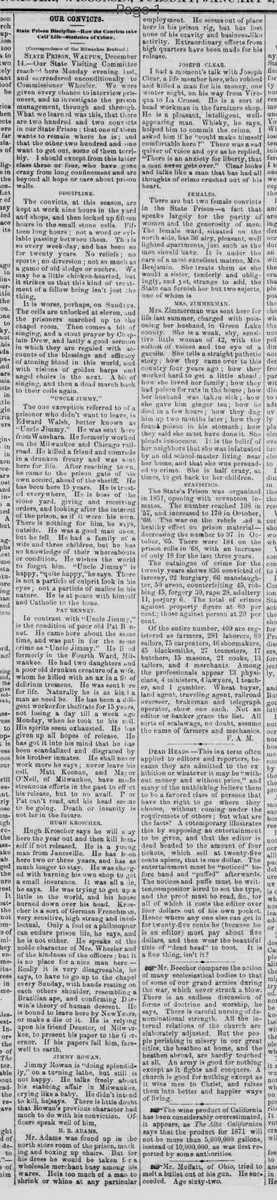
State Prison Discipline—How the Convicts take Cell-Life—Statistics of Crime.
[Correspondence of the Milwaukee Sentinel.]
State Prison, Waupun, December 14.—Our State Visiting Committee reached here Monday evening last, and surrendered unconditionally to Commissioner Wheeler. We were given every chance to interview prisoners, and to investigate the prison management, through and through. What we learned was this, that there are two hundred and two convicts in our State Prison; that one of them wants to remain where he is; and that the other two hundred and one want to get out, some of them terribly. I should except from this latter class three or four, who have gone crazy from long confinement and are beyond all hope or care about prison walls.
DISCIPLINE,
The convicts, at this season, are kept at work nine hours in the yard and shops, and then locked up fifteen hours in the small stone cells. Fifteen long hours: not a word or syllable passing between them. This is so every week-day, and has been so for twenty years. No reliefs; no sports; no diversion; not so much as a game of old sledge or euchre. We may be a little chicken-hearted, but it strikes us that this kind of treatment of a fellow being isn't just the thing.
It is worse, perhaps, on Sundays. The cells are unlocked at eleven, and the prisoners marched up to the chapel room. Then comes a bit of singing, and a stout prayer by Chaplain Drew, and lastly a good sermon in which they are regaled with accounts of the blessings and efficacy of atoning blood in this world, and with visions of golden harps and angel choirs in the next. A bit of singing, and then a dead march back to their cells again.
"UNCLE JIMMY"
The one exception referred to of a prisoner who didn't want to leave, is Edward Walsh, better known as "Uncle Jimmy." He was sent here from Waushara. He formerly worked on the Milwaukee and Chicago railroad. He killed a friend and comrade in a drunken frenzy and was sent here for life. After reaching town, he came to the prison gate of his own accord, ahead of the sheriff. He has been here 15 years. He is trusted everywhere. He is boss of the stone yard, giving and receiving orders, and looking after the interest of the prison, as if it were his own. There is nothing for him, he says, outside. He was a good man once, but he fell. He had a family of a wife and three children, but he has no knowledge of their whereabouts or condition. He wishes the world to forget him. "Uncle Jimmy" is happy, "quite happy," he says. There is not a particle of culprit look in his eyes; not a particle of malice in his nature. He is at peace with himself and Catholic to the bone.
PAT BENNET.
In contrast with "Uncle Jimmy," is the condition of poor old Pat Bennett. He came here about the same time, and was put in for the same crime as "Uncle Jimmy." He lived formerly in the Fourth Ward, Milwaukee. He had two daughters and a poor old drunken creature of a wife, whom he killed with an ax in a fit of delirium tremens. He was sent here for life. Naturally he is as kind a man as need be. He has been a diligent worker for the State for 15 years, not losing a day till a week ago Monday, when he took to his cell. His spirits seem exhausted. He has given up all hopes of release. He has got it into his mind that he has been scandalized and disgraced by his brother inmates. He shall never work more, he says; never leave his cell. Matt Keenan, and Mayor O'Neil, of Milwaukee, have made strenuous efforts in the past to effect his release, but to no avail. Poor Pat can't read, and his head seems to be going. Death or insanity is not far in the future.
HUGH KROSCHER.
Hugh Kroscher says he will stay here the year out and then kill himself if not released. He is a young man from Janesville. He has been here two or three years, and has as much longer to stay. He was charged with burning his own shop to get a small insurance. It was all a lie, he says. He was trying to get up a little in the world, and his house burned down over his head. Kroscher is a sort of German Frenchman, very sensitive, high strung and intellectual. Only a fool or a philosopher can endure prison life, he says, and he is not either. He speaks of the noble character of Mrs. Wheeler and of the kindness of the officers; but it is no place for a nice man here—Really it is very disagreeable, he says, to have to go up to the chapel every Sunday, with hands resting on each others shoulder, resembling a Brazilian ape, and confirming Darwin's theory of human descent. He is bound to leave here by New Year's, or make a die of it. He is relying upon his friend Deuster, of Milwaukee, to present his paper to the Governor. If his papers fail him, farewell to earth.
JIMMY ROWAN.
Jimmy Rowan is "doing splendidly," on a turning lathe, but still is not happy. He talks freely about his stabbing affair in Milwaukee, crying like a baby. He didn't intend to kill, he says. There is little doubt that Rowan's previous character had much to do with his conviction. Officers speak well of him.
H. R. ADAMS.
Mr. Adams was found up in the north store room of the prison, marking and boxing up chairs. But for his dress he would be taken for a wholesale merchant busy among his wares. He is too much of a man to shrink or whine at any particular employment. He seems out of place here in his prison rig, but has lost none of his suavity and business-like activity. Extraordinary efforts from high quarters have been made for his release.
JOSEPH CLEAR
I had a moment's talk with Joseph Clear, a life member here, who robbed and killed a man for his money, one winter night, on his way from Viroqua to La Crosse. He is a sort of head workman in the furniture shop. He is a pleasant, intelligent, well-appearing man. Whisky, he says, helped him to commit the crime. I asked him if he "could make himself comfortable here?" There was a sad quiver of voice and eye as he replied, "There is an anxiety for liberty, that a man never gets over." Clear looks and talks like a man that has had all thoughts of crime crushed out of his heart.
FEMALES.
There are but two female convicts in the State Prison—a fact that speaks largely for the purity of women and the generosity of men. The female ward, situated on the north side, has 36 airy, pleasant, well lighted apartments, just such as the men should have. It is under the care of a most excellent matron, Mrs. Benjamin. She treats them as she would a sister, tenderly and obligingly, and yet, strange to add, the State can furnish her but two subjects, one of whom is
MRS. ZIMMERMAN.
Mrs. Zimmerman was sent here for life last summer, charged with poisoning her husband, in Green Lake county. She is a weak, shy, sensitive little woman of 42, with the softest of voices and the eye of a gazelle. She tells a straight pathetic story; how they came over to this country four years ago; how they worked hard to get a little ahead; how she loved her family; how they had poison for rats in the house; how her husband was taken sick; how she gave him ginger tea; how he died in a few hours; how they dug him up two months later; how they found poison in his stomach; how they said she must have done it. She pleads innocence. It is the belief of her neighbors that she was infatuated by an old school-master living near her home, and that she was persuaded to crime. She is half crazy, at times, to get back to her children.
STATISTICS.
The State's Prison was organized in 1851, opening with seventeen inmates. The number reached 108 in '57, and increased to 170 in October, '60. The war on the rebels had a healthy effect on prison material—decreasing the number to 97 in October, '65. There were 184 on the prison rolls in '68, with an increase of only 18 for the last three years. The catalogue of crime for the twenty years shows 336 convicted of larceny, 92 burglary, 66 manslaughter, 50 arson, counterfeiting 45, robbery 45, forgery 30, rape 28, adultery 11, perjury 6. The total of crimes against property figure at 80 per cent.; those against person at 20 per cent.
Of the entire number, 409 are registered as farmers, 281 laborers, 89 sailors, 75 carpenters, 46 shoemakers, 45 blacksmiths, 27 teamsters, 17 butchers, 15 masons, 21 cooks, 13 tailors, and 4 merchants. Among the professionals appear 13 physicians, 4 ministers, 4 lawyers, 1 teacher, and 1 gambler. Wheat buyer, land agent, traveling agent, railroad overseer, brakeman and telegraph operator, show one each. Not an editor or banker grace the list. All sorts of scalawags, no doubt, assume the name of farmers and mechanics.
What sub-type of article is it?
What themes does it cover?
What keywords are associated?
What entities or persons were involved?
Where did it happen?
Story Details
Key Persons
Location
State Prison, Waupun
Event Date
December 14
Story Details
A visiting committee reports on Waupun State Prison conditions, including strict daily discipline of 9 hours work and 15 hours solitary confinement, Sunday chapel services, profiles of long-term convicts like content Uncle Jimmy Walsh, despairing Pat Bennett, suicidal Hugh Kroscher, and others convicted of manslaughter, arson, murder, and poisoning; two female inmates; and statistics showing 202 convicts mostly for property crimes by farmers and laborers from 1851-1870.