Thank you for visiting SNEWPapers!
Sign up free
Alexandria Advertiser And Commercial Intelligencer
Alexandria, Virginia
What is this article about?
Commissioners report on land claims in Mississippi Territory by Georgia companies, detailing 1795 sales of tracts to Georgia, Mississippi, Upper Mississippi, and Tennessee companies, subsequent transfers, and Georgia's 1796 annulment of the sales due to fraud and corruption in the legislature.
Clipping
OCR Quality
Full Text
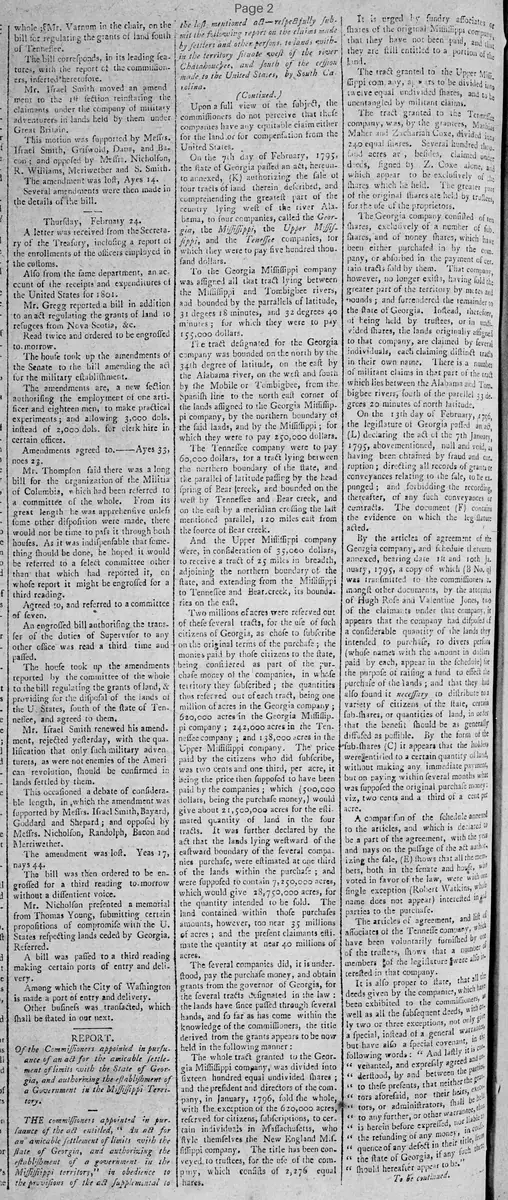
Of the Commissioners appointed in pursuance of an act for the amicable settlement of limits with the State of Georgia, and authorizing the establishment of a Government in the Mississippi Territory.
THE commissioners appointed in pursuance of the act entitled, "An act for an amicable settlement of limits with the state of Georgia, and authorizing the establishment of a government in the Mississippi territory," in obedience to the provisions of the act supplemental to the last mentioned act—respectfully submit the following report on the claims made by settlers and other persons, to lands within the territory situate west of the river Chattahoochee, and south of the cession made to the United States, by South Carolina.
(Continued.)
Upon a full view of the subject, the commissioners do not perceive that these companies have any equitable claim either for the land or for compensation from the United States.
On the 7th day of February, 1795, the state of Georgia passed an act, hereunto annexed, (K) authorizing the sale of four tracts of land therein described, and comprehending the greatest part of the country lying west of the river Alabama, to four companies, called the Georgia, the Mississippi, the Upper Mississippi, and the Tennessee companies, for which they were to pay five hundred thousand dollars.
To the Georgia Mississippi company was assigned all that tract lying between the Mississippi and Tombigbee rivers, and bounded by the parallels of latitude, 31 degrees 18 minutes, and 32 degrees 40 minutes; for which they were to pay 155,000 dollars.
The tract designated for the Georgia company was bounded on the north by the 34th degree of latitude, on the east by the Alabama river, on the west and south by the Mobile or Tombigbee, from the Spanish line to the north east corner of the lands assigned to the Georgia Mississippi company, by the northern boundary of the said lands, and by the Mississippi; for which they were to pay 250,000 dollars.
The Tennessee company were to pay 60,000 dollars, for a tract lying between the northern boundary of the state, and the parallel of latitude passing by the head spring of Bear creek, and bounded on the west by Tennessee and Bear creek, and on the east by a meridian crossing the last mentioned parallel, 120 miles east from the source of Bear creek.
And the Upper Mississippi company were, in consideration of 35,000 dollars, to receive a tract of 25 miles in breadth, adjoining the northern boundary of the state, and extending from the Mississippi to Tennessee and Bear creek, its boundaries on the east.
Two millions of acres were reserved out of these several tracts, for the use of such citizens of Georgia, as chose to subscribe on the original terms of the purchase; the monies paid by those citizens to the state, being considered as part of the purchase money of the companies, in whose territory they subscribed; the quantities thus reserved out of each tract, being one million of acres in the Georgia company; 620,000 acres in the Georgia Mississippi company; 242,000 acres in the Tennessee company; and 138,000 acres in the Upper Mississippi company. The price paid by the citizens who did subscribe, was two cents and one third, per acre, it being the price then supposed to have been paid by the companies; which (500,000 dollars, being the purchase money,) would give about 21,500,000 acres for the estimated quantity of land in the four tracts. It was further declared by the act that the lands lying westward of the eastward boundary of the several companies purchase, were estimated at one third of the lands within the purchase; and were supposed to contain 7,250,000 acres, which would give 28,750,000 acres, for the quantity intended to be sold. The land contained within those purchases amounts, however, to near 35 millions of acres; and the present claimants estimate the quantity at near 40 millions of acres.
The several companies did, it is understood, pay the purchase money, and obtain grants from the governor of Georgia, for the several tracts designated in the law: the lands have since passed through several hands, and so far as has come within the knowledge of the commissioners, the title derived from the grants appears to be now held in the following manner:
The whole tract granted to the Georgia Mississippi company, was divided into sixteen hundred equal undivided shares; and the president and directors of the company, in January, 1796, sold the whole, with the exception of the 620,000 acres, reserved for citizens, subscriptions, to certain individuals in Massachusetts, who style themselves the New England Mississippi company. The title has been conveyed to trustees, for the use of the company, which consists of 2,276 equal shares.
It is urged by sundry associates shares of the original Mississippi company, that they have not been paid, and that they are still entitled to a portion of the land.
The tract granted to the Upper Mississippi company, appears to be divided into thirteen equal undivided shares, and to be unentangled by militant claims.
The tract granted to the Tennessee company, was, by the grantees, Mathias Maher and Zachariah Coxe, divided into 240 equal shares. Several hundred thousand acres are, besides, claimed under deeds, signed by Z. Coxe alone, and which appear to be exclusively of the shares which he held. The greater part of the original shares are held by trustees for the use of the proprietors.
The Georgia company consisted of ten shares, exclusively of a number of sub-shares, and of money shares, which have been either purchased in by the company, or absorbed in the payment of certain tracts sold by them. That company, however, no longer exists, having sold the greater part of the territory by metes and bounds; and surrendered the remainder to the state of Georgia. Instead, therefore, of being held by trustees, or in undivided shares, the lands originally assigned to that company, are claimed by several individuals, each claiming distinct tracts in their own name. There is a number of militant claims in that part of the tract which lies between the Alabama and Tombigbee rivers, south of the parallel 33 degrees 20 minutes of north latitude.
On the 13th day of February, 1796 the legislature of Georgia passed an act, (L) declaring the act of the 7th January, 1795, abovementioned, null and void, as having been obtained by fraud and corruption; directing all records of grants or conveyances relating to the sale, to be expunged; and forbidding the recording, thereafter, of any such conveyances or contracts. The document (F) contains the evidence on which the legislature acted.
By the articles of agreement of the Georgia company, and schedule thereunto annexed, bearing date 1st and 10th January, 1795, a copy of which (B No. 1) was transmitted to the commissioners amongst other documents, by the attorney of Hugh Rose and Valentine Jones, two of the claimants under that company, it appears that the company had disposed of a considerable quantity of the lands they intended to purchase, to divers persons (whose names with the amount in dollars paid by each, appear in the schedule) for the purpose of raising a fund to effect the purchase of the lands; and that they had also found it necessary to distribute to a variety of citizens of the state, certain sub-shares, or quantities of land, in order that the benefit should be as generally diffused as possible. By the form of the sub-shares (C) it appears that the holders were entitled to a certain quantity of land, without making any immediate payment, but on paying within several months what was supposed the original purchase money: viz, two cents and a third of a cent per acre.
A comparison of the schedule annexed to the articles, and which is declared to be a part of the agreement, with the yeas and nays on the passage of the act authorizing the sale, (E) shows that all the members, both in the senate and house, who voted in favor of the law, were with one single exception (Robert Watkins, whose name does not appear) interested in and parties to the purchase.
[A comparison] of the trustees, shows that a number of [members of the legislature] have been voluntarily furnished by one associates of the Tennessee company, which The articles of agreement, and list of members of the legislature were also interested in that company.
[There] been exhibited to the commissioners, deeds given by the companies, which have It is also proper to state, that all [the deeds] as well as all the subsequent deeds, with only two or three exceptions, not only give a special, instead of a general warrantee, but have also a special covenant, in the following words: "And lastly it is covenanted, and expressly agreed and understood, by and between the parties, to these presents, that neither the grantors aforesaid, nor their heirs, executors, administrators, shall be held responsible for any loss or damage that may happen to the grantee, his heirs or assigns, by reason of the claim of the state of Georgia, if any such should hereafter appear to be."
To be continued.
What sub-type of article is it?
What keywords are associated?
What entities or persons were involved?
Where did it happen?
Domestic News Details
Primary Location
Mississippi Territory
Event Date
7th Day Of February, 1795; 13th Day Of February, 1796
Key Persons
Outcome
georgia legislature annulled the 1795 land sale act due to fraud and corruption; commissioners find no equitable claims for the companies; lands passed through sales and now held by various trustees and individuals.
Event Details
Commissioners report on claims to lands west of Chattahoochee River by four Georgia companies (Georgia, Mississippi, Upper Mississippi, Tennessee) following 1795 sales act; details tracts, payments, reservations, and transfers; 1796 act voids the sales; evidence of legislative corruption shown.