Thank you for visiting SNEWPapers!
Sign up free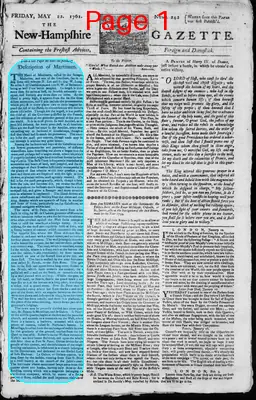
The New Hampshire Gazette
Portsmouth, Rockingham County, New Hampshire
What is this article about?
Detailed description of the French colony of Martinico (Martinique) in the Caribbean, covering its geography, population density, fortifications, harbors, soil, rivers, and the town of St. Peter, including damage from a 1760 hurricane.
Clipping
OCR Quality
Full Text
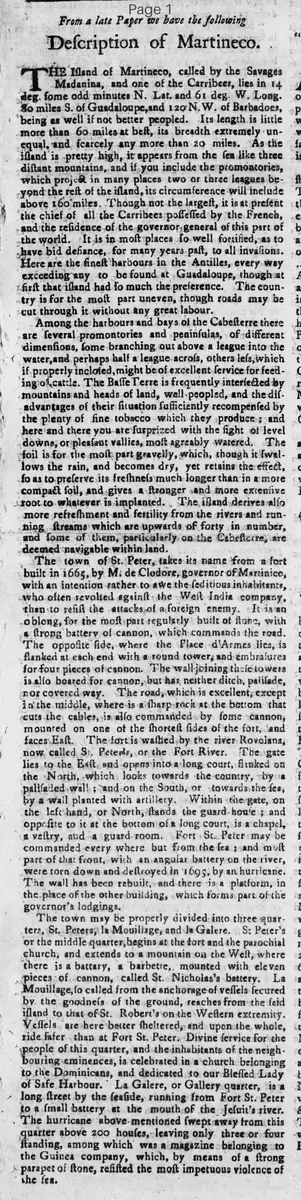
Description of Martinico.
The Island of Martinico, called by the Savages
Madanina, and one of the Carribees, lies in 14
deg. some odd minutes N. Lat. and 61 deg. W. Long.
50 miles S. of Guadaloupe, and 120 N. W. of Barbadoes,
being as well if not better peopled. Its length is little
more than 60 miles at best, its breadth extremely unequal,
and scarcely any more than 20 miles. As the
island is pretty high, it appears from the sea like three
distant mountains, and if you include the promontories,
which project in many places two or three leagues beyond the rest of the island, its circumference will include
above 160 miles. Though not the largest, it is at present
the chief of all the Carribees possessed by the French,
and the residence of the governor general of this part of
the world. It is in most places so well fortified, as to
have bid defiance, for many years past, to all invasions.
Here are the finest harbours in the Antilles, every way
exceeding any to be found at Guadaloupe, though at
first that island had so much the preference. The country is for the most part uneven, though roads may be
cut through it without any great labour.
Among the harbours and bays of the Cabesterre there
are several promontories and peninsulas, of different
dimensions, some branching out above a league into the
water, and perhaps half a league across, others less, which
if properly enclosed, might be of excellent service for feeding of cattle. The Baie Terre is frequently intersected by
mountains and heads of land, well-peopled, and the disadvantages of their situation sufficiently recompensed by
the plenty of fine tobacco which they produce; and
here and there you are surprised with the sight of level
downs, or pleasant vallies, most agreeably watered. The
soil is for the most part gravelly, which, though it wall-
allows the rain, and becomes dry, yet retains the effect,
so as to preserve its freshness much longer than in a more
compact soil, and gives a stronger and more extensive
root to whatever is implanted. The island derives also
more refreshment and fertility from the rivers and running streams which are upwards of forty in number.
and some of them, particularly on the Cabesterre, are
deemed navigable within land.
The town of St. Peter, takes its name from a fort
built in 1662 by M. de Clodore, governor of Martinico,
with an intention rather to awe the seditious inhabitants,
who often revolted against the West India company.
than to resist the attacks of a foreign enemy. It is an
oblong, for the most part regularly built of one, with
a strong battery of cannon, which commands the road.
The opposite side, where the Place d'Armes lies, is
flanked at each end with a round tower, and embrasures
for four pieces of cannon. The wall joining these towers
is also bored for cannon, but has neither ditch, palisade.
nor covered way. The road, which is excellent; except
in the middle, where is a sharp rock at the bottom that
cuts the cables, is also commanded by some cannon,
mounted on one of the shortest sides of the fort. and
faces East. The fort is washed by the river Riviere Salée,
now called St. Peter's, or the Fort River. The gate
lies to the East, and opens into a long court. Flanked on
the North, which looks towards the country, by a
palisaded wall; and on the South, or towards the sea.
by a wall planted with artillery. Within the gate, on
the left hand, or North: stands the guard-house; and
opposite to it at the bottom of a long court, is a chapel,
a vestry. and a guard-room. Fort St. Peter may be
commanded every where but from the sea; and most
part of that front, with an angular battery on the river,
were torn down and destroyed in 1760, by an hurricane.
The wall has been rebuilt, and there is a platform, in
the place of the other building. which forms part of the
governor's lodgings.
The town may be properly divided into three quarters. St. Peters, la Mouillage, and la Galere. St Peter's
or the middle quarter, begins at the fort and the parochial
church. and extends to a mountain on the West, where
there is a battery, a barbette, mounted with eleven
pieces of cannon, called St. Nicholas's battery. La
Mouillage, so called from the anchorage of vessels secured
by the goodness of the ground, reaches from the said
island to that of St. Robert's on the Western extremity.
Vessels are here better sheltered, and upon the whole,
ride safer than at Fort St. Peter. Divine service for the
people of this quarter, and the inhabitants of the neighbouring eminences, is celebrated in a church belonging
to the Dominicans, and dedicated to our Blessed Lady
of Safe Harbour. La Galere, or Gallery quarter, is a
long street by the seaside, running from Fort St. Peter
to a small battery at the mouth of the Jesuit's river.
The hurricane above-mentioned swept away from this
quarter above 200 houses, leaving only three or four
standing, among which was a magazine belonging to
the Guinea company, which, by means of a strong
parapet of stone, resisted the most impetuous violence of
the sea.
What sub-type of article is it?
What keywords are associated?
What entities or persons were involved?
Where did it happen?
Foreign News Details
Primary Location
Martinico
Key Persons
Outcome
hurricane in 1760 destroyed parts of fort st. peter and over 200 houses in la galere quarter.
Event Details
Description of Martinico's geography, location in 14 deg. N. Lat. and 61 deg. W. Long., 50 miles S. of Guadaloupe, 120 N.W. of Barbadoes; well-peopled, 60 miles long, uneven breadth up to 20 miles, circumference over 160 miles; chief French Carribee island, governor general's residence, well-fortified; finest harbors in Antilles; uneven country with gravelly soil producing tobacco, over 40 rivers; town of St. Peter with fort built 1662 by M. de Clodore to control seditious inhabitants; fort details including batteries, walls, river; town divided into St. Peters, la Mouillage, la Galere quarters; hurricane damage in 1760.