Thank you for visiting SNEWPapers!
Sign up free
Letter to Editor
December 31, 1818
Daily National Intelligencer
Washington, District Of Columbia
What is this article about?
William Lambert discusses the discrepancy between observed latitude at 45 degrees and true latitude, accounting for the Earth's oblate spheroid shape. He provides calculations for diameters, a correction of 12.4485 miles, and a general rule using equatorial and polar dimensions.
Clipping
OCR Quality
95%
Excellent
Full Text
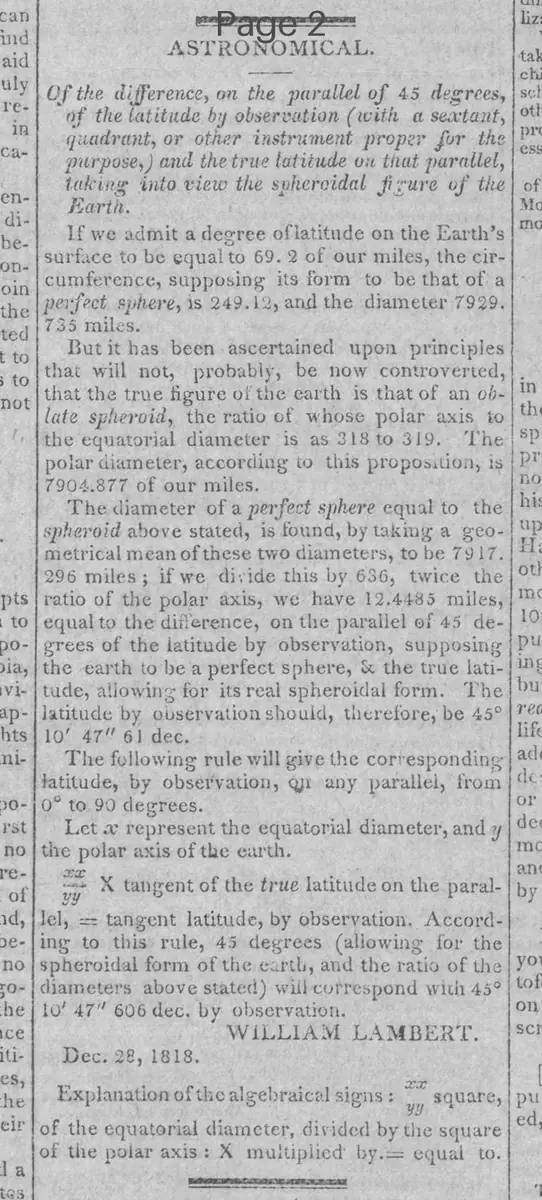
ASTRONOMICAL.
Of the difference, on the parallel of 45 degrees, of the latitude by observation (with a sextant, quadrant, or other instrument proper for the purpose,) and the true latitude on that parallel, taking into view the spheroidal figure of the Earth.
If we admit a degree of latitude on the Earth's surface to be equal to 69.2 of our miles, the circumference, supposing its form to be that of a perfect sphere, is 24912, and the diameter 7929.735 miles.
But it has been ascertained upon principles that will not, probably, be now controverted, that the true figure of the earth is that of an oblate spheroid, the ratio of whose polar axis to the equatorial diameter is as 318 to 319. The polar diameter, according to this proposition, is 7904.877 of our miles.
The diameter of a perfect sphere equal to the spheroid above stated, is found, by taking a geometrical mean of these two diameters, to be 7917.296 miles; if we divide this by 636, twice the ratio of the polar axis, we have 12.4485 miles, equal to the difference, on the parallel of 45 degrees of the latitude by observation, supposing the earth to be a perfect sphere, & the true latitude, allowing for its real spheroidal form. The latitude by observation should, therefore, be 45 10' 47" 61 dec.
The following rule will give the corresponding latitude, by observation, on any parallel, from 0 to 90 degrees.
Let x represent the equatorial diameter, and y the polar axis of the earth.
x² X tangent of the true latitude on the parallel, = tangent latitude, by observation. According to this rule, 45 degrees (allowing for the spheroidal form of the earth, and the ratio of the diameters above stated) will correspond with 45 10' 47" 606 dec. by observation.
WILLIAM LAMBERT.
Dec. 28, 1818.
Explanation of the algebraical signs:
x² square,
y² of the equatorial diameter, divided by the square of the polar axis : X multiplied by.= equal to.
Of the difference, on the parallel of 45 degrees, of the latitude by observation (with a sextant, quadrant, or other instrument proper for the purpose,) and the true latitude on that parallel, taking into view the spheroidal figure of the Earth.
If we admit a degree of latitude on the Earth's surface to be equal to 69.2 of our miles, the circumference, supposing its form to be that of a perfect sphere, is 24912, and the diameter 7929.735 miles.
But it has been ascertained upon principles that will not, probably, be now controverted, that the true figure of the earth is that of an oblate spheroid, the ratio of whose polar axis to the equatorial diameter is as 318 to 319. The polar diameter, according to this proposition, is 7904.877 of our miles.
The diameter of a perfect sphere equal to the spheroid above stated, is found, by taking a geometrical mean of these two diameters, to be 7917.296 miles; if we divide this by 636, twice the ratio of the polar axis, we have 12.4485 miles, equal to the difference, on the parallel of 45 degrees of the latitude by observation, supposing the earth to be a perfect sphere, & the true latitude, allowing for its real spheroidal form. The latitude by observation should, therefore, be 45 10' 47" 61 dec.
The following rule will give the corresponding latitude, by observation, on any parallel, from 0 to 90 degrees.
Let x represent the equatorial diameter, and y the polar axis of the earth.
x² X tangent of the true latitude on the parallel, = tangent latitude, by observation. According to this rule, 45 degrees (allowing for the spheroidal form of the earth, and the ratio of the diameters above stated) will correspond with 45 10' 47" 606 dec. by observation.
WILLIAM LAMBERT.
Dec. 28, 1818.
Explanation of the algebraical signs:
x² square,
y² of the equatorial diameter, divided by the square of the polar axis : X multiplied by.= equal to.
What sub-type of article is it?
Informative
What themes does it cover?
Science Nature
What keywords are associated?
Earth Spheroid
Latitude Observation
Astronomical Calculation
Oblate Earth
Equatorial Diameter
What entities or persons were involved?
William Lambert
Letter to Editor Details
Author
William Lambert
Main Argument
observed latitude at 45 degrees must be adjusted by about 12.45 miles due to the earth's oblate spheroid shape; provides a rule using equatorial and polar diameters to compute true from observed latitude.
Notable Details
Ratio Of Polar Axis To Equatorial Diameter As 318 To 319
Latitude By Observation: 45 10' 47" 61 Dec.
Rule: X² × Tangent Of True Latitude = Tangent Of Observed Latitude, Where X Is Equatorial Diameter, Y Polar Axis