Thank you for visiting SNEWPapers!
Sign up free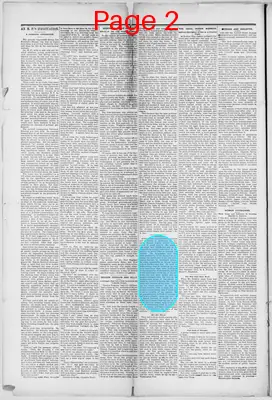
Story
August 1, 1895
The Republican
Oakland, Garrett County, Maryland
What is this article about?
Adam Smith relied on a student's expressive reactions during lectures to gauge audience interest and adjust his delivery accordingly, as recounted by his biographer via Archibald Alison.
Clipping
OCR Quality
98%
Excellent
Full Text
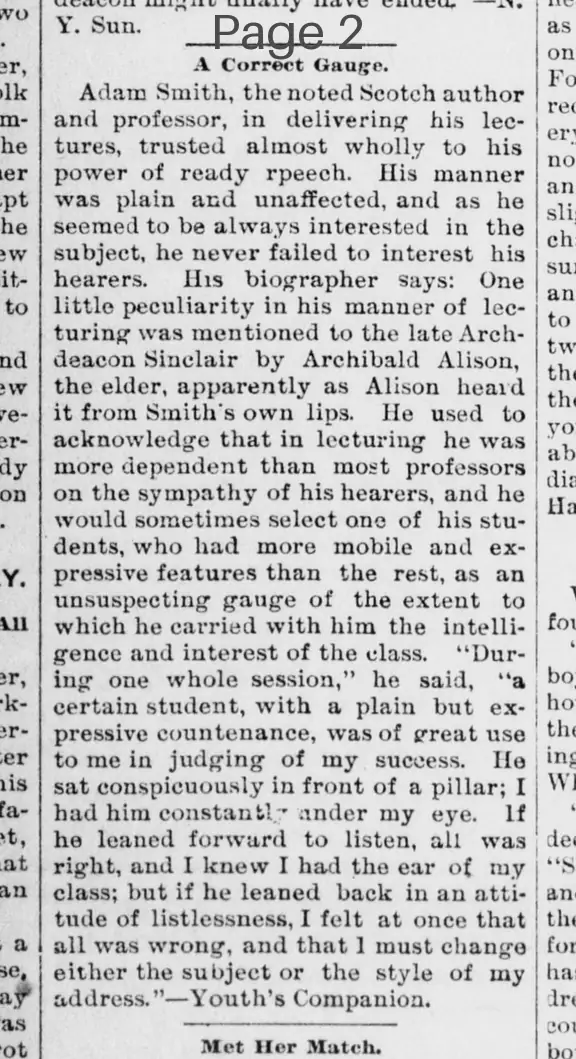
A Correct Gauge.
Adam Smith, the noted Scotch author and professor, in delivering his lectures, trusted almost wholly to his power of ready speech. His manner was plain and unaffected, and as he seemed to be always interested in the subject, he never failed to interest his hearers. His biographer says: One little peculiarity in his manner of lecturing was mentioned to the late Archdeacon Sinclair by Archibald Alison, the elder, apparently as Alison heard it from Smith's own lips. He used to acknowledge that in lecturing he was more dependent than most professors on the sympathy of his hearers, and he would sometimes select one of his students, who had more mobile and expressive features than the rest, as an unsuspecting gauge of the extent to which he carried with him the intelligence and interest of the class. "During one whole session," he said, "a certain student, with a plain but expressive countenance, was of great use to me in judging of my success. He sat conspicuously in front of a pillar; I had him constantly under my eye. If he leaned forward to listen, all was right, and I knew I had the ear of my class; but if he leaned back in an attitude of listlessness, I felt at once that all was wrong, and that I must change either the subject or the style of my address."—Youth's Companion.
Adam Smith, the noted Scotch author and professor, in delivering his lectures, trusted almost wholly to his power of ready speech. His manner was plain and unaffected, and as he seemed to be always interested in the subject, he never failed to interest his hearers. His biographer says: One little peculiarity in his manner of lecturing was mentioned to the late Archdeacon Sinclair by Archibald Alison, the elder, apparently as Alison heard it from Smith's own lips. He used to acknowledge that in lecturing he was more dependent than most professors on the sympathy of his hearers, and he would sometimes select one of his students, who had more mobile and expressive features than the rest, as an unsuspecting gauge of the extent to which he carried with him the intelligence and interest of the class. "During one whole session," he said, "a certain student, with a plain but expressive countenance, was of great use to me in judging of my success. He sat conspicuously in front of a pillar; I had him constantly under my eye. If he leaned forward to listen, all was right, and I knew I had the ear of my class; but if he leaned back in an attitude of listlessness, I felt at once that all was wrong, and that I must change either the subject or the style of my address."—Youth's Companion.
What sub-type of article is it?
Biography
Curiosity
What themes does it cover?
Social Manners
What keywords are associated?
Adam Smith
Lecturing
Audience Engagement
Student Gauge
Peculiarity
What entities or persons were involved?
Adam Smith
Archdeacon Sinclair
Archibald Alison
A Certain Student
Story Details
Key Persons
Adam Smith
Archdeacon Sinclair
Archibald Alison
A Certain Student
Event Date
During One Whole Session
Story Details
Adam Smith used a student's body language as a gauge for his lecture's success, leaning forward indicating engagement and leaning back signaling the need to adjust his approach.