Thank you for visiting SNEWPapers!
Sign up free
Editorial
June 19, 1862
Yorkville Enquirer
York, York County, South Carolina
What is this article about?
Confederate editorial criticizes the Philadelphia Inquirer's view that Jackson's victory over Banks in Virginia's Valley will provoke stronger Northern efforts, arguing instead for unrelenting aggressive blows to extort respect from the enemy, dismissing fears of Northern anger.
Clipping
OCR Quality
98%
Excellent
Full Text
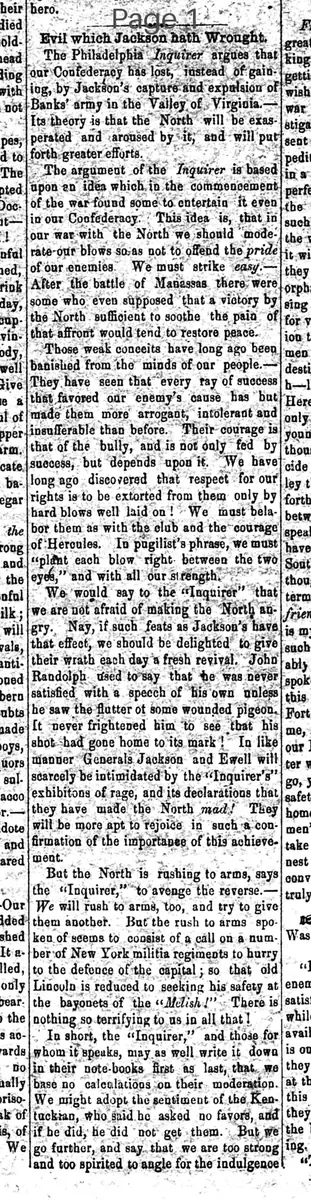
Evil which Jackson hath Wrought.
The Philadelphia Inquirer argues that our Confederacy has lost, instead of gaining, by Jackson's capture and expulsion of Banks' army in the Valley of Virginia. Its theory is that the North will be exasperated and aroused by it, and will put forth greater efforts.
The argument of the Inquirer is based upon an idea which, in the commencement of the war found some to entertain it even in our Confederacy. This idea is, that in our war with the North we should moderate our blows so as not to offend the pride of our enemies. We must strike easy.
After the battle of Manassas there were some who even supposed that a victory by the North sufficient to soothe the pain of that affront would tend to restore peace.
Those weak conceits have long ago been banished from the minds of our people. They have seen that every ray of success that favored our enemy's cause has but made them more arrogant, intolerant and insufferable than before. Their courage is that of the bully, and is not only fed by success, but depends upon it. We have long ago discovered that respect for our rights is to be extorted from them only by hard blows well laid on! We must belabor them as with the club and the courage of Hercules. In pugilist's phrase, we must "plant each blow right between the two eyes," and with all our strength.
We would say to the "Inquirer" that we are not afraid of making the North angry. Nay, if such feats as Jackson's have that effect, we should be delighted to give their wrath each day a fresh revival. John Randolph used to say that he was never satisfied with a speech of his own unless he saw the flutter of some wounded pigeon. It never frightened him to see that his shot had gone home to its mark! In like manner Generals Jackson and Ewell will scarcely be intimidated by the "Inquirer's" exhibitions of rage, and its declarations that they have made the North mad! They will be more apt to rejoice in such a confirmation of the importance of this achievement.
But the North is rushing to arms, says the "Inquirer," to avenge the reverse.—We will rush to arms, too, and try to give them another. But the rush to arms spoken of seems to consist of a call on a number of New York militia regiments to hurry to the defence of the capital; so that old Lincoln is reduced to seeking his safety at the bayonets of the "Melish!" There is nothing so terrifying to us in all that!
In short, the "Inquirer," and those for whom it speaks, may as well write it down in their note-books first as last, that we base no calculations on their moderation. We might adopt the sentiment of the Kentuckian, who said he asked no favors, and if he did, he did not get them. But we go further, and say that we are too strong and too spirited to angle for the indulgence of our implacable and despicable enemies.
As said another Kentuckian, we bow to none but God.
The Philadelphia Inquirer argues that our Confederacy has lost, instead of gaining, by Jackson's capture and expulsion of Banks' army in the Valley of Virginia. Its theory is that the North will be exasperated and aroused by it, and will put forth greater efforts.
The argument of the Inquirer is based upon an idea which, in the commencement of the war found some to entertain it even in our Confederacy. This idea is, that in our war with the North we should moderate our blows so as not to offend the pride of our enemies. We must strike easy.
After the battle of Manassas there were some who even supposed that a victory by the North sufficient to soothe the pain of that affront would tend to restore peace.
Those weak conceits have long ago been banished from the minds of our people. They have seen that every ray of success that favored our enemy's cause has but made them more arrogant, intolerant and insufferable than before. Their courage is that of the bully, and is not only fed by success, but depends upon it. We have long ago discovered that respect for our rights is to be extorted from them only by hard blows well laid on! We must belabor them as with the club and the courage of Hercules. In pugilist's phrase, we must "plant each blow right between the two eyes," and with all our strength.
We would say to the "Inquirer" that we are not afraid of making the North angry. Nay, if such feats as Jackson's have that effect, we should be delighted to give their wrath each day a fresh revival. John Randolph used to say that he was never satisfied with a speech of his own unless he saw the flutter of some wounded pigeon. It never frightened him to see that his shot had gone home to its mark! In like manner Generals Jackson and Ewell will scarcely be intimidated by the "Inquirer's" exhibitions of rage, and its declarations that they have made the North mad! They will be more apt to rejoice in such a confirmation of the importance of this achievement.
But the North is rushing to arms, says the "Inquirer," to avenge the reverse.—We will rush to arms, too, and try to give them another. But the rush to arms spoken of seems to consist of a call on a number of New York militia regiments to hurry to the defence of the capital; so that old Lincoln is reduced to seeking his safety at the bayonets of the "Melish!" There is nothing so terrifying to us in all that!
In short, the "Inquirer," and those for whom it speaks, may as well write it down in their note-books first as last, that we base no calculations on their moderation. We might adopt the sentiment of the Kentuckian, who said he asked no favors, and if he did, he did not get them. But we go further, and say that we are too strong and too spirited to angle for the indulgence of our implacable and despicable enemies.
As said another Kentuckian, we bow to none but God.
What sub-type of article is it?
War Or Peace
Military Affairs
Partisan Politics
What keywords are associated?
Jackson Victory
Valley Of Virginia
Confederate Strategy
Northern Anger
Hard Blows
Civil War Aggression
What entities or persons were involved?
General Jackson
General Banks
General Ewell
Philadelphia Inquirer
Abraham Lincoln
John Randolph
Editorial Details
Primary Topic
Defense Of Aggressive Warfare Against The North
Stance / Tone
Pro Unrelenting Military Aggression, Mocking Northern Fears
Key Figures
General Jackson
General Banks
General Ewell
Philadelphia Inquirer
Abraham Lincoln
John Randolph
Key Arguments
Confederate Victories Like Jackson's Arouse But Do Not Deter The North; Aggressive Blows Are Necessary
Northern Success Breeds Arrogance, Requiring Hard Hits To Extort Respect
Delighted To Provoke Northern Wrath Daily
Northern Rush To Arms With Militia Is Not Terrifying
No Reliance On Northern Moderation; Confederacy Too Strong For Indulgence