Thank you for visiting SNEWPapers!
Sign up free
Poem
September 20, 1869
The Wheeling Daily Intelligencer
Wheeling, Ohio County, West Virginia
What is this article about?
Elegy mourning Lady Byron's suffering and early death, critiquing Lord Byron's heroism and double moral standards for men and women, envisioning her heavenly forgiveness. By Lizzie G. Parker for the Intelligencer.
Clipping
OCR Quality
90%
Excellent
Full Text
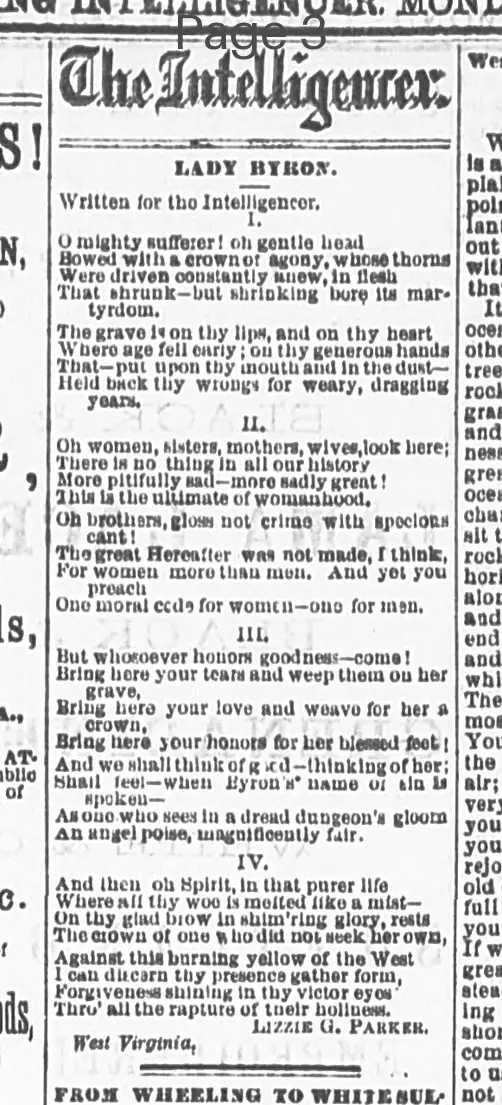
The Intelligencer.
Lady Byron,
Written for the Intelligencer,
Bowed with a crown of agony, whose thorns
Were driven constantly anew, in flesh
That shrunk—but shrinking bore its martyrdom.
The grave is on thy lips, and on thy heart
Where age fell early; on thy generous hands
That—put upon thy mouth and in the dust
Held back thy wrongs for weary, dragging
years,
II.
Oh women, sisters, mothers, wives, look here;
There is no thing in all our history
More pitifully sad—more sadly great!
This is the ultimate of womanhood.
Oh brothers, glory not crime with specious
cant!
The great Hero after was not made, I think,
For women more than men. And yet you
preach
One moral code for women—one for men.
III.
But whosoever honor goodness—come!
Bring here your tears and weep them on her
grave,
Bring here your love and weave for her a
crown,
Bring here your honors for her blessed feet!
And we shall think of God—thinking of her;
Shall feel—when Byron's name on time's
rolls
spoken—
As one who sees in a dread dungeon's gloom
An angel poise, magnificently fair.
IV.
And then oh Spirit, in that purer life
Where all thy woe is melted like a mist—
On thy glad brow in shimmering glory, rests
The crown of one who held not seek her own,
Against this burning yellow of the West
I can discern thy presence gather form
Forgiveness shining in thy victor eyes
Thro' all the rapture of their holiness.
LIZZIE G. PARKER.
West Virginia,
Lady Byron,
Written for the Intelligencer,
Bowed with a crown of agony, whose thorns
Were driven constantly anew, in flesh
That shrunk—but shrinking bore its martyrdom.
The grave is on thy lips, and on thy heart
Where age fell early; on thy generous hands
That—put upon thy mouth and in the dust
Held back thy wrongs for weary, dragging
years,
II.
Oh women, sisters, mothers, wives, look here;
There is no thing in all our history
More pitifully sad—more sadly great!
This is the ultimate of womanhood.
Oh brothers, glory not crime with specious
cant!
The great Hero after was not made, I think,
For women more than men. And yet you
preach
One moral code for women—one for men.
III.
But whosoever honor goodness—come!
Bring here your tears and weep them on her
grave,
Bring here your love and weave for her a
crown,
Bring here your honors for her blessed feet!
And we shall think of God—thinking of her;
Shall feel—when Byron's name on time's
rolls
spoken—
As one who sees in a dread dungeon's gloom
An angel poise, magnificently fair.
IV.
And then oh Spirit, in that purer life
Where all thy woe is melted like a mist—
On thy glad brow in shimmering glory, rests
The crown of one who held not seek her own,
Against this burning yellow of the West
I can discern thy presence gather form
Forgiveness shining in thy victor eyes
Thro' all the rapture of their holiness.
LIZZIE G. PARKER.
West Virginia,
What sub-type of article is it?
Elegy
What themes does it cover?
Death Mourning
Moral Virtue
Satire Society
What keywords are associated?
Lady Byron
Elegy
Martyrdom
Womanhood
Byron Critique
Forgiveness
Gender Morals
What entities or persons were involved?
Lizzie G. Parker.
Poem Details
Title
Lady Byron
Author
Lizzie G. Parker.
Subject
Written For The Intelligencer
Key Lines
Bowed With A Crown Of Agony, Whose Thorns
Were Driven Constantly Anew, In Flesh
This Is The Ultimate Of Womanhood.
One Moral Code For Women—One For Men.
Forgiveness Shining In Thy Victor Eyes