Thank you for visiting SNEWPapers!
Sign up free
Literary
May 14, 1821
Alexandria Gazette & Daily Advertiser
Alexandria, Virginia
What is this article about?
A reflective piece from the National Gazette using poetry and prose to compare morning to the infancy of day, life, and love, emphasizing the purity, joy, and irreplaceable charm of beginnings before the decline of later stages.
Merged-components note: The literary piece expands on and continues the theme of the preceding poem 'MORNING', forming a single cohesive literary component.
Clipping
OCR Quality
95%
Excellent
Full Text
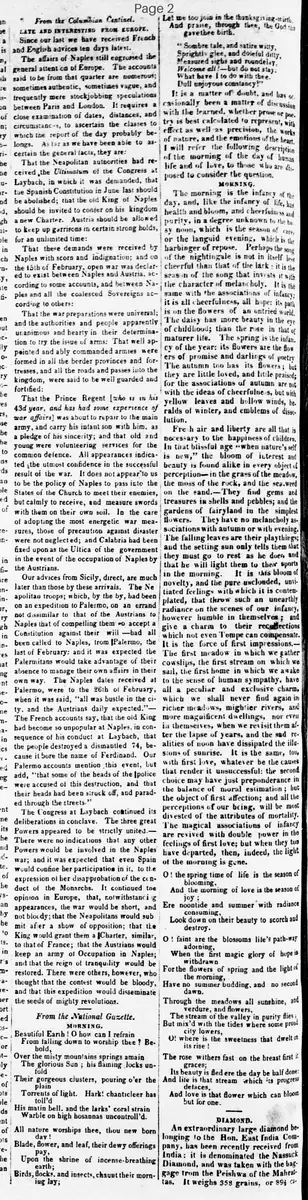
From the National Gazette.
MORNING.
Beautiful Earth! O how can I refrain
From falling down to worship thee? Behold,
Over the misty mountains springs amain
The glorious Sun; his flaming locks unfold
Their gorgeous clusters, pouring o'er the plain
Torrents of light. Hark! chanticleer hath toil'd
His matin bell, and the larks' coral strain
Warble on high hosannas uncontroll'd.
All nature worships thee, thou new born day!
Blade, flower, and leaf, their dewy offerings pay,
Upon the shrine of incense-breathing earth:
Birds, flocks, and insects, chant their morning lay;
Let me too join in the thanksgiving-mirth.
And praise, through thee, the God that gave thee birth.
"Sombre tale, and satire witty.
Sprightiy glee, and doleful ditty,
Measured sighs and roundelay,
Welcome all! but do not stay:
What have I to do with thee.
Dull unjoyous constancy?"
It is a matter of doubt, and has occasionally been a matter of discussion
with the learned, whether prose or poetry is best calculated to represent, with
effect as well as precision, the works
of nature, and the emotions of the heart.
I will refer the following
description
of the morning of the day of human
life and of love, to those who are disposed to consider the question.
MORNING.
The morning is the infancy of the
day, and, like the infancy of life, has
health and bloom, and cheerfulness and
purity, in a degree unknown to the busy noon, which is the season of cares
or the languid evening, which is the
harbinger of repose. Perhaps the song
of the nightingale is not in itself less
cheerful than that of the lark: it is the
season of the song that invests it with
the character of melancholy. It is the
same with the associations of infancy;
it is all cheerfulness, all hope: its path
is on the flowers of an untried world.
The daisy has more beauty in the eye
of childhood; than the rose in that of
maturer life.
The spring is the infancy of the year: its flowers are the flowers of promise and darlings of poetry.
The autumn too has its flowers; but
they are little loved, and little praised;
for the associations of autumn are not
with the ideas of cheerfulness, but with
yellow leaves and hollow winds, heralds of winter, and emblems of dissolution.
Fresh air and liberty are all that is
necessary to the happiness of children.
In that blissful age when nature's self
is new," the bloom of interest and
beauty is found alike in every object of
perception in the grass of the meadow.
the moss of the rock, and the sea-weed
on the sand.—They find gems and
treasures in shells and pebbles; and the
gardens of fairyland in the simplest
flowers. They have no melancholy associations with autumn or with evening.
The falling leaves are their playthings;
and the setting sun only tells them that
they must go to rest as he does, and
that he will light them to their sports
in the morning. It is this bloom of
novelty, and the pure unclouded, unvitiated feelings with which it is contemplated, that throw such an unearthly
radiance on the scenes of our infancy,
however humble in themselves: and
give a charm to their recollections
which not even Tempe can compensate.
It is the force of first impressions.—
The first meadow in which we gather
cowslips, the first stream on which we
sail, the first home in which we awake
to the sense of human sympathy, have
all a peculiar and exclusive charm,
which we shall never find again in
richer meadows, mightier rivers, and
more magnificent dwellings, nor even
in themselves, when we revisit them after the lapse of years, and the sad realities of noon have dissipated the illusions of sunrise. It is the same, too,
with first love, whatever be the causes
that render it unsuccessful: the second
choice may have just preponderance in
the balance of moral estimation; but
the object of first affection; and all the
perceptions of our being. will be most
divested of the attributes of mortality.
The magical associations of infancy
are revived with double power in the
feelings of first love; but when they too
have departed, then, indeed, the light
of the morning is gone.
O! the spring time of life is the season of
blooming,
And the morning of love is the season of
joy;
Ere noontide and summer with radiance
consuming
Look down on their beauty to scorch and
destroy.
O! faint are the blossoms life's path-way
adorning,
When the first magic glory of hope is
withdrawn;
For the flowers of spring and the light of
the morning
Have no summer budding, and no second
dawn.
Through the meadows all sunshine,
and
verdure, and flowers,
The stream of the valley in purity flies;
But mix'd with the tides where some proud
city towers,
O! where is the sweetness that dwelt on
its rise!
The rose withers fast on the breast first it
g races;
Its beauty is fled ere the day be half done:
And life is that stream which its progress
defaces,
And love is that flower which can bloom
but for one.
MORNING.
Beautiful Earth! O how can I refrain
From falling down to worship thee? Behold,
Over the misty mountains springs amain
The glorious Sun; his flaming locks unfold
Their gorgeous clusters, pouring o'er the plain
Torrents of light. Hark! chanticleer hath toil'd
His matin bell, and the larks' coral strain
Warble on high hosannas uncontroll'd.
All nature worships thee, thou new born day!
Blade, flower, and leaf, their dewy offerings pay,
Upon the shrine of incense-breathing earth:
Birds, flocks, and insects, chant their morning lay;
Let me too join in the thanksgiving-mirth.
And praise, through thee, the God that gave thee birth.
"Sombre tale, and satire witty.
Sprightiy glee, and doleful ditty,
Measured sighs and roundelay,
Welcome all! but do not stay:
What have I to do with thee.
Dull unjoyous constancy?"
It is a matter of doubt, and has occasionally been a matter of discussion
with the learned, whether prose or poetry is best calculated to represent, with
effect as well as precision, the works
of nature, and the emotions of the heart.
I will refer the following
description
of the morning of the day of human
life and of love, to those who are disposed to consider the question.
MORNING.
The morning is the infancy of the
day, and, like the infancy of life, has
health and bloom, and cheerfulness and
purity, in a degree unknown to the busy noon, which is the season of cares
or the languid evening, which is the
harbinger of repose. Perhaps the song
of the nightingale is not in itself less
cheerful than that of the lark: it is the
season of the song that invests it with
the character of melancholy. It is the
same with the associations of infancy;
it is all cheerfulness, all hope: its path
is on the flowers of an untried world.
The daisy has more beauty in the eye
of childhood; than the rose in that of
maturer life.
The spring is the infancy of the year: its flowers are the flowers of promise and darlings of poetry.
The autumn too has its flowers; but
they are little loved, and little praised;
for the associations of autumn are not
with the ideas of cheerfulness, but with
yellow leaves and hollow winds, heralds of winter, and emblems of dissolution.
Fresh air and liberty are all that is
necessary to the happiness of children.
In that blissful age when nature's self
is new," the bloom of interest and
beauty is found alike in every object of
perception in the grass of the meadow.
the moss of the rock, and the sea-weed
on the sand.—They find gems and
treasures in shells and pebbles; and the
gardens of fairyland in the simplest
flowers. They have no melancholy associations with autumn or with evening.
The falling leaves are their playthings;
and the setting sun only tells them that
they must go to rest as he does, and
that he will light them to their sports
in the morning. It is this bloom of
novelty, and the pure unclouded, unvitiated feelings with which it is contemplated, that throw such an unearthly
radiance on the scenes of our infancy,
however humble in themselves: and
give a charm to their recollections
which not even Tempe can compensate.
It is the force of first impressions.—
The first meadow in which we gather
cowslips, the first stream on which we
sail, the first home in which we awake
to the sense of human sympathy, have
all a peculiar and exclusive charm,
which we shall never find again in
richer meadows, mightier rivers, and
more magnificent dwellings, nor even
in themselves, when we revisit them after the lapse of years, and the sad realities of noon have dissipated the illusions of sunrise. It is the same, too,
with first love, whatever be the causes
that render it unsuccessful: the second
choice may have just preponderance in
the balance of moral estimation; but
the object of first affection; and all the
perceptions of our being. will be most
divested of the attributes of mortality.
The magical associations of infancy
are revived with double power in the
feelings of first love; but when they too
have departed, then, indeed, the light
of the morning is gone.
O! the spring time of life is the season of
blooming,
And the morning of love is the season of
joy;
Ere noontide and summer with radiance
consuming
Look down on their beauty to scorch and
destroy.
O! faint are the blossoms life's path-way
adorning,
When the first magic glory of hope is
withdrawn;
For the flowers of spring and the light of
the morning
Have no summer budding, and no second
dawn.
Through the meadows all sunshine,
and
verdure, and flowers,
The stream of the valley in purity flies;
But mix'd with the tides where some proud
city towers,
O! where is the sweetness that dwelt on
its rise!
The rose withers fast on the breast first it
g races;
Its beauty is fled ere the day be half done:
And life is that stream which its progress
defaces,
And love is that flower which can bloom
but for one.
What sub-type of article is it?
Poem
Essay
What themes does it cover?
Nature
Love Romance
Seasonal Cycle
What keywords are associated?
Morning
Infancy
First Love
Nature Worship
Life Stages
Literary Details
Title
Morning
Subject
Description Of The Morning Of The Day Of Human Life And Of Love
Form / Style
Poetic And Prosaic Reflections On Morning As Metaphor For Infancy And First Love
Key Lines
Beautiful Earth! O How Can I Refrain
From Falling Down To Worship Thee? Behold,
Over The Misty Mountains Springs Amain
The Glorious Sun; His Flaming Locks Unfold
All Nature Worships Thee, Thou New Born Day!
Blade, Flower, And Leaf, Their Dewy Offerings Pay,
Upon The Shrine Of Incense Breathing Earth:
O! The Spring Time Of Life Is The Season Of Blooming,
And The Morning Of Love Is The Season Of Joy;
The Rose Withers Fast On The Breast First It Graces;
Its Beauty Is Fled Ere The Day Be Half Done:
And Life Is That Stream Which Its Progress Defaces,
And Love Is That Flower Which Can Bloom But For One.