Thank you for visiting SNEWPapers!
Sign up free
Editorial
June 9, 1873
The Rock Island Daily Argus
Rock Island, Rock Island County County, Illinois
What is this article about?
The Chicago Times defends the election of Judge Craig to the Illinois Supreme Court over Judge Lawrence, criticizing the Chicago Tribune's claim of a 'brutal outrage' under universal suffrage. It argues that voters hold sovereign authority in such elections, rejecting elite interference.
Clipping
OCR Quality
85%
Good
Full Text
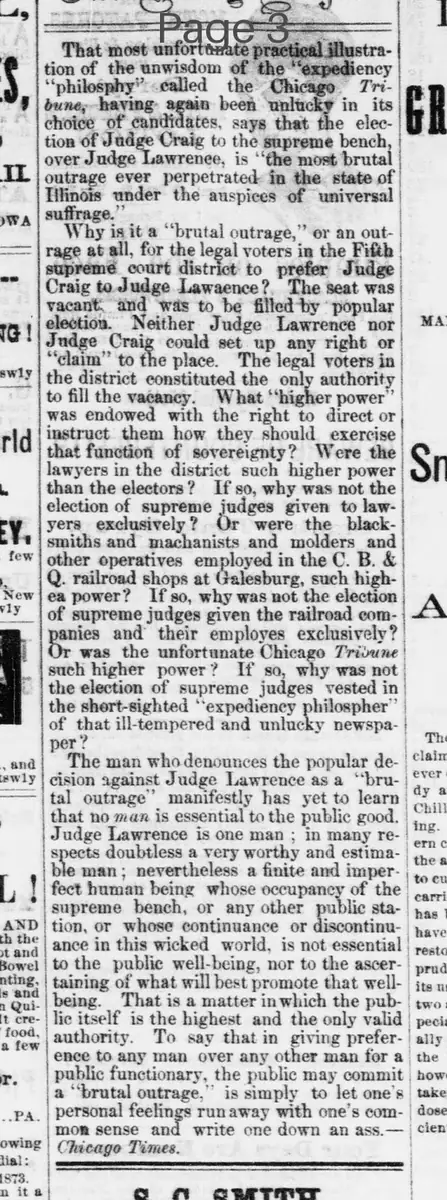
That most unfortunate practical illustration of the unwisdom of the "expediency philosophy" called the Chicago Tribune, having again been unlucky in its choice of candidates, says that the election of Judge Craig to the supreme bench, over Judge Lawrence, is "the most brutal outrage ever perpetrated in the state of Illinois under the auspices of universal suffrage."
Why is it a "brutal outrage," or an outrage at all, for the legal voters in the Fifth supreme court district to prefer Judge Craig to Judge Lawrence? The seat was vacant, and was to be filled by popular election. Neither Judge Lawrence nor Judge Craig could set up any right or "claim" to the place. The legal voters in the district constituted the only authority to fill the vacancy. What "higher power" was endowed with the right to direct or instruct them how they should exercise that function of sovereignty? Were the lawyers in the district such higher power than the electors? If so, why was not the election of supreme judges given to lawyers exclusively? Or were the blacksmiths and machinists and molders and other operatives employed in the C. B. & Q. railroad shops at Galesburg, such higher power? If so, why was not the election of supreme judges given the railroad companies and their employees exclusively? Or was the unfortunate Chicago Tribune such higher power? If so, why was not the election of supreme judges vested in the short-sighted "expediency philosopher" of that ill-tempered and unlucky newspaper?
The man who denounces the popular decision against Judge Lawrence as a "brutal outrage" manifestly has yet to learn that no man is essential to the public good. Judge Lawrence is one man; in many respects doubtless a very worthy and estimable man: nevertheless a finite and imperfect human being whose occupancy of the supreme bench, or any other public station, or whose continuance or discontinuance in this wicked world, is not essential to the public well-being, nor to the ascertaining of what will best promote that well-being. That is a matter in which the public itself is the highest and the only valid authority. To say that in giving preference to any man over any other man for a public functionary, the public may commit a 'brutal outrage," is simply to let one's personal feelings run away with one's common sense and write one down an ass.
- Chicago Times.
Why is it a "brutal outrage," or an outrage at all, for the legal voters in the Fifth supreme court district to prefer Judge Craig to Judge Lawrence? The seat was vacant, and was to be filled by popular election. Neither Judge Lawrence nor Judge Craig could set up any right or "claim" to the place. The legal voters in the district constituted the only authority to fill the vacancy. What "higher power" was endowed with the right to direct or instruct them how they should exercise that function of sovereignty? Were the lawyers in the district such higher power than the electors? If so, why was not the election of supreme judges given to lawyers exclusively? Or were the blacksmiths and machinists and molders and other operatives employed in the C. B. & Q. railroad shops at Galesburg, such higher power? If so, why was not the election of supreme judges given the railroad companies and their employees exclusively? Or was the unfortunate Chicago Tribune such higher power? If so, why was not the election of supreme judges vested in the short-sighted "expediency philosopher" of that ill-tempered and unlucky newspaper?
The man who denounces the popular decision against Judge Lawrence as a "brutal outrage" manifestly has yet to learn that no man is essential to the public good. Judge Lawrence is one man; in many respects doubtless a very worthy and estimable man: nevertheless a finite and imperfect human being whose occupancy of the supreme bench, or any other public station, or whose continuance or discontinuance in this wicked world, is not essential to the public well-being, nor to the ascertaining of what will best promote that well-being. That is a matter in which the public itself is the highest and the only valid authority. To say that in giving preference to any man over any other man for a public functionary, the public may commit a 'brutal outrage," is simply to let one's personal feelings run away with one's common sense and write one down an ass.
- Chicago Times.
What sub-type of article is it?
Partisan Politics
Suffrage
What keywords are associated?
Universal Suffrage
Popular Election
Supreme Court Judges
Chicago Tribune Criticism
Illinois Judiciary
What entities or persons were involved?
Chicago Tribune
Judge Craig
Judge Lawrence
Chicago Times
Editorial Details
Primary Topic
Defense Of Popular Election Of Judge Craig Over Judge Lawrence
Stance / Tone
Strongly Supportive Of Universal Suffrage And Popular Sovereignty, Critical Of Chicago Tribune
Key Figures
Chicago Tribune
Judge Craig
Judge Lawrence
Chicago Times
Key Arguments
Election Of Judge Craig Is Not A Brutal Outrage But The Rightful Exercise Of Popular Sovereignty
No Individual Has An Inherent Claim To Public Office; Voters Are The Highest Authority
Denouncing Popular Decisions As Outrages Undermines Common Sense And Democracy
Judge Lawrence's Defeat Does Not Harm Public Well Being; No Man Is Essential