Thank you for visiting SNEWPapers!
Sign up free
Editorial
August 27, 1927
The West Virginia News
Ronceverte, Greenbrier County, West Virginia
What is this article about?
Editorial celebrates 'old-time religion' for inspiring a converted Ohio man to pay debts, recalls historical church oversight of converts' honesty, critiques modern churches, and suggests adding a debt-related question to admissions. (187 characters)
Clipping
OCR Quality
98%
Excellent
Full Text
THE OLD-TIME RELIGION
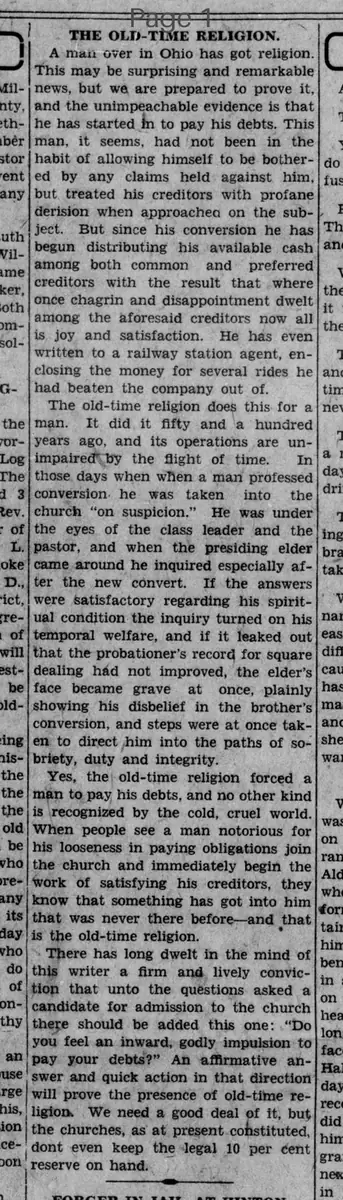
A man over in Ohio has got religion. This may be surprising and remarkable news, but we are prepared to prove it, and the unimpeachable evidence is that he has started in to pay his debts. This man, it seems, had not been in the habit of allowing himself to be bothered by any claims held against him, but treated his creditors with profane derision when approached on the subject. But since his conversion he has begun distributing his available cash among both common and preferred creditors with the result that where once chagrin and disappointment dwelt among the aforesaid creditors now all is joy and satisfaction. He has even written to a railway station agent, enclosing the money for several rides he had beaten the company out of.
The old-time religion does this for a man. It did it fifty and a hundred years ago, and its operations are unimpaired by the flight of time. In those days when a man professed conversion he was taken into the church "on suspicion." He was under the eyes of the class leader and the pastor, and when the presiding elder came around he inquired especially after the new convert. If the answers were satisfactory regarding his spiritual condition the inquiry turned on his temporal welfare, and if it leaked out that the probationer's record for square dealing had not improved, the elder's face became grave at once, plainly showing his disbelief in the brother's conversion, and steps were at once taken to direct him into the paths of sobriety, duty and integrity.
Yes, the old-time religion forced a man to pay his debts, and no other kind is recognized by the cold, cruel world. When people see a man notorious for his looseness in paying obligations join the church and immediately begin the work of satisfying his creditors, they know that something has got into him that was never there before and that is the old-time religion.
There has long dwelt in the mind of this writer a firm and lively conviction that unto the questions asked a candidate for admission to the church there should be added this one: "Do you feel an inward, godly impulsion to pay your debts?" An affirmative answer and quick action in that direction will prove the presence of old-time religion. We need a good deal of it, but the churches, as at present constituted, don't even keep the legal 10 per cent reserve on hand.
A man over in Ohio has got religion. This may be surprising and remarkable news, but we are prepared to prove it, and the unimpeachable evidence is that he has started in to pay his debts. This man, it seems, had not been in the habit of allowing himself to be bothered by any claims held against him, but treated his creditors with profane derision when approached on the subject. But since his conversion he has begun distributing his available cash among both common and preferred creditors with the result that where once chagrin and disappointment dwelt among the aforesaid creditors now all is joy and satisfaction. He has even written to a railway station agent, enclosing the money for several rides he had beaten the company out of.
The old-time religion does this for a man. It did it fifty and a hundred years ago, and its operations are unimpaired by the flight of time. In those days when a man professed conversion he was taken into the church "on suspicion." He was under the eyes of the class leader and the pastor, and when the presiding elder came around he inquired especially after the new convert. If the answers were satisfactory regarding his spiritual condition the inquiry turned on his temporal welfare, and if it leaked out that the probationer's record for square dealing had not improved, the elder's face became grave at once, plainly showing his disbelief in the brother's conversion, and steps were at once taken to direct him into the paths of sobriety, duty and integrity.
Yes, the old-time religion forced a man to pay his debts, and no other kind is recognized by the cold, cruel world. When people see a man notorious for his looseness in paying obligations join the church and immediately begin the work of satisfying his creditors, they know that something has got into him that was never there before and that is the old-time religion.
There has long dwelt in the mind of this writer a firm and lively conviction that unto the questions asked a candidate for admission to the church there should be added this one: "Do you feel an inward, godly impulsion to pay your debts?" An affirmative answer and quick action in that direction will prove the presence of old-time religion. We need a good deal of it, but the churches, as at present constituted, don't even keep the legal 10 per cent reserve on hand.
What sub-type of article is it?
Moral Or Religious
What keywords are associated?
Old Time Religion
Debt Repayment
Religious Conversion
Church Integrity
Moral Reform
What entities or persons were involved?
Man In Ohio
Creditors
Class Leader
Pastor
Presiding Elder
Editorial Details
Primary Topic
Effects Of Old Time Religion On Debt Repayment And Integrity
Stance / Tone
Supportive And Exhortative Of Traditional Religious Conversion
Key Figures
Man In Ohio
Creditors
Class Leader
Pastor
Presiding Elder
Key Arguments
Religious Conversion Leads To Paying Debts
Historical Church Scrutiny Ensured Honest Dealings
Modern Churches Lack Emphasis On Financial Integrity
Add Debt Repayment Question To Church Admission