Thank you for visiting SNEWPapers!
Sign up free
Editorial
March 14, 1804
Alexandria Daily Advertiser
Alexandria, Virginia
What is this article about?
Editorial urges maintaining good U.S.-British relations despite recent captures by British cruisers, criticizes specific colonial judges and captains for injustices but exonerates the British government, and condemns privateering while suggesting reforms to mitigate its harms.
Clipping
OCR Quality
95%
Excellent
Full Text
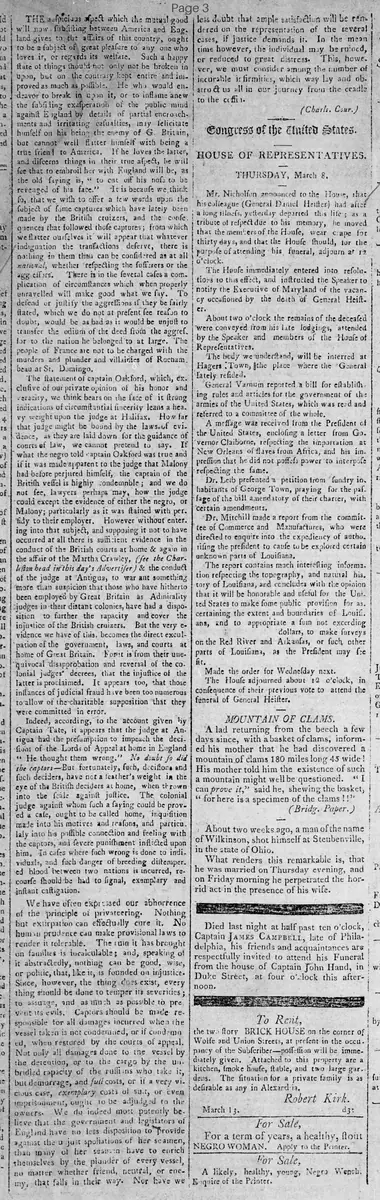
THE auspicious aspect which the mutual good will now subsisting between America and England gives to the affairs of this country, ought to be a subject of great pleasure to any one who loves it, or regards its welfare. Such a happy state of things should not only not be broken in upon, but on the contrary kept entire and improved as much as possible. He who would endeavor to break in upon it, or to inflame anew the subsiding exasperation of the public mind against England by details of partial encroachments and irritating casualties,--may felicitate himself on his being the enemy of G. Britain, but cannot well flatter himself with being a true friend to America. If he loves the latter, and discerns things in their true aspect, he will see that to embroil her with England will be, as the old saying is, "to cut off his nose to be revenged of his face." It is because we think so, that we wish to offer a few words upon the subject of some captures which have lately been made by the British cruizers, and the consequences that followed those captures; from which we flatter ourselves it will appear that whatever indignation the transactions deserve, there is nothing in them that can be considered as at all national, whether respecting the sufferers or the aggressors. There is in the several cases a complication of circumstances which when properly unravelled will make good what we say. To defend or justify the aggressions if they be fairly stated, which we do not at present see reason to doubt, would be as bad as it would be unjust to transfer the odium of the deed from the aggressor to the nation he belonged to at large. The people of France are not to be charged with the murders and plunder and villanies of Rochambeau at St. Domingo.
The statement of captain Oakford, which, exclusive of our private opinion of his honor and veracity, we think bears on the face of it strong indications of circumstantial insincerity leans a heavy weight upon the judge at Halifax. How far that judge might be bound by the laws of evidence, as they are laid down for the guidance of courts of law, we cannot pretend to say. If what the negro told captain Oakford was true and if it was made apparent to the judge that Malony had before perjured himself, the captain of the British vessel is highly condemnable; and we do not see, lawyers perhaps may, how the judge could accept the evidence of either the negro, or Malony; particularly as it was tainted with perjury to their employer. However without entering into that subject, and supposing it not to have occurred at all there is sufficient evidence in the conduct of the British courts at home & again in the affair of the Martha Cawry. (see the Charleston head in this day's Advertiser) & the conduct of the judge at Antigua, to warrant something more than suspicion that those who have hitherto been employed by Great Britain as Admiralty judges in their distant colonies, have had a disposition to further the rapacity and cover the injustice of the British cruizers. But the very evidence we have of this, becomes the direct exculpation of the government, laws, and courts at home of Great Britain. For it is from their unequivocal disapprobation and reversal of the colonial judges' decrees, that the injustice of the latter is proclaimed. It appears too, that those instances of judicial fraud have been too numerous to allow of the charitable supposition that they were committed in error.
Indeed, according to the account given by Captain Tate, it appears that the judge at Antigua had the presumption to impeach the decisions of the Lords of Appeal at home in England "He thought them wrong." No doubt so did the captors-But fortunately, such decisions and such deciders, have not a feather's weight in the eye of the British deciders at home, when thrown into the scale against justice. The colonial judge against whom such a saying could be proved a case, ought to be called home, inquisition made into his motives and reasons, and particularly into his possible connection and feeling with the captors, and severe punishment inflicted upon him. In cases where such wrong is done to individuals, and such danger of breeding distempered blood between two nations is incurred, recourse should be had to signal, exemplary and instant castigation.
We have often expressed our abhorrence of the principle of privateering. Nothing but extirpation can effectually cure it. No human prudence can make provisional laws to render it tolerable. The ruin it has brought on families is incalculable; and, speaking of it abstractedly, nothing can be good, wise, or politic, that, like it, is founded on injustice. Since, however, the thing does exist, every thing should be done to temper its severities; to assuage, and as much as possible to prevent its evils. Captors should be made responsible for all damages incurred when the vessel taken is not condemned, or if condemned, when restored by the courts of appeal. Not only all damages done to the vessel by the detention, or to the cargo by the unbridled rapacity of the ruffians who take it, but demurrage, and full costs, or if a very vicious case, exemplary costs of suit, or even imprisonment, ought to be adjudged to the owners. We do indeed most potently believe that the government and legislators of England have no less disposition to provide against the unjust spoliations of her seamen, than many of her seamen have to enrich themselves by the plunder of every vessel, no matter whether friend, neutral, or enemy, that falls in their way. Nor have we
The statement of captain Oakford, which, exclusive of our private opinion of his honor and veracity, we think bears on the face of it strong indications of circumstantial insincerity leans a heavy weight upon the judge at Halifax. How far that judge might be bound by the laws of evidence, as they are laid down for the guidance of courts of law, we cannot pretend to say. If what the negro told captain Oakford was true and if it was made apparent to the judge that Malony had before perjured himself, the captain of the British vessel is highly condemnable; and we do not see, lawyers perhaps may, how the judge could accept the evidence of either the negro, or Malony; particularly as it was tainted with perjury to their employer. However without entering into that subject, and supposing it not to have occurred at all there is sufficient evidence in the conduct of the British courts at home & again in the affair of the Martha Cawry. (see the Charleston head in this day's Advertiser) & the conduct of the judge at Antigua, to warrant something more than suspicion that those who have hitherto been employed by Great Britain as Admiralty judges in their distant colonies, have had a disposition to further the rapacity and cover the injustice of the British cruizers. But the very evidence we have of this, becomes the direct exculpation of the government, laws, and courts at home of Great Britain. For it is from their unequivocal disapprobation and reversal of the colonial judges' decrees, that the injustice of the latter is proclaimed. It appears too, that those instances of judicial fraud have been too numerous to allow of the charitable supposition that they were committed in error.
Indeed, according to the account given by Captain Tate, it appears that the judge at Antigua had the presumption to impeach the decisions of the Lords of Appeal at home in England "He thought them wrong." No doubt so did the captors-But fortunately, such decisions and such deciders, have not a feather's weight in the eye of the British deciders at home, when thrown into the scale against justice. The colonial judge against whom such a saying could be proved a case, ought to be called home, inquisition made into his motives and reasons, and particularly into his possible connection and feeling with the captors, and severe punishment inflicted upon him. In cases where such wrong is done to individuals, and such danger of breeding distempered blood between two nations is incurred, recourse should be had to signal, exemplary and instant castigation.
We have often expressed our abhorrence of the principle of privateering. Nothing but extirpation can effectually cure it. No human prudence can make provisional laws to render it tolerable. The ruin it has brought on families is incalculable; and, speaking of it abstractedly, nothing can be good, wise, or politic, that, like it, is founded on injustice. Since, however, the thing does exist, every thing should be done to temper its severities; to assuage, and as much as possible to prevent its evils. Captors should be made responsible for all damages incurred when the vessel taken is not condemned, or if condemned, when restored by the courts of appeal. Not only all damages done to the vessel by the detention, or to the cargo by the unbridled rapacity of the ruffians who take it, but demurrage, and full costs, or if a very vicious case, exemplary costs of suit, or even imprisonment, ought to be adjudged to the owners. We do indeed most potently believe that the government and legislators of England have no less disposition to provide against the unjust spoliations of her seamen, than many of her seamen have to enrich themselves by the plunder of every vessel, no matter whether friend, neutral, or enemy, that falls in their way. Nor have we
What sub-type of article is it?
Foreign Affairs
Trade Or Commerce
What keywords are associated?
British Captures
Maritime Incidents
Anglo American Relations
Privateering
Admiralty Judges
Judicial Injustice
What entities or persons were involved?
Captain Oakford
Judge At Halifax
Malony
Negro
Captain Of The British Vessel
Judge At Antigua
Captain Tate
Lords Of Appeal
Rochambeau
British Cruisers
Great Britain Government
British Admiralty Judges
Editorial Details
Primary Topic
Maintaining Amicable Relations Between America And England Amid Maritime Captures By British Cruisers
Stance / Tone
Advocacy For Peace And Restraint In Response To Specific Injustices, Criticism Of Colonial Judges And Privateering
Key Figures
Captain Oakford
Judge At Halifax
Malony
Negro
Captain Of The British Vessel
Judge At Antigua
Captain Tate
Lords Of Appeal
Rochambeau
British Cruisers
Great Britain Government
British Admiralty Judges
Key Arguments
Goodwill Between America And England Should Be Preserved And Not Inflamed By Individual Incidents
Captures By British Cruisers Involve Personal Aggressions, Not National Policy
Colonial Judges In Halifax And Antigua Show Bias Toward Captors, But British Home Courts Reverse Unjust Decisions
Privateering Is Inherently Unjust And Ruinous, Requiring Extirpation Or Strict Regulations
Captors Should Be Held Accountable For Damages When Vessels Are Restored