Thank you for visiting SNEWPapers!
Sign up free
Story
February 21, 1866
The Daily Dispatch
Richmond, Virginia
What is this article about?
In the New Kent murder case, defense counsel J. H. Gilmer Jr. argues for prisoner Clark, highlighting trial responsibilities, defense disadvantages, challenging military commission jurisdiction post-Civil War, and disputing evidence of guilt or complicity in the murder.
Clipping
OCR Quality
95%
Excellent
Full Text
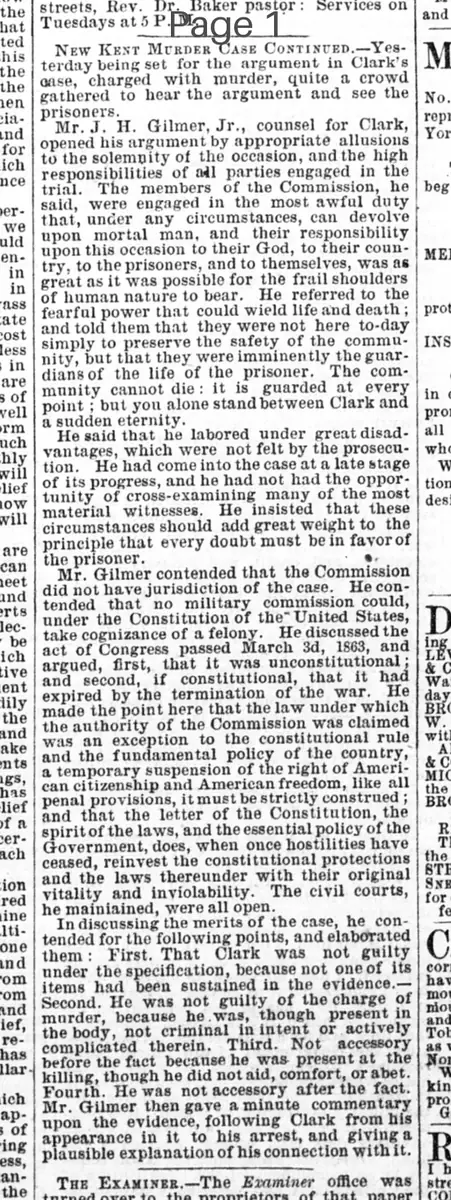
New Kent Murder Case Continued.—Yesterday being set for the argument in Clark's case, charged with murder, quite a crowd gathered to hear the argument and see the prisoners.
Mr. J. H. Gilmer, Jr., counsel for Clark, opened his argument by appropriate allusions to the solemnity of the occasion, and the high responsibilities of all parties engaged in the trial. The members of the Commission, he said, were engaged in the most awful duty that, under any circumstances, can devolve upon mortal man, and their responsibility upon this occasion to their God, to their country, to the prisoners, and to themselves, was as great as it was possible for the frail shoulders of human nature to bear. He referred to the fearful power that could wield life and death; and told them that they were not here to-day simply to preserve the safety of the community, but that they were eminently the guardians of the life of the prisoner. The community cannot die: it is guarded at every point; but you alone stand between Clark and a sudden eternity.
He said that he labored under great disadvantages, which were not felt by the prosecution. He had come into the case at a late stage of its progress, and he had not had the opportunity of cross-examining many of the most material witnesses. He insisted that these circumstances should add great weight to the principle that every doubt must be in favor of the prisoner.
Mr. Gilmer contended that the Commission did not have jurisdiction of the case. He contended that no military commission could, under the Constitution of the United States, take cognizance of a felony. He discussed the act of Congress passed March 3d, 1863, and argued, first, that it was unconstitutional; and second, if constitutional, that it had expired by the termination of the war. He made the point here that the law under which the authority of the Commission was claimed was an exception to the constitutional rule and the fundamental policy of the country, a temporary suspension of the right of American citizenship and American freedom, like all penal provisions, it must be strictly construed; and that the letter of the Constitution, the spirit of the laws, and the essential policy of the Government, does, when once hostilities have ceased, reinvest the constitutional protections and the laws thereunder with their original vitality and inviolability. The civil courts, he maintained, were all open.
In discussing the merits of the case, he contended for the following points, and elaborated them: First. That Clark was not guilty under the specification, because not one of its items had been sustained in the evidence. Second. He was not guilty of the charge of murder, because he was, though present in the body, not criminal in intent or actively complicated therein. Third. Not accessory before the fact because he was present at the killing, though he did not aid, comfort, or abet. Fourth. He was not accessory after the fact.
Mr. Gilmer then gave a minute commentary upon the evidence, following Clark from his appearance in it to his arrest, and giving a plausible explanation of his connection with it.
Mr. J. H. Gilmer, Jr., counsel for Clark, opened his argument by appropriate allusions to the solemnity of the occasion, and the high responsibilities of all parties engaged in the trial. The members of the Commission, he said, were engaged in the most awful duty that, under any circumstances, can devolve upon mortal man, and their responsibility upon this occasion to their God, to their country, to the prisoners, and to themselves, was as great as it was possible for the frail shoulders of human nature to bear. He referred to the fearful power that could wield life and death; and told them that they were not here to-day simply to preserve the safety of the community, but that they were eminently the guardians of the life of the prisoner. The community cannot die: it is guarded at every point; but you alone stand between Clark and a sudden eternity.
He said that he labored under great disadvantages, which were not felt by the prosecution. He had come into the case at a late stage of its progress, and he had not had the opportunity of cross-examining many of the most material witnesses. He insisted that these circumstances should add great weight to the principle that every doubt must be in favor of the prisoner.
Mr. Gilmer contended that the Commission did not have jurisdiction of the case. He contended that no military commission could, under the Constitution of the United States, take cognizance of a felony. He discussed the act of Congress passed March 3d, 1863, and argued, first, that it was unconstitutional; and second, if constitutional, that it had expired by the termination of the war. He made the point here that the law under which the authority of the Commission was claimed was an exception to the constitutional rule and the fundamental policy of the country, a temporary suspension of the right of American citizenship and American freedom, like all penal provisions, it must be strictly construed; and that the letter of the Constitution, the spirit of the laws, and the essential policy of the Government, does, when once hostilities have ceased, reinvest the constitutional protections and the laws thereunder with their original vitality and inviolability. The civil courts, he maintained, were all open.
In discussing the merits of the case, he contended for the following points, and elaborated them: First. That Clark was not guilty under the specification, because not one of its items had been sustained in the evidence. Second. He was not guilty of the charge of murder, because he was, though present in the body, not criminal in intent or actively complicated therein. Third. Not accessory before the fact because he was present at the killing, though he did not aid, comfort, or abet. Fourth. He was not accessory after the fact.
Mr. Gilmer then gave a minute commentary upon the evidence, following Clark from his appearance in it to his arrest, and giving a plausible explanation of his connection with it.
What sub-type of article is it?
Crime Story
Historical Event
What themes does it cover?
Crime Punishment
Justice
What keywords are associated?
Murder Trial
Legal Argument
Military Commission
Clark Case
New Kent Murder
What entities or persons were involved?
Clark
J. H. Gilmer, Jr.
Where did it happen?
New Kent
Story Details
Key Persons
Clark
J. H. Gilmer, Jr.
Location
New Kent
Story Details
Counsel J. H. Gilmer Jr. argues in defense of Clark, charged with murder, emphasizing the solemnity of the trial, disadvantages faced by the defense, lack of jurisdiction by the military commission post-war, and that evidence does not prove guilt under any specification or as accessory.