Thank you for visiting SNEWPapers!
Sign up free
Toledo Union Journal
Toledo, Lucas County, Ohio
What is this article about?
AFL-CIO research reports that wage incentive programs are declining in industry due to union efforts via collective bargaining, replacing them with hourly wages that maintain or increase pay without reducing productivity. Case studies from paper and potash industries illustrate successful transitions.
Clipping
OCR Quality
Full Text
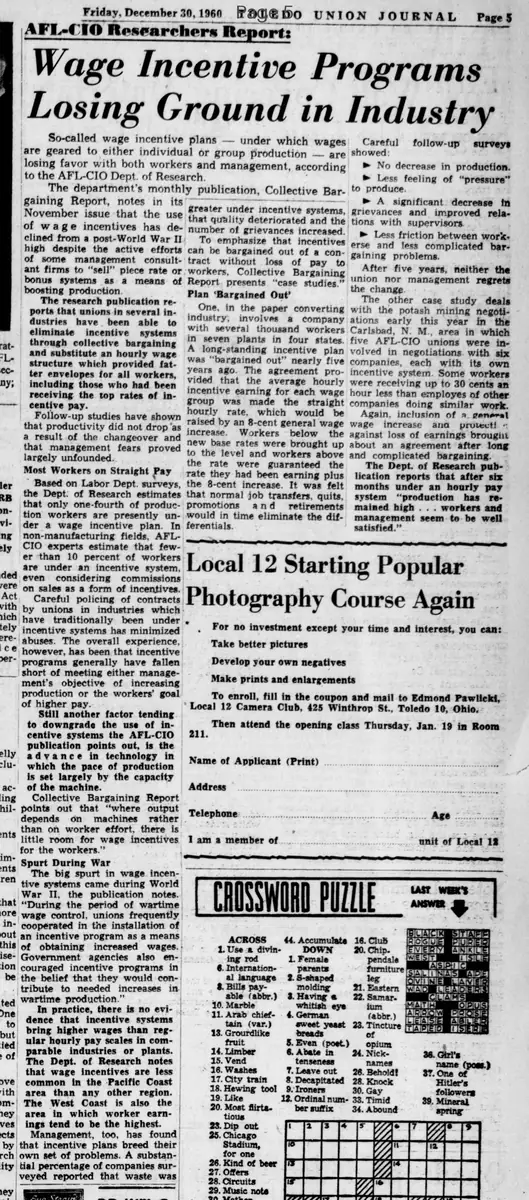
Wage Incentive Programs Losing Ground in Industry
So-called wage incentive plans - under which wages are geared to either individual or group production - are losing favor with both workers and management, according to the AFL-CIO Dept. of Research.
The department's monthly Collective Bargaining Report, notes in its November issue that the use of wage incentives has declined from a post-World War II high despite the active efforts of some management consultant firms to "sell" piece rate or bonus systems as a means of boosting production.
The research publication reports that unions in several industries have been able to eliminate incentive systems through collective bargaining and substitute an hourly wage structure which provided fatter envelopes for all workers, including those who had been receiving the top rates of incentive pay.
Follow-up studies have shown that productivity did not drop as a result of the changeover and that management fears proved largely unfounded.
Most Workers on Straight Pay
Based on Labor Dept. surveys, the Dept. of Research estimates that only one-fourth of production workers are presently under a wage incentive plan. In non-manufacturing fields, AFL-CIO experts estimate that fewer than 10 percent of workers are under an incentive system, even considering commissions on sales as a form of incentives.
Careful policing of contracts by unions in industries which have traditionally been under incentive systems has minimized abuses. The overall experience, however, has been that incentive programs generally have fallen short of meeting either management's objective of increasing production or the workers' goal of higher pay.
Still another factor tending to downgrade the use of incentive systems the AFL-CIO publication points out, is the advance in technology in which the pace of production is set largely by the capacity of the machine.
Collective Bargaining Report points out that "where output depends on machines rather than on worker effort, there is little room for wage incentives for the workers."
Spurt During War
The big spurt in wage incentive systems came during World War II, the publication notes. "During the period of wartime wage control, unions frequently cooperated in the installation of an incentive program as a means of obtaining increased wages. Government agencies also encouraged incentive programs in the belief that they would contribute to needed increases in wartime production.
In practice, there is no evidence that incentive systems bring higher wages than regular hourly pay scales in comparable industries or plants. The Dept. of Research notes that wage incentives are less common in the Pacific Coast area than any other region. The West Coast is also the area in which worker earnings tend to be the highest.
Management, too, has found that incentive plans breed their own set of problems. A substantial percentage of companies surveyed reported that waste was greater under incentive systems, that quality deteriorated and the number of grievances increased.
To emphasize that incentives can be bargained out of a contract without loss of pay to workers, Collective Bargaining Report presents "case studies."
Plan 'Bargained Out'
One, in the paper converting industry, involves a company with several thousand workers in seven plants in four states. A long-standing incentive plan was "bargained out" nearly five years ago. The agreement provided that the average hourly incentive earning for each wage group was made the straight hourly rate, which would be raised by an 8-cent general wage increase. Workers below the new base rates were brought up to the level and workers above the rate were guaranteed the rate they had been earning plus the 8-cent increase. It was felt that normal job transfers, quits, promotions and retirements would in time eliminate the differentials.
Case studies, Collective Bargaining Report: greater under incentive systems, that quality deteriorated and the number of grievances increased.
Careful follow-up surveys showed:
No decrease in production.
Less feeling of "pressure" to produce.
A significant decrease in grievances and improved relations with supervisors
Less friction between workers and less complicated bargaining problems.
After five years, neither the union nor management regrets the change.
The other case study deals with the potash mining negotiations early this year in the Carlsbad, N. M., area in which five AFL-CIO unions were involved in negotiations with six companies, each with its own incentive system. Some workers were receiving up to 30 cents an hour less than employees of other companies doing similar work.
Again, inclusion of a general wage increase and protection against loss of earnings brought about an agreement after long and complicated bargaining.
The Dept. of Research publication reports that after six months under an hourly pay system "production has remained high . . . workers and management seem to be well satisfied."
What sub-type of article is it?
What keywords are associated?
What entities or persons were involved?
Where did it happen?
Story Details
Key Persons
Location
United States, Pacific Coast, Carlsbad N.M.
Event Date
November Issue, Post World War Ii
Story Details
AFL-CIO reports decline in wage incentive plans due to union bargaining for hourly wages, maintaining productivity and satisfaction; case studies in paper industry (five years ago) and potash mining (early this year) show successful transitions without pay loss.