Thank you for visiting SNEWPapers!
Sign up free
Alexandria Gazette & Advertiser
Alexandria, Virginia
What is this article about?
A pseudonymous letter criticizes Thomas Jefferson's July 2, 1822, letter to Mr. Barry for reviving party animosities, questioning judicial independence, and attacking the Supreme Court, arguing it harms national unity and Jefferson's legacy.
Merged-components note: These two components form a single continuous letter to the editor criticizing Mr. Jefferson's views.
Clipping
OCR Quality
Full Text
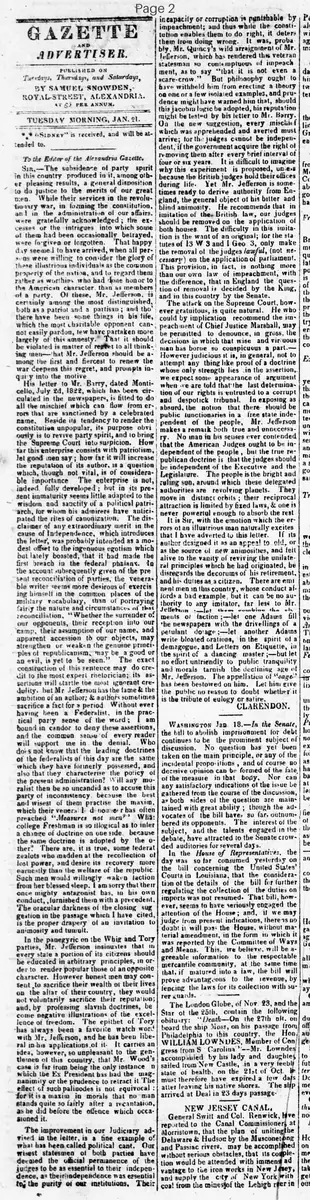
SIR,--The subsidence of party spirit in this country produced in it, among other pleasing results, a general disposition to do justice to the merits of our great men. While their services in the revolutionary war, in forming the constitution, and in the administration of our affairs, were gratefully acknowledged; the excesses or the intrigues into which some of them had been occasionally betrayed were forgiven or forgotten. That happy day seemed to have arrived, when all persons were willing to consider the glory of these illustrious individuals as the common property of the nation, and to regard them rather as worthies who had done honor to the American character, than as members of a party. Of these, Mr. Jefferson, is certainly among the most distinguished, both as a patriot and a partisan; and though there have been some things in his life, which the most charitable opponent cannot easily pardon, few have partaken more largely of this amnesty. That it should be violated is matter of regret to all thinking men--but Mr. Jefferson should be among the first and fiercest to renew the war deepens this regret! and prompts inquiry into the motive
His letter to Mr. Barry, dated Monticello, July 2d. 1822, which has been circulated in the newspapers, is fitted to do all the mischief which can flow from errors that are sanctioned by a celebrated name. Beside its tendency to render the constitution unpopular, its purpose obviously is to revive party spirit, and to bring the Supreme Court into suspicion. How far this enterprise consists with patriotism, let good men say: how far it will increase the reputation of its author, is a question which, though not vital, is of considerable importance The enterprise is not, indeed, fully developed; but in its present immaturity seems little adapted to the wisdom and sanctity of a political patriarch, for whom his admirers have anticipated the rites of canonization. The disclaimer of any extraordinary merit in the cause of Independence, which introduces the letter, was probably intended as a modest offset to the ingenuous egotism which but lately boasted, that it had made the first breach in the federal phalanx. in the account subsequently given of the present reconciliation of parties, the venerable writer seems more desirous of exercising himself in the common places of the military vocabulary, than of portraying fairly the nature and circumstances of that reconciliation. "Whether the surrender of our opponents, their reception into our camp, their assumption of our name, and apparent accession to our objects, may strengthen or weaken the genuine principles of republicanism, may be a good or an evil, is yet to be seen." The exact construction of this sentence may do credit to the most expert rhetorician; its assertions will startle the most ignorant credulity, but Mr Jefferson has the fame & the ambition of an author; & authors sometimes sacrifice a fact for a period. Without ever having been a Federalist, in the practical party sense of the word;
I am bound in candor to deny these assertions, and the common sense of every reader will support me in the denial. Who does not know that the leading doctrines of the federalists of this day are the same which they have formerly possessed, and also that they characterise the policy of the present administration? Will any moralist then be so uncandid as to accuse this party of inconsistency, because the best and wisest of them practise the maxim, which their venerable doyen has often preached "Measures not men?" What college Freshman is so illogical as to infer a change of doctrine on one side, because the same doctrine is adopted by the other. There are, it is true, some federal zealots who madden at the recollection of lost power, and desire its recovery more earnestly than the welfare of the republic. Such men would willingly waken faction from her blessed sleep. I am sorry that they once mighty antagonist has, in his own conduct, furnished them with a precedent. The oracular darkness of the closing suggestion in the passage which I have cited, is the proper drapery of an invitation to animosity and tumult.
In the panegyric on the Whig and Tory parties, Mr. Jefferson insinuates that in every state a portion of its citizens should be educated in arbitrary principles, in order to render popular those of an opposite character. However honest men may consent to sacrifice their wealth or their lives on the altar of their country, they would not voluntarily sacrifice their reputation; and, by professing slavish doctrines, become negative illustrations of the excellence of freedom. The epithet of Tory has always been a favorite watch word with Mr. Jefferson, and he has been liberal in his applications of it. It carries an idea, however, so unpleasant to the gentlemen of this country, that Mr. Wood's case is far from being the only instance in which the Ex-President has had the magnanimity or the prudence to retract it The effect of such palinodes is not equivocal: for it is a maxim in morals that no man stands quite so fairly after a recantation, as he did before the offence which occasioned it.
The improvement in our Judiciary adverted to in the letter, is a fine example of what has been called political cant. Our wisest statesmen of both parties have deemed the official permanence of the judges to be as essential to their independence, as their independence was essential to the purity of our institutions. Their
incapacity or corruption is punishable by impeachment; and thus while the constitution enables them to do right, it deters them from doing wrong. It was, probably, Mr. Quincy's wild arraignment of Mr. Jefferson, which has rendered this veteran statesman so contemptuous of impeachment, as to say "that it is not even a scare-crow."
But philosophy ought to have withheld him from erecting a theory on one or a few isolated examples, and prudence might have warned him that, should this jacobin logic be adopted, his reputation might be tested by his letter to Mr. Barry.
On the new suggestion, every mischief which was apprehended and averted must arrive; for the judges cannot be independent, if the government acquire the right of removing them after every brief interval of four or six years. It is difficult to imagine why this experiment is proposed, unless because the British judges hold their offices during life. Yet Mr. Jefferson is sometimes ready to derive authority from England, the general object of his bitter and blind animosity. He recommends that in imitation of the British law, our judges should be removed on the application of both houses. The difficulty in this imitation is the want of an original; for the statutes of 13 W 3 and I Geo 3, only make the removal of the judges lawful, (not necessary) on the application of parliament. This provision, in fact, is nothing more than our own law of impeachment, with the difference, that in England the question of removal is decided by the King, and in this country by the Senate.
The attack on the Supreme Court, however gratuitous, is quite natural. He who could by implication recommend the impeachment of Chief Justice Marshall, may be permitted to denounce, in gross, the decisions in which that wise and virtuous man has borne so conspicuous a part.
However judicious it is, in general, not to attempt any thing like proof of a doctrine whose only strength lies, in the assertion, we expect some appearance of argument when we are told that the last determination of our rights is entrusted to a corrupt and despotick tribunal. In exposing as absurd, the notion that there should be public functionaries in a free state independent of the people, Mr. Jefferson makes a remark both true and unnecessary. No man in his senses ever contended that the American Judges ought to be independent of the people, but the true republican doctrine is that the judges should be independent of the Executive and the Legislature. The people is the bright and ruling sun, around which these delegated authorities are revolving planets. They move in distinct orbits: their reciprocal attraction is limited by fixed laws, & one is never powerful enough to absorb the rest
It is Sir, with the emotion which the errors of an illustrious man naturally excites that I have adverted to this letter. If its author designed it as an appeal to old, or as the source of new animosities, and felt alive to the vanity of reviving the unilateral principles which he had originated, he disregards the decorums of his retirement, and his duties as a citizen. There are eminent men in this country, whose conduct affords a bad example, but it can be no authority to any imitator, far less to Mr. Jefferson:--let
them, combining the elements of faction;--let one Adams fill the newspapers with the drivellings of a petulant dotage;--let another Adams write bloated orations, in the spirit of a demagogue, and Letters on Etiquette, in the spirit of a dancing master; but let no effort unfriendly to public tranquility and morals tarnish the declining age of Mr. Jefferson. The appellation of "sage" has been bestowed on him. Let him give the public no reason to doubt whether it is the tribute of eulogy or satire.
CLARENDON.
What sub-type of article is it?
What themes does it cover?
What keywords are associated?
What entities or persons were involved?
Letter to Editor Details
Author
Clarendon.
Recipient
The Editor Of The Alexandria Gazette
Main Argument
thomas jefferson's letter to mr. barry revives partisan divisions, undermines judicial independence and the supreme court, and proposes unwise changes to the judiciary, which is unbecoming of his stature and harmful to the nation.
Notable Details