Thank you for visiting SNEWPapers!
Sign up free
Story
October 29, 1898
Yorkville Enquirer
York, York County, South Carolina
What is this article about?
Article from San Francisco Chronicle describes how smokeless powder is manufactured using old cotton garments like white shirts, sourced in large quantities for a one-million-pound order. Details historical discoveries from 1838 by Pelouse and Knop, production at Pinole works, and safety handling of the explosive material.
Clipping
OCR Quality
95%
Excellent
Full Text
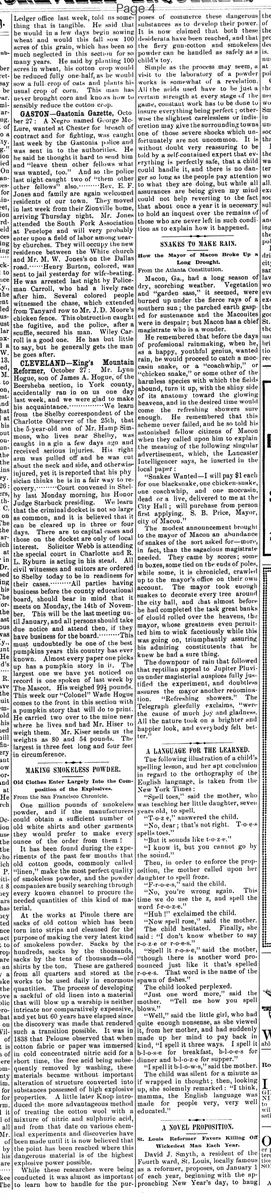
MAKING SMOKELESS POWDER.
Old Clothes Enter Largely Into the Composition of the Explosives.
From the San Francisco Chronicle.
One million pounds of smokeless powder, and if the manufacturers could obtain a sufficient number of old white shirts and other garments they would prefer to make every ounce of the order from them!
It has been found during the experiments of the past few months that old cotton goods, commonly called "linen," make the most perfect quality of smokeless powder, and the powder companies are busily searching through every known channel to procure the needed quantities of this kind of material.
At the works at Pinole there are sacks of old cotton which has been torn into strips and cleansed for the purpose of making the very latest kind of smokeless powder. Sacks by the hundreds, sacks by the thousands sacks by the tens of thousands-old shirts by the ton. These are gathered from all quarters and stored at the works to be used daily in enormous quantities. The process of developing a sackful of old linen into a material that will blow up a warship is neither intricate nor comparatively expensive. and yet but 60 years have elapsed since the discovery was made that rendered such a transition possible. It was in 1838 that Pelouse observed that when cotton fabric or paper was immersed in cold concentrated nitric acid for a short time, the free acid being subsequently removed by washing, these materials became without important alteration of structure converted into substances possessed of high explosive properties. A little later Knop introduced the more advantageous method of treating the cotton wool with a mixture of nitric and sulphuric acid, and from that date on various chemical experiments and discoveries have been made until it is now believed that the point has been reached where this dangerous material is of the highest explosive power possible.
While these researches were being conducted it was almost as important to learn how to handle for the purposes of commerce these dangerous substances as to develop their power. It is now claimed that both these desiderata have been reached, and that the fiery gun-cotton and smokeless powder can be handled as safely as a child's toy.
Simple as the process may seem, a visit to the laboratory of a powder works is somewhat of a revolution. All the acids used have to be just a certain strength at every stage of the game, constant work has to be done to insure everything being perfect; otherwise the slightest carelessness or indiscretion may give the surrounding towns one of those severe shocks which unfortunately are not uncommon. It is without doubt very reassuring to be told by a self-contained expert that everything is perfectly safe, that a child could handle it, and there is no danger so long as the people pay attention to what they are doing, but while all assurances are being given my mind could not help reverting to the fact that about once a year it is necessary to hold an inquest over the remains of those who are never left in such condition as to explain how it happened.
Old Clothes Enter Largely Into the Composition of the Explosives.
From the San Francisco Chronicle.
One million pounds of smokeless powder, and if the manufacturers could obtain a sufficient number of old white shirts and other garments they would prefer to make every ounce of the order from them!
It has been found during the experiments of the past few months that old cotton goods, commonly called "linen," make the most perfect quality of smokeless powder, and the powder companies are busily searching through every known channel to procure the needed quantities of this kind of material.
At the works at Pinole there are sacks of old cotton which has been torn into strips and cleansed for the purpose of making the very latest kind of smokeless powder. Sacks by the hundreds, sacks by the thousands sacks by the tens of thousands-old shirts by the ton. These are gathered from all quarters and stored at the works to be used daily in enormous quantities. The process of developing a sackful of old linen into a material that will blow up a warship is neither intricate nor comparatively expensive. and yet but 60 years have elapsed since the discovery was made that rendered such a transition possible. It was in 1838 that Pelouse observed that when cotton fabric or paper was immersed in cold concentrated nitric acid for a short time, the free acid being subsequently removed by washing, these materials became without important alteration of structure converted into substances possessed of high explosive properties. A little later Knop introduced the more advantageous method of treating the cotton wool with a mixture of nitric and sulphuric acid, and from that date on various chemical experiments and discoveries have been made until it is now believed that the point has been reached where this dangerous material is of the highest explosive power possible.
While these researches were being conducted it was almost as important to learn how to handle for the purposes of commerce these dangerous substances as to develop their power. It is now claimed that both these desiderata have been reached, and that the fiery gun-cotton and smokeless powder can be handled as safely as a child's toy.
Simple as the process may seem, a visit to the laboratory of a powder works is somewhat of a revolution. All the acids used have to be just a certain strength at every stage of the game, constant work has to be done to insure everything being perfect; otherwise the slightest carelessness or indiscretion may give the surrounding towns one of those severe shocks which unfortunately are not uncommon. It is without doubt very reassuring to be told by a self-contained expert that everything is perfectly safe, that a child could handle it, and there is no danger so long as the people pay attention to what they are doing, but while all assurances are being given my mind could not help reverting to the fact that about once a year it is necessary to hold an inquest over the remains of those who are never left in such condition as to explain how it happened.
What sub-type of article is it?
Curiosity
Historical Event
What themes does it cover?
Triumph
Misfortune
What keywords are associated?
Smokeless Powder
Old Cotton
Explosives
Pinole Works
Nitric Acid
Historical Discovery
What entities or persons were involved?
Pelouse
Knop
Where did it happen?
Pinole
Story Details
Key Persons
Pelouse
Knop
Location
Pinole
Event Date
1838
Story Details
Manufacturers produce one million pounds of smokeless powder from old cotton garments like white shirts, torn into strips and treated with acids. Discovery in 1838 by Pelouse of nitric acid treatment, improved by Knop with mixed acids, leading to safe handling despite risks.