Thank you for visiting SNEWPapers!
Sign up free
Story
December 25, 1828
The Litchfield County Post
Litchfield, Litchfield County, Connecticut
What is this article about?
Vivid historical account of George Washington's daring nighttime crossing of the Delaware River and surprise attack on Hessian troops at Trenton in 1776, boosting American morale through heroic leadership and victory in harsh winter conditions.
Clipping
OCR Quality
98%
Excellent
Full Text
BATTLE OF TRENTON.
The following description will probably be new to most of our readers. Its vivid details, although extracted from a work of fiction, are agreeable to the truth of history. An event that raised the drooping confidence and courage of those who fought and prayed for our cause, which before had assumed an appearance almost desperate.
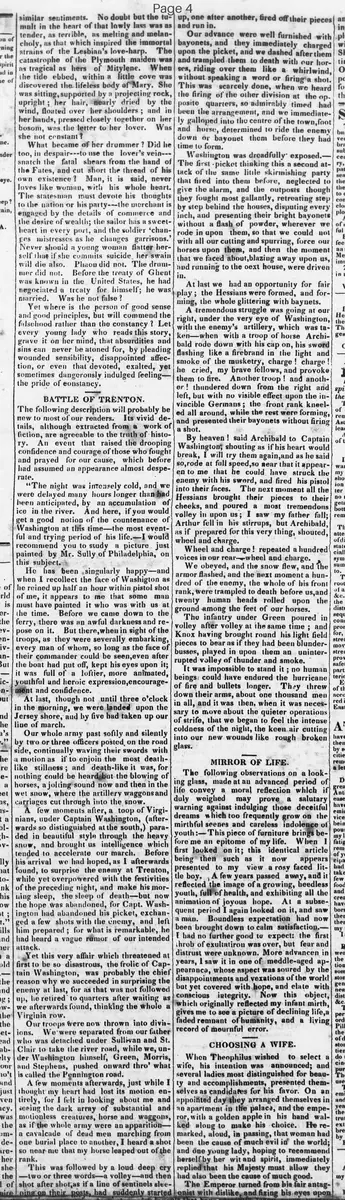
"The night was intensely cold, and we were delayed many hours longer than had been anticipated, by an accumulation of ice in the river. And here, if you would get a good notion of the countenance of Washington at this time-the most eventful and trying period of his life.-I would recommend you to study a picture just painted by Mr. Sully of Philadelphia, on this subject. He has been singularly happy-and when I recollect the face of Washington as he reined up half an hour within pistol shot of me, it appears to me that some man must have painted it who was with us at the time. Before we came down to the ferry, there was an awful darkness and repose on it. But there, when in sight of the troops, as they were severally embarking, every man of whom, so long as the face of their commander could be seen, even after the boat had put off, kept his eyes upon it; it was full of a loftier, more animated, youthful and heroic expression, encouragement and confidence. At last, though not until three o'clock in the morning, we were landed upon the Jersey shore, and by five had taken up our line of march. Our whole army passed softly and silently by two or three officers posted on the road side, continually waving their swords with a motion as if to enjoin the most death-like stillness; and death-like it was, for nothing could be heard but the blowing of horses, a jolting sound now and then in the wet snow, where the artillery waggons and carriages cut through into the snow. A few moments after, a troop of Virginians, under Captain Washington, (afterwards so distinguished at the south,) paraded in beautiful style through the heavy snow, and brought us intelligence which tended to accelerate our march. Before his arrival we had hoped, as I afterwards found, to surprise the enemy at Trenton, while yet overpowered with the festivities of the preceding night, and make his morning sleep, the sleep of death-but now the hope was abandoned, for Capt. Washington had abandoned his picket, exchanged a few shots with the enemy, and left him prepared; for what is remarkable, he had heard a vague rumor of our intended attack. Yet this very affair which threatened at first to be so disastrous, the frolic of Captain Washington, was probably the chief reason why we succeeded in surprising the enemy at last, for as that was not followed up, he retired to quarters after waiting, as we afterwards found, thinking the whole a Virginia row. Our troops were now thrown into divisions. We were separated from our father who was detached under Sullivan and St. Clair to take the river road, while we, under Washington himself, Green, Mercer, and Stephens, pushed onward thro' what is called the Pennington road. A few moments afterwards, just while I thought my heart had lost its motion entirely, for I felt in looking about me and seeing the dark array of substantial and motionless creatures, horse and waggons, as if the whole army were an apparition-a cavalcade of dead men marching from one burial place to another, I heard a shot so near me that my horse leaped out of the rank. This was followed by a loud deep cry -two or three words-a volley-and then shot after shot as if a line of sentinels sleeping up, one after another, fired off their pieces and run in. Our advance were well furnished with bayonets, and they immediately charged upon the picket, and we dashed after them and trampled them to death with our horses, riding over them like a whirlwind, without speaking a word or firing a shot. This was scarcely done, when we heard the firing of the other division at the opposite quarters, so admirably timed had been the arrangement, and we immediately galloped into the centre of the town, foot and horse, determined to ride the enemy down or bayonet them before they had time to form. Washington was dreadfully exposed.— The first picket thinking this a second attack of the same little skirmishing party that fired into them before, neglected to give the alarm, and the outposts though they fought most gallantly, retreating step by step behind the houses, disputing every inch, and presenting their bright bayonets without a flash of powder, wherever we rode in upon them, so that we could not with all our cutting and spurring, force our horses upon them, and then the moment that we faced about, blazing away upon us, and running to the next house, were driven in. At last we had an opportunity for fair play; the Hessians were formed, and forming, the whole glittering with bayonets. A tremendous struggle was going at our right, under the very eye of Washington, with the enemy's artillery, which was taken-when with a troop of horse Archibald rode down with his cap on, his sword flashing like a firebrand in the light and smoke of the musketry, charge! charge! he cried, my brave fellows, and provoke them to fire. Another troop! and another! thundered down from the right and left, but with no visible effect upon the invincible Germans; the front rank kneeled all around, while the rest were forming, and presented their bayonets without firing a shot. By heaven! said Archibald to Captain Washington, shouting as if his heart would break, I will try them again, and as he said so, rode at full speed, so near that it appeared to me that he could have struck the enemy with his sword, and fired his pistol into their faces. The next moment all the Hessians brought their pieces to their cheeks, and poured a most tremendous volley in upon us; I saw my father fall: Arthur fell in his stirrups, but Archibald, as if prepared for this very thing, shouted. wheel and charge. Wheel and charge! repeated a hundred voices in our rear--wheel and charge. We obeyed, and the snow flew, and the armor flashed, and the next moment a hundred of the enemy, the whole of his front rank, were trampled to death before us, and twenty human heads rolled upon the ground among the feet of our horses. The infantry under Green poured in volley after volley at the same time; and Knox having brought round his light field pieces to bear as if they had been blunderbusses, played in upon them an uninterrupted volley of thunder and smoke. It was impossible to stand it; no human beings, could have endured the hurricane of fire and bullets longer. They threw down their arms, about one thousand men in all, and it was then, when it was necessary to move about the quieter operations of strife, that we began to feel the intense coldness of the night, the keen air cutting into our new wounds like rough broken glass.
The following description will probably be new to most of our readers. Its vivid details, although extracted from a work of fiction, are agreeable to the truth of history. An event that raised the drooping confidence and courage of those who fought and prayed for our cause, which before had assumed an appearance almost desperate.
"The night was intensely cold, and we were delayed many hours longer than had been anticipated, by an accumulation of ice in the river. And here, if you would get a good notion of the countenance of Washington at this time-the most eventful and trying period of his life.-I would recommend you to study a picture just painted by Mr. Sully of Philadelphia, on this subject. He has been singularly happy-and when I recollect the face of Washington as he reined up half an hour within pistol shot of me, it appears to me that some man must have painted it who was with us at the time. Before we came down to the ferry, there was an awful darkness and repose on it. But there, when in sight of the troops, as they were severally embarking, every man of whom, so long as the face of their commander could be seen, even after the boat had put off, kept his eyes upon it; it was full of a loftier, more animated, youthful and heroic expression, encouragement and confidence. At last, though not until three o'clock in the morning, we were landed upon the Jersey shore, and by five had taken up our line of march. Our whole army passed softly and silently by two or three officers posted on the road side, continually waving their swords with a motion as if to enjoin the most death-like stillness; and death-like it was, for nothing could be heard but the blowing of horses, a jolting sound now and then in the wet snow, where the artillery waggons and carriages cut through into the snow. A few moments after, a troop of Virginians, under Captain Washington, (afterwards so distinguished at the south,) paraded in beautiful style through the heavy snow, and brought us intelligence which tended to accelerate our march. Before his arrival we had hoped, as I afterwards found, to surprise the enemy at Trenton, while yet overpowered with the festivities of the preceding night, and make his morning sleep, the sleep of death-but now the hope was abandoned, for Capt. Washington had abandoned his picket, exchanged a few shots with the enemy, and left him prepared; for what is remarkable, he had heard a vague rumor of our intended attack. Yet this very affair which threatened at first to be so disastrous, the frolic of Captain Washington, was probably the chief reason why we succeeded in surprising the enemy at last, for as that was not followed up, he retired to quarters after waiting, as we afterwards found, thinking the whole a Virginia row. Our troops were now thrown into divisions. We were separated from our father who was detached under Sullivan and St. Clair to take the river road, while we, under Washington himself, Green, Mercer, and Stephens, pushed onward thro' what is called the Pennington road. A few moments afterwards, just while I thought my heart had lost its motion entirely, for I felt in looking about me and seeing the dark array of substantial and motionless creatures, horse and waggons, as if the whole army were an apparition-a cavalcade of dead men marching from one burial place to another, I heard a shot so near me that my horse leaped out of the rank. This was followed by a loud deep cry -two or three words-a volley-and then shot after shot as if a line of sentinels sleeping up, one after another, fired off their pieces and run in. Our advance were well furnished with bayonets, and they immediately charged upon the picket, and we dashed after them and trampled them to death with our horses, riding over them like a whirlwind, without speaking a word or firing a shot. This was scarcely done, when we heard the firing of the other division at the opposite quarters, so admirably timed had been the arrangement, and we immediately galloped into the centre of the town, foot and horse, determined to ride the enemy down or bayonet them before they had time to form. Washington was dreadfully exposed.— The first picket thinking this a second attack of the same little skirmishing party that fired into them before, neglected to give the alarm, and the outposts though they fought most gallantly, retreating step by step behind the houses, disputing every inch, and presenting their bright bayonets without a flash of powder, wherever we rode in upon them, so that we could not with all our cutting and spurring, force our horses upon them, and then the moment that we faced about, blazing away upon us, and running to the next house, were driven in. At last we had an opportunity for fair play; the Hessians were formed, and forming, the whole glittering with bayonets. A tremendous struggle was going at our right, under the very eye of Washington, with the enemy's artillery, which was taken-when with a troop of horse Archibald rode down with his cap on, his sword flashing like a firebrand in the light and smoke of the musketry, charge! charge! he cried, my brave fellows, and provoke them to fire. Another troop! and another! thundered down from the right and left, but with no visible effect upon the invincible Germans; the front rank kneeled all around, while the rest were forming, and presented their bayonets without firing a shot. By heaven! said Archibald to Captain Washington, shouting as if his heart would break, I will try them again, and as he said so, rode at full speed, so near that it appeared to me that he could have struck the enemy with his sword, and fired his pistol into their faces. The next moment all the Hessians brought their pieces to their cheeks, and poured a most tremendous volley in upon us; I saw my father fall: Arthur fell in his stirrups, but Archibald, as if prepared for this very thing, shouted. wheel and charge. Wheel and charge! repeated a hundred voices in our rear--wheel and charge. We obeyed, and the snow flew, and the armor flashed, and the next moment a hundred of the enemy, the whole of his front rank, were trampled to death before us, and twenty human heads rolled upon the ground among the feet of our horses. The infantry under Green poured in volley after volley at the same time; and Knox having brought round his light field pieces to bear as if they had been blunderbusses, played in upon them an uninterrupted volley of thunder and smoke. It was impossible to stand it; no human beings, could have endured the hurricane of fire and bullets longer. They threw down their arms, about one thousand men in all, and it was then, when it was necessary to move about the quieter operations of strife, that we began to feel the intense coldness of the night, the keen air cutting into our new wounds like rough broken glass.
What sub-type of article is it?
Historical Event
Military Action
Heroic Act
What themes does it cover?
Bravery Heroism
Triumph
Fortune Reversal
What keywords are associated?
Battle Of Trenton
Delaware Crossing
Washington Leadership
Hessian Defeat
Surprise Attack
Revolutionary War
American Victory
What entities or persons were involved?
Washington
Captain Washington
Archibald
Sullivan
St. Clair
Green
Mercer
Stephens
Knox
Where did it happen?
Trenton, New Jersey
Story Details
Key Persons
Washington
Captain Washington
Archibald
Sullivan
St. Clair
Green
Mercer
Stephens
Knox
Location
Trenton, New Jersey
Event Date
The Night Of The Crossing, 1776
Story Details
Washington's army crosses the icy Delaware River at night, delayed by ice, lands on the Jersey shore, marches silently through snow to surprise Hessian forces at Trenton. They engage pickets, charge into town, defeat the enemy in close combat, capture about one thousand men despite intense cold.