Thank you for visiting SNEWPapers!
Sign up free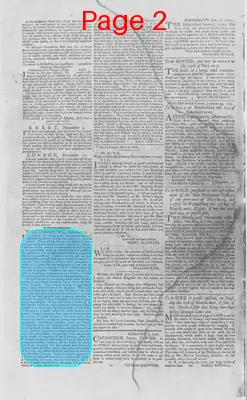
Editorial
February 2, 1769
The Virginia Gazette
Williamsburg, Virginia
What is this article about?
An anonymous editorial in Williamsburg critiques the influx of overly flattering addresses to the newly arrived Governor, likening them to insincere historical tributes to English monarchs like Cromwell, Charles II, and William III, dismissing them as cheap 'lip-loyalty' that free men should avoid.
Clipping
OCR Quality
98%
Excellent
Full Text
WILLIAMSBURG. February 2.
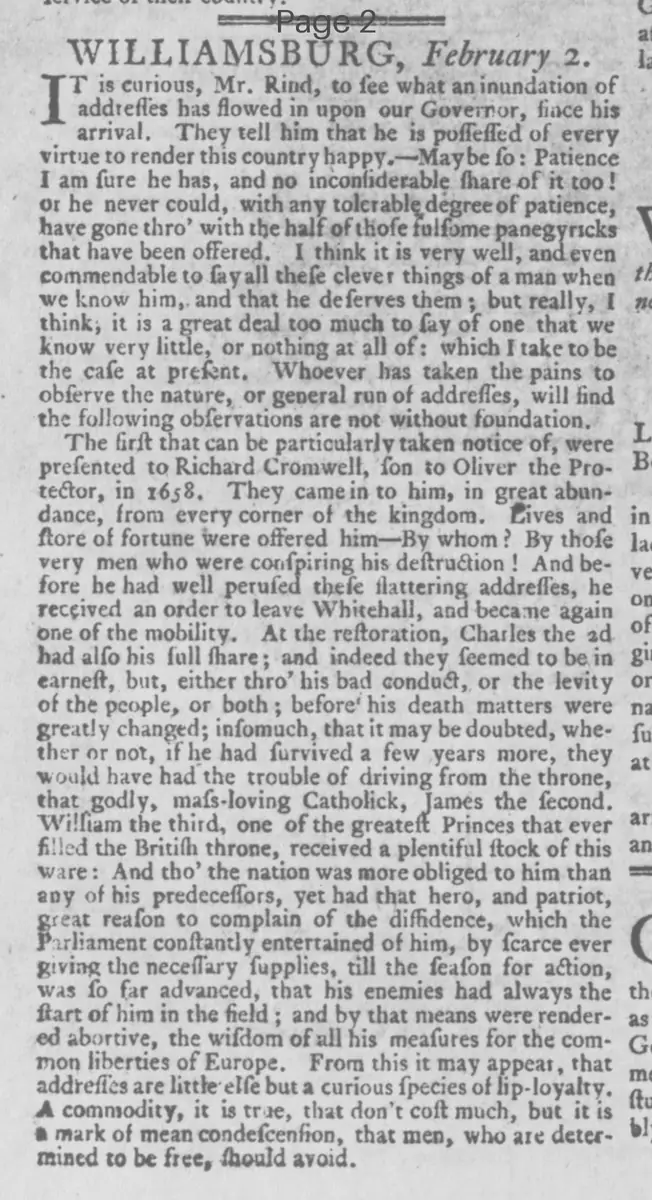
It is curious, Mr. Rind, to see what an inundation of addresses has flowed in upon our Governor, since his arrival. They tell him that he is possessed of every virtue to render this country happy.—Maybe so: Patience I am sure he has, and no inconsiderable share of it too! or he never could, with any tolerable degree of patience, have gone thro' with the half of those fulsome panegyrics that have been offered. I think it is very well, and even commendable to say all these clever things of a man when we know him, and that he deserves them; but really, I think, it is a great deal too much to say of one that we know very little, or nothing at all of: which I take to be the case at present. Whoever has taken the pains to observe the nature, or general run of addresses, will find the following observations are not without foundation.
The first that can be particularly taken notice of, were presented to Richard Cromwell, or to Oliver the Protector, in 1658. They came in to him, in great abundance, from every corner of the kingdom. Lives and store of fortune were offered him—By whom? By those very men who were conspiring his destruction! And before he had well perused these flattering addresses, he received an order to leave Whitehall, and became again one of the mobility. At the restoration, Charles the 2d had also his full share: and indeed they seemed to be in earnest, but, either thro' his bad conduct, or the levity of the people, or both; before his death matters were greatly changed; insomuch, that it may be doubted, whether or not, if he had survived a few years more, they would have had the trouble of driving from the throne, that godly, mass-loving Catholic, James the second.
William the third, one of the greatest Princes that ever filled the British throne, received a plentiful stock of this ware: And tho' the nation was more obliged to him than any of his predecessors, yet had that hero, and patriot, great reason to complain of the diffidence, which the Parliament constantly entertained of him, by scarce ever giving the necessary supplies, till the season for action, was so far advanced, that his enemies had always the start of him in the field: and by that means were rendered abortive, the wisdom of all his measures for the common liberties of Europe. From this it may appear, that addresses are little else but a curious species of lip-loyalty. A commodity, it is true, that don't cost much, but it is mark of mean condescension, that men, who are determined to be free, should avoid.
It is curious, Mr. Rind, to see what an inundation of addresses has flowed in upon our Governor, since his arrival. They tell him that he is possessed of every virtue to render this country happy.—Maybe so: Patience I am sure he has, and no inconsiderable share of it too! or he never could, with any tolerable degree of patience, have gone thro' with the half of those fulsome panegyrics that have been offered. I think it is very well, and even commendable to say all these clever things of a man when we know him, and that he deserves them; but really, I think, it is a great deal too much to say of one that we know very little, or nothing at all of: which I take to be the case at present. Whoever has taken the pains to observe the nature, or general run of addresses, will find the following observations are not without foundation.
The first that can be particularly taken notice of, were presented to Richard Cromwell, or to Oliver the Protector, in 1658. They came in to him, in great abundance, from every corner of the kingdom. Lives and store of fortune were offered him—By whom? By those very men who were conspiring his destruction! And before he had well perused these flattering addresses, he received an order to leave Whitehall, and became again one of the mobility. At the restoration, Charles the 2d had also his full share: and indeed they seemed to be in earnest, but, either thro' his bad conduct, or the levity of the people, or both; before his death matters were greatly changed; insomuch, that it may be doubted, whether or not, if he had survived a few years more, they would have had the trouble of driving from the throne, that godly, mass-loving Catholic, James the second.
William the third, one of the greatest Princes that ever filled the British throne, received a plentiful stock of this ware: And tho' the nation was more obliged to him than any of his predecessors, yet had that hero, and patriot, great reason to complain of the diffidence, which the Parliament constantly entertained of him, by scarce ever giving the necessary supplies, till the season for action, was so far advanced, that his enemies had always the start of him in the field: and by that means were rendered abortive, the wisdom of all his measures for the common liberties of Europe. From this it may appear, that addresses are little else but a curious species of lip-loyalty. A commodity, it is true, that don't cost much, but it is mark of mean condescension, that men, who are determined to be free, should avoid.
What sub-type of article is it?
Satire
Partisan Politics
Moral Or Religious
What keywords are associated?
Governor Addresses
Political Flattery
Lip Loyalty
Historical Precedents
Colonial Sycophancy
English Monarchs
Williamsburg Editorial
What entities or persons were involved?
Governor
Mr. Rind
Richard Cromwell
Oliver Cromwell
Charles Ii
James Ii
William Iii
Editorial Details
Primary Topic
Critique Of Flattering Addresses To The Governor
Stance / Tone
Satirical And Skeptical Of Sycophantic Flattery
Key Figures
Governor
Mr. Rind
Richard Cromwell
Oliver Cromwell
Charles Ii
James Ii
William Iii
Key Arguments
Addresses To The Governor Are Premature And Overly Fulsome Given Lack Of Knowledge About Him
Historical Addresses To Cromwell Were From Conspirators Against Him
Charles Ii Received Addresses But Lost Support Due To Conduct Or Public Levity
Even William Iii Faced Parliamentary Distrust Despite Obligations To Him
Addresses Represent Insincere 'Lip Loyalty' That Free Men Should Avoid