Thank you for visiting SNEWPapers!
Sign up free
Story
July 28, 1897
The Dawson News
Dawson, Terrell County, Georgia
What is this article about?
Thomas E. Watson details the 1896 U.S. presidential campaign, accusing Populist leader Marion Butler of fusing with Democrats, betraying party principles for personal gain, and claiming he was offered a cabinet post to join, leading to the party's collapse.
Clipping
OCR Quality
98%
Excellent
Full Text
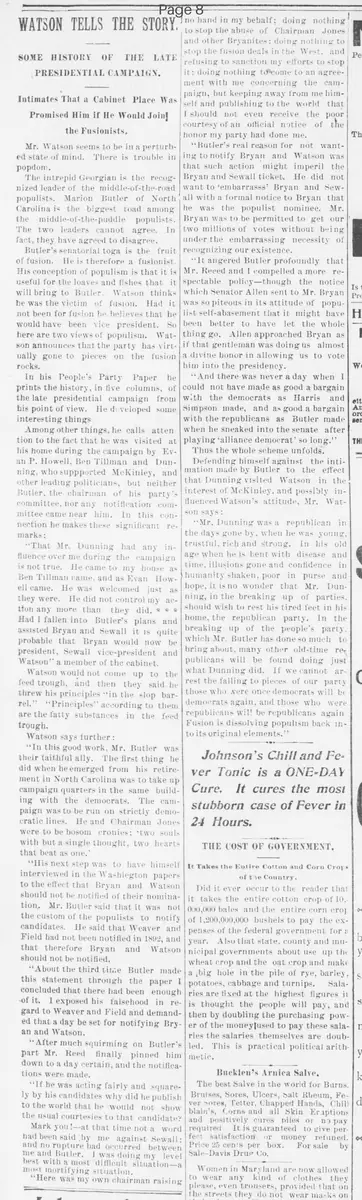
WATSON TELLS THE STORY.
SOME HISTORY OF THE LATE PRESIDENTIAL CAMPAIGN.
Intimates That a Cabinet Place Was Promised Him if He Would Join the Fusionists.
Mr. Watson seems to be in a perturbed state of mind. There is trouble in popdom. The intrepid Georgian is the recognized leader of the middle-of-the-road populists. Marion Butler of North Carolina is the biggest toad among the middle-of-the-puddle populists. The two leaders cannot agree. In fact, they have agreed to disagree. Butler's senatorial toga is the fruit of fusion. He is therefore a fusionist. His conception of populism is that it is useful for the loaves and fishes that it will bring to Butler. Watson thinks he was the victim of fusion. Had it not been for fusion he believes that he would have been vice president. So here are two views of populism. Watson announces that the party has virtually gone to pieces on the fusion rocks.
In his People's Party Paper he prints the history, in five columns, of the late presidential campaign from his point of view. He developed some interesting things. Among other things, he calls attention to the fact that he was visited at his home during the campaign by Evan P. Howell, Ben Tillman and Dunning, who supported McKinley, and other leading politicians, but neither Butler, the chairman of his party's committee, nor any notification committee came near him. In this connection he makes these significant remarks:
"That Mr. Dunning had any influence over me during the campaign is not true. He came to my house as Ben Tillman came, and as Evan Howell came. He was welcomed just as they were. He did not control my action any more than they did. * * *
Had I fallen into Butler's plans and assisted Bryan and Sewall it is quite probable that Bryan would now be president, Sewall vice-president and Watson a member of the cabinet.
Watson would not come up to the feed trough, and then they said he threw his principles 'in the slop barrel.' 'Principles' according to them are the fatty substances in the feed trough.
Watson says further:
"In this good work, Mr. Butler was their faithful ally. The first thing he did when he emerged from his retirement in North Carolina was to take up campaign quarters in the same building with the democrats. The campaign was to be run on strictly democratic lines. He and Chairman Jones were to be bosom cronies; 'two souls with but a single thought, two hearts that beat as one.'
"His next step was to have himself interviewed in the Washington papers to the effect that Bryan and Watson should not be notified of their nomination. Mr. Butler said that it was not the custom of the populists to notify candidates. He said that Weaver and Field had not been notified in 1892, and that therefore Bryan and Watson should not be notified.
"About the third time Butler made this statement through the papers I concluded that there had been enough of it. I exposed his falsehood in regard to Weaver and Field and demanded that a day be set for notifying Bryan and Watson.
"After much squirming on Butler's part Mr. Reed finally pinned him down to a day certain, and the notifications were made.
"If he was acting fairly and squarely by his candidates why did he publish to the world that he would not show the usual courtesies to that candidate? Mark you!--at that time not a word had been said by me against Sewall; and no rupture had occurred between me and Butler. I was doing my level best with a most difficult situation--a most mortifying situation.
"Here was my own chairman raising no hand in my behalf; doing nothing to stop the abuse of Chairman Jones and other Bryanites; doing nothing to stop the fusion deals in the West, and refusing to sanction my efforts to stop it; doing nothing to come to an agreement with me concerning the campaign, but keeping away from me himself and publishing to the world that I should not even receive the poor courtesy of an official notice of the honor my party had done me.
"Butler's real reason for not wanting to notify Bryan and Watson was that such action might imperil the Bryan and Sewall ticket. He did not want to 'embarrass' Bryan and Sewall with a formal notice to Bryan that he was the populist nominee. Mr. Bryan was to be permitted to get our two millions of votes without being under the embarrassing necessity of recognizing our existence.
"It angered Butler profoundly that Mr. Reed and I compelled a more respectable policy--though the notice which Senator Allen sent to Mr. Bryan was so piteous in its attitude of populist self-abasement that it might have been better to have let the whole thing go. Allen approached Bryan as if that gentleman was doing us almost a divine honor in allowing us to vote him into the presidency.
"And there was never a day when I could not have made as good a bargain with the democrats as Harris and Simpson made, and as good a bargain with the republicans as Butler made when he sneaked into the senate after playing 'alliance democrat' so long."
Thus the whole scheme unfolds. Defending himself against the intimation made by Butler to the effect that Dunning visited Watson in the interest of McKinley, and possibly influenced Watson's attitude, Mr. Watson says:
"Mr. Dunning was a republican in the days gone by, when he was young, trustful, rich and strong. In his old age when he is bent with disease and time, illusions gone and confidence in humanity shaken, poor in purse and hope, it is no wonder that Mr. Dunning, in the breaking up of parties, should wish to rest his tired feet in his home, the republican party. In the breaking up of the people's party, which Mr. Butler has done so much to bring about, many other old-time republicans will be found doing just what Dunning did. If we cannot arrest the falling to pieces of our party those who were once democrats will be democrats again, and those who were republicans will be republicans again. Fusion is dissolving populism back into its original elements."
SOME HISTORY OF THE LATE PRESIDENTIAL CAMPAIGN.
Intimates That a Cabinet Place Was Promised Him if He Would Join the Fusionists.
Mr. Watson seems to be in a perturbed state of mind. There is trouble in popdom. The intrepid Georgian is the recognized leader of the middle-of-the-road populists. Marion Butler of North Carolina is the biggest toad among the middle-of-the-puddle populists. The two leaders cannot agree. In fact, they have agreed to disagree. Butler's senatorial toga is the fruit of fusion. He is therefore a fusionist. His conception of populism is that it is useful for the loaves and fishes that it will bring to Butler. Watson thinks he was the victim of fusion. Had it not been for fusion he believes that he would have been vice president. So here are two views of populism. Watson announces that the party has virtually gone to pieces on the fusion rocks.
In his People's Party Paper he prints the history, in five columns, of the late presidential campaign from his point of view. He developed some interesting things. Among other things, he calls attention to the fact that he was visited at his home during the campaign by Evan P. Howell, Ben Tillman and Dunning, who supported McKinley, and other leading politicians, but neither Butler, the chairman of his party's committee, nor any notification committee came near him. In this connection he makes these significant remarks:
"That Mr. Dunning had any influence over me during the campaign is not true. He came to my house as Ben Tillman came, and as Evan Howell came. He was welcomed just as they were. He did not control my action any more than they did. * * *
Had I fallen into Butler's plans and assisted Bryan and Sewall it is quite probable that Bryan would now be president, Sewall vice-president and Watson a member of the cabinet.
Watson would not come up to the feed trough, and then they said he threw his principles 'in the slop barrel.' 'Principles' according to them are the fatty substances in the feed trough.
Watson says further:
"In this good work, Mr. Butler was their faithful ally. The first thing he did when he emerged from his retirement in North Carolina was to take up campaign quarters in the same building with the democrats. The campaign was to be run on strictly democratic lines. He and Chairman Jones were to be bosom cronies; 'two souls with but a single thought, two hearts that beat as one.'
"His next step was to have himself interviewed in the Washington papers to the effect that Bryan and Watson should not be notified of their nomination. Mr. Butler said that it was not the custom of the populists to notify candidates. He said that Weaver and Field had not been notified in 1892, and that therefore Bryan and Watson should not be notified.
"About the third time Butler made this statement through the papers I concluded that there had been enough of it. I exposed his falsehood in regard to Weaver and Field and demanded that a day be set for notifying Bryan and Watson.
"After much squirming on Butler's part Mr. Reed finally pinned him down to a day certain, and the notifications were made.
"If he was acting fairly and squarely by his candidates why did he publish to the world that he would not show the usual courtesies to that candidate? Mark you!--at that time not a word had been said by me against Sewall; and no rupture had occurred between me and Butler. I was doing my level best with a most difficult situation--a most mortifying situation.
"Here was my own chairman raising no hand in my behalf; doing nothing to stop the abuse of Chairman Jones and other Bryanites; doing nothing to stop the fusion deals in the West, and refusing to sanction my efforts to stop it; doing nothing to come to an agreement with me concerning the campaign, but keeping away from me himself and publishing to the world that I should not even receive the poor courtesy of an official notice of the honor my party had done me.
"Butler's real reason for not wanting to notify Bryan and Watson was that such action might imperil the Bryan and Sewall ticket. He did not want to 'embarrass' Bryan and Sewall with a formal notice to Bryan that he was the populist nominee. Mr. Bryan was to be permitted to get our two millions of votes without being under the embarrassing necessity of recognizing our existence.
"It angered Butler profoundly that Mr. Reed and I compelled a more respectable policy--though the notice which Senator Allen sent to Mr. Bryan was so piteous in its attitude of populist self-abasement that it might have been better to have let the whole thing go. Allen approached Bryan as if that gentleman was doing us almost a divine honor in allowing us to vote him into the presidency.
"And there was never a day when I could not have made as good a bargain with the democrats as Harris and Simpson made, and as good a bargain with the republicans as Butler made when he sneaked into the senate after playing 'alliance democrat' so long."
Thus the whole scheme unfolds. Defending himself against the intimation made by Butler to the effect that Dunning visited Watson in the interest of McKinley, and possibly influenced Watson's attitude, Mr. Watson says:
"Mr. Dunning was a republican in the days gone by, when he was young, trustful, rich and strong. In his old age when he is bent with disease and time, illusions gone and confidence in humanity shaken, poor in purse and hope, it is no wonder that Mr. Dunning, in the breaking up of parties, should wish to rest his tired feet in his home, the republican party. In the breaking up of the people's party, which Mr. Butler has done so much to bring about, many other old-time republicans will be found doing just what Dunning did. If we cannot arrest the falling to pieces of our party those who were once democrats will be democrats again, and those who were republicans will be republicans again. Fusion is dissolving populism back into its original elements."
What sub-type of article is it?
Historical Event
Biography
Deception Fraud
What themes does it cover?
Deception
Betrayal
Fortune Reversal
What keywords are associated?
Populist Party
Fusion
Presidential Campaign
Watson
Butler
Bryan
Deception
What entities or persons were involved?
Watson
Marion Butler
Evan P. Howell
Ben Tillman
Dunning
Bryan
Sewall
Weaver
Field
Reed
Allen
Harris
Simpson
Jones
Story Details
Key Persons
Watson
Marion Butler
Evan P. Howell
Ben Tillman
Dunning
Bryan
Sewall
Weaver
Field
Reed
Allen
Harris
Simpson
Jones
Event Date
1896 Presidential Campaign
Story Details
Watson recounts the 1896 presidential campaign from his perspective, accusing fusionists of promising him a cabinet position if he joined them, detailing Butler's alliance with Democrats, refusal to notify nominees, and how fusion destroyed the Populist Party, believing he could have been vice president without it.