Thank you for visiting SNEWPapers!
Sign up free
Letter to Editor
March 7, 1804
Virginia Argus
Richmond, Virginia
What is this article about?
In a letter dated February 25, 1804, from Henrico, 'Senex' critiques 'Fair Play's' essays defending against the 'British Spy,' pointing out factual errors, contradictions, and stylistic issues, while suggesting revisions to enhance clarity and avoid misrepresentations of public opinion and Virginia's character.
Clipping
OCR Quality
95%
Excellent
Full Text
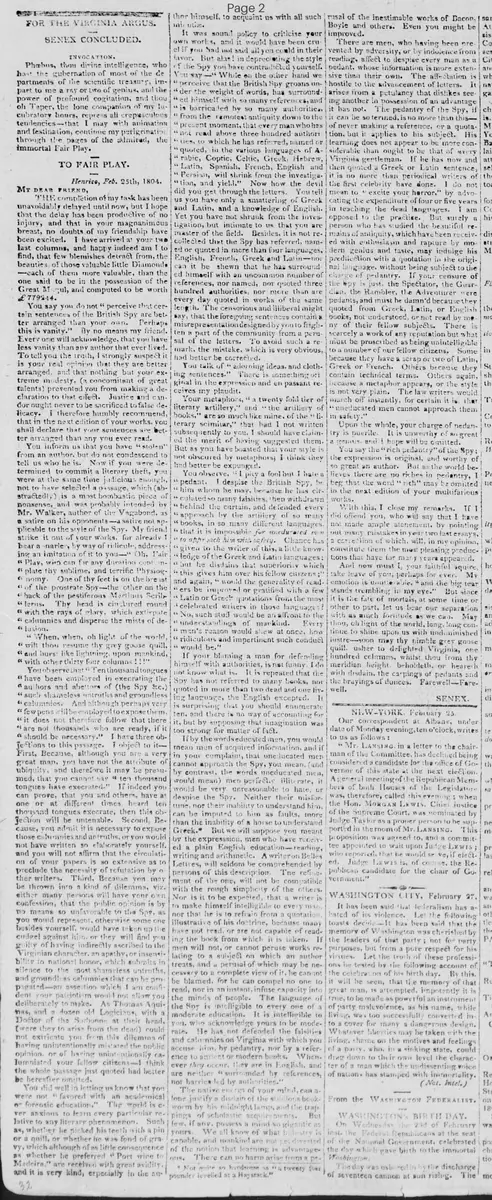
Phœbus, thou divine intelligence, who
hast the gubernation of most of the departments of the scientific treasury, impart to me a ray or two of genius, and the power of profound cogitation, and thou, oh Taper, the lone companion of my lucubratory hours, repress all crepusculous tendencies—that I may with animation and festination, continue my peregrination through the pages of the admired, the immortal Fair Play.
TO FAIR PLAY.
Henrico, Feb. 25th, 1804.
MY DEAR FRIEND,
THE completion of my task has been unavoidably delayed until now, but I hope that the delay has been productive of no injury, and that in your magnanimous breast, no doubts of my friendship have been excited. I have arrived at your two last columns, and happy indeed am I to find, that few blemishes detract from, the beauties, of those valuable little Diamonds—each of them more valuable, than the one said to be in the possession of the Great Mogul, and computed to be worth £779,944.
You say you do not perceive that certain sentences of the British Spy are better arranged than your own. Perhaps this is vanity. By no means my friend. Every one will acknowledge, that you have less vanity than any author that ever lived. To tell you the truth, I strongly suspect it is your real opinion that they are better arranged, and that nothing but your extreme modesty (a concomitant of great talents) prevented you from making a declaration to that effect. Justice and candor ought never to be sacrificed to false delicacy. I therefore humbly recommend, that in the next edition of your works, you shall declare that your sentences are better arranged than any you ever read.
You inform us that you have "stolen" from an author, but do not condescend to tell us who he is. Now if you were determined to commit a literary theft, you were at the same time judicious enough, not to have selected a passage, which (abstractedly) is a most bombastic piece of nonsense, and was probably intended by Mr. Walker, author of the Vagabond, as a satire on his opponents—a satire not applicable to the style of the Spy. My friend strike it out of your works, for already I hear an argler, by way of ridicule, addressing an imitation of it to you—"Oh, Fair Play, who can for any duration contemplate thy sublime, and terrific Physiognomy. One of thy feet is on the breast of the prostrate Spy—the other on the back of the Destiferous Moctinus Scrililerus. Thy head is cinctured round with the rays of glory, which extirpate calumnies and disperse the mists of delusion. When, when, oh light of the world, wilt thou resume thy grey goose quill, and burst like lightning, upon mankind, with other thirty-four columns!!!"
You observe that "Ten thousand tongues have been employed in execrating the authors and abettors of (the Spy &c.) such shameless untruths and groundless calumnies, And although perhaps very few pens will be employed to expose them. it does not therefore follow that there are not thousands who are ready, if it should be necessary." I have three objections to this passage. I object to it—First, Because, although you are a very great man, you have not the attribute of ubiquity, and therefore it may be presumed, that you cannot say "ten thousand tongues have execrated." If indeed you can prove, that you and others, have at one or at different times heard ten thousand tongues execrate, then this objection will be untenable. Second, Because, you admit it is necessary to expose those calumnies and untruths, or you would not have written so elaborately yourself. and you will not affirm that the circulation of your papers is so extensive as to preclude the necessity of refutation by other writers. Third, Because you may be thrown into a kind of dilemma, viz. either many persons will have your own confession, that the public opinion is by no means so unfavorable to the Spy, as you would represent, otherwise some one besides yourself, would have taken up the cudgel against him. or they will find you guilty of having indirectly ascribed to the Virginian character, an apathy, or insensibility to national honor, which submits in silence to the most shameless untruths, and groundless calumnies that can be propagated—an assertion which I am confident your patriotism would not allow you deliberately to make. As Thomas Aquinas, and a dozen old Logicians, with a Doctor of the Sorbonne at their head, (were they to arise from the dead) could not extricate you from this dilemma of having unintentionally misstated the public opinion. or of having unintentionally calumniated your fellow citizens—I think the whole passage just quoted had better be hereafter omitted.
You did well in letting us know that you were not "favored with an academical or forensic education," The world is ever anxious to learn every particular relative to any literary phenomenon. Such as, whether he picked his teeth with a pin or a quill, or whether he was fond of strawberry, which although of as little consequence as whether he preferred "Port wine to Madeira," are received with great avidity. and it is very kind, especially in the author himself, to acquaint us with all such minutia.
It was sound policy to criticise your own works, and it would have been cruel if you had not said all you could in their favor. But alas! in depreciating the style of the Spy you have contradicted yourself. You say "While on the other hand we perceive that the British Spy groans under the weight of words, has surrounded himself with so many references, and is barricaded by so many authorities from the remotest antiquity down to the present moment, that every man who has not read above three hundred authorities, to which he has referred, named or quoted, in the various languages of Arabic, Coptic, Celtic, Greek, Hebrew, Latin, Spanish, French, English and Persian, will shrink from the investigation, and yield." Now how the devil did you get through the letters. You tell us you have only a smattering of Greek and Latin, and a knowledge of English. Yet you have not shrunk from the investigation, but intimate to us that you are master of the field. Besides, it is not recollected that the Spy has referred, named or quoted in more than four languages, English, French, Greek and Latin—nor can it be shewn that he has surrounded himself with an uncommon number of references, nor named, nor quoted three hundred authorities, nor more than are every day quoted in works of the same length. The censorious and illiberal might say, that the foregoing sentences contain a misrepresentation designed by you to frighten a part of the community from a perusal of the letters. To avoid such a remark, the mistake, which is obvious, had better be corrected.
You talk of "adorning ideas, and clothing sentences." There is something original in the expression and en passant receives my plaudit.
Your metaphors, "a twenty fold tier of literary artillery," and "the artillery of books," are so much like mine, of the "literary scimitar," that had I not written subsequently to you, I should have claimed the merit of having suggested them. But as you have boasted that your style is not obscured by metaphors I think they had better be expunged.
You observe, "I pity a fool but I hate a pedant. I despise the British Spy, by him whom he may, because he has circulated so many falsities, then withdrawn behind the curtain, and defended every approach by the artillery of so many books, in so many different languages. that it is impossible for uneducated men to approach him with safety. Chance has given to the writer of this, a little knowledge of the Greek and Latin languages: but he disdains that superiority which this gives him over his fellow citizens;" and again, "would the generality of readers be improved or gratified with a few Latin or Greek quotations from the most celebrated writers in those languages? No, such stuff would be an affront to the understandings of mankind. Every man's reason would shew at once, how ridiculous and impertinent such conduct would be."
If your blaming a man for defending himself with authorities, is not funny, I do not know what is. It is repeated that the Spy has not referred to many books, not quoted in more than two dead and one living language, the English excepted. It is surprising that you should enumerate ten, and there in no way of accounting for it, but by supposing that imagination was too strong for matter of fact.
If by the words educated men, you would mean men of acquired information. and if in your complaint, that uneducated men cannot approach the Spy, you mean. (under the contrast, the words uneducated men, would mean men perfectly illiterate, it would be very unreasonable to hate, or despise the Spy. Neither their misfortune, nor their inability to understand him, can be imputed to him as faults, more than the inability of a horse to understand Greek." But we will suppose you meant by the expression, men who have received a plain English education—reading, writing and arithmetic. A writer on Belle Lettres, will seldom be comprehended by persons of this description. "The refinement of the one, will not be compatible with the rough simplicity of the others. Nor is it to be expected, that a writer is to make himself intelligible to every man, nor that he is to refrain from a quotation. illustrative of his doctrine, because many have not read, or are not capable of reading the book from which it is taken. If men will not, or cannot peruse works relating to a subject on which an author treats, and - perusal of which may be necessary to a complete view of it. he cannot be blamed, for he can compel no one to read, nor in an instant, infuse capacity into the minds of people. The language of the Spy is intelligible to every one of a moderate education. It is intelligible to you, who acknowledge yours to be moderate. He has not defended the falsities and calumnies on Virginia with which you accuse him, by pedantry, nor by a reference to ancient or modern books." Whenever they occur, they are in English, and are neither "surrounded by references, nor barricaded by authorities."
The native energy of your mind, can alone justify a disdain of the studious book-worm by his midnight lamp, and the trappings of scholastic acquirement's. But few, if any, possess a mind so gigantic as yours. We all know of what industry is capable, and mankind are not so divested of the notion that learning is advantageous, There can no harm arise from a perusal of the inestimable works of Bacon, Boyle and others. Even you might be improved.
There are men, who having been prevented by adversity, or by indolence from reading, affect to despise every man as a pedant, whose information is more extensive than their own. The affectation is hostile to the advancement of letters. It arises from a petulancy that dislikes seeing another in possession of an advantage it has not. The pedantry of the Spy, if it can be so termed, is no more than this—of never making a reference, or a quotation. but it applies to his subject. His learning does not appear to be more considerable than ought to be that of every Virginia gentleman. If he has now and then quoted a Greek or Latin sentence, it is no more than periodical writers of the first celebrity have done. I do not mean to "excite your horror," by advocating the expenditure of four or five years in teaching the dead languages. I am opposed to the practice. But surely a person who has studied the beautiful remains of antiquity, which have been received with enthusiasm and rapture by modern genius and taste, may indulge his predilection within a quotation in the original language. without being subject to the charge of pedantry. If your censure of the Spy is just. the Spectator, the Guardian, the Rambler, the Adventurer were pedants, and must be damn'd because they quoted from Greek, Latin, or English books, not understood, or not read by many of their fellow subjects. There is scarcely a work of any reputation but what must be proscribed as being unintelligible to a number of our fellow citizens, Some because they have a scrap or two of Latin, Greek or French. Others because they contain technical terms. Others again, because a metaphor appears, or the style is not very plain. The law writers would march off instantly, for certain it is. that "uneducated men cannot approach them in safety."
Upon the whole, your charge of pedantry is puerile. It is unworthy of so great a genius. and I hope will be omitted.
You say the "rich pedantry" of the Spy; the expression is original, and worthy of so great an author. But as the world believes there are no riches in pedantry, I beg that the word "rich" may be omitted in the next edition of your multifarious works.
With this, I close my remarks. If I did offend you, who will say that I have not made ample atonement. by pointing out many mistakes in your two last essays, a correction of which, will, in my opinion, constitute them the most pleasing productions that have for many years appeared. And now must I, your faithful squire, take leave of you, perhaps for ever. My emotion is unutterable, "and the big tear stands trembling in my eye." But since it is the fate of mortals, at some time or other to part, let us bear our separation with as much fortitude as we can. May thou, oh light of the world, long, long continue to shine upon us with undiminished lustre—soon may thy nimble grey goose quill. usher to delighted Virginia, one hundred columns, whilst thou from thy meridian height. beholdest, or hearest with disdain, the carpings of pedants and the brayings of dunces. Farewell—Farewell.
SENEX.
hast the gubernation of most of the departments of the scientific treasury, impart to me a ray or two of genius, and the power of profound cogitation, and thou, oh Taper, the lone companion of my lucubratory hours, repress all crepusculous tendencies—that I may with animation and festination, continue my peregrination through the pages of the admired, the immortal Fair Play.
TO FAIR PLAY.
Henrico, Feb. 25th, 1804.
MY DEAR FRIEND,
THE completion of my task has been unavoidably delayed until now, but I hope that the delay has been productive of no injury, and that in your magnanimous breast, no doubts of my friendship have been excited. I have arrived at your two last columns, and happy indeed am I to find, that few blemishes detract from, the beauties, of those valuable little Diamonds—each of them more valuable, than the one said to be in the possession of the Great Mogul, and computed to be worth £779,944.
You say you do not perceive that certain sentences of the British Spy are better arranged than your own. Perhaps this is vanity. By no means my friend. Every one will acknowledge, that you have less vanity than any author that ever lived. To tell you the truth, I strongly suspect it is your real opinion that they are better arranged, and that nothing but your extreme modesty (a concomitant of great talents) prevented you from making a declaration to that effect. Justice and candor ought never to be sacrificed to false delicacy. I therefore humbly recommend, that in the next edition of your works, you shall declare that your sentences are better arranged than any you ever read.
You inform us that you have "stolen" from an author, but do not condescend to tell us who he is. Now if you were determined to commit a literary theft, you were at the same time judicious enough, not to have selected a passage, which (abstractedly) is a most bombastic piece of nonsense, and was probably intended by Mr. Walker, author of the Vagabond, as a satire on his opponents—a satire not applicable to the style of the Spy. My friend strike it out of your works, for already I hear an argler, by way of ridicule, addressing an imitation of it to you—"Oh, Fair Play, who can for any duration contemplate thy sublime, and terrific Physiognomy. One of thy feet is on the breast of the prostrate Spy—the other on the back of the Destiferous Moctinus Scrililerus. Thy head is cinctured round with the rays of glory, which extirpate calumnies and disperse the mists of delusion. When, when, oh light of the world, wilt thou resume thy grey goose quill, and burst like lightning, upon mankind, with other thirty-four columns!!!"
You observe that "Ten thousand tongues have been employed in execrating the authors and abettors of (the Spy &c.) such shameless untruths and groundless calumnies, And although perhaps very few pens will be employed to expose them. it does not therefore follow that there are not thousands who are ready, if it should be necessary." I have three objections to this passage. I object to it—First, Because, although you are a very great man, you have not the attribute of ubiquity, and therefore it may be presumed, that you cannot say "ten thousand tongues have execrated." If indeed you can prove, that you and others, have at one or at different times heard ten thousand tongues execrate, then this objection will be untenable. Second, Because, you admit it is necessary to expose those calumnies and untruths, or you would not have written so elaborately yourself. and you will not affirm that the circulation of your papers is so extensive as to preclude the necessity of refutation by other writers. Third, Because you may be thrown into a kind of dilemma, viz. either many persons will have your own confession, that the public opinion is by no means so unfavorable to the Spy, as you would represent, otherwise some one besides yourself, would have taken up the cudgel against him. or they will find you guilty of having indirectly ascribed to the Virginian character, an apathy, or insensibility to national honor, which submits in silence to the most shameless untruths, and groundless calumnies that can be propagated—an assertion which I am confident your patriotism would not allow you deliberately to make. As Thomas Aquinas, and a dozen old Logicians, with a Doctor of the Sorbonne at their head, (were they to arise from the dead) could not extricate you from this dilemma of having unintentionally misstated the public opinion. or of having unintentionally calumniated your fellow citizens—I think the whole passage just quoted had better be hereafter omitted.
You did well in letting us know that you were not "favored with an academical or forensic education," The world is ever anxious to learn every particular relative to any literary phenomenon. Such as, whether he picked his teeth with a pin or a quill, or whether he was fond of strawberry, which although of as little consequence as whether he preferred "Port wine to Madeira," are received with great avidity. and it is very kind, especially in the author himself, to acquaint us with all such minutia.
It was sound policy to criticise your own works, and it would have been cruel if you had not said all you could in their favor. But alas! in depreciating the style of the Spy you have contradicted yourself. You say "While on the other hand we perceive that the British Spy groans under the weight of words, has surrounded himself with so many references, and is barricaded by so many authorities from the remotest antiquity down to the present moment, that every man who has not read above three hundred authorities, to which he has referred, named or quoted, in the various languages of Arabic, Coptic, Celtic, Greek, Hebrew, Latin, Spanish, French, English and Persian, will shrink from the investigation, and yield." Now how the devil did you get through the letters. You tell us you have only a smattering of Greek and Latin, and a knowledge of English. Yet you have not shrunk from the investigation, but intimate to us that you are master of the field. Besides, it is not recollected that the Spy has referred, named or quoted in more than four languages, English, French, Greek and Latin—nor can it be shewn that he has surrounded himself with an uncommon number of references, nor named, nor quoted three hundred authorities, nor more than are every day quoted in works of the same length. The censorious and illiberal might say, that the foregoing sentences contain a misrepresentation designed by you to frighten a part of the community from a perusal of the letters. To avoid such a remark, the mistake, which is obvious, had better be corrected.
You talk of "adorning ideas, and clothing sentences." There is something original in the expression and en passant receives my plaudit.
Your metaphors, "a twenty fold tier of literary artillery," and "the artillery of books," are so much like mine, of the "literary scimitar," that had I not written subsequently to you, I should have claimed the merit of having suggested them. But as you have boasted that your style is not obscured by metaphors I think they had better be expunged.
You observe, "I pity a fool but I hate a pedant. I despise the British Spy, by him whom he may, because he has circulated so many falsities, then withdrawn behind the curtain, and defended every approach by the artillery of so many books, in so many different languages. that it is impossible for uneducated men to approach him with safety. Chance has given to the writer of this, a little knowledge of the Greek and Latin languages: but he disdains that superiority which this gives him over his fellow citizens;" and again, "would the generality of readers be improved or gratified with a few Latin or Greek quotations from the most celebrated writers in those languages? No, such stuff would be an affront to the understandings of mankind. Every man's reason would shew at once, how ridiculous and impertinent such conduct would be."
If your blaming a man for defending himself with authorities, is not funny, I do not know what is. It is repeated that the Spy has not referred to many books, not quoted in more than two dead and one living language, the English excepted. It is surprising that you should enumerate ten, and there in no way of accounting for it, but by supposing that imagination was too strong for matter of fact.
If by the words educated men, you would mean men of acquired information. and if in your complaint, that uneducated men cannot approach the Spy, you mean. (under the contrast, the words uneducated men, would mean men perfectly illiterate, it would be very unreasonable to hate, or despise the Spy. Neither their misfortune, nor their inability to understand him, can be imputed to him as faults, more than the inability of a horse to understand Greek." But we will suppose you meant by the expression, men who have received a plain English education—reading, writing and arithmetic. A writer on Belle Lettres, will seldom be comprehended by persons of this description. "The refinement of the one, will not be compatible with the rough simplicity of the others. Nor is it to be expected, that a writer is to make himself intelligible to every man, nor that he is to refrain from a quotation. illustrative of his doctrine, because many have not read, or are not capable of reading the book from which it is taken. If men will not, or cannot peruse works relating to a subject on which an author treats, and - perusal of which may be necessary to a complete view of it. he cannot be blamed, for he can compel no one to read, nor in an instant, infuse capacity into the minds of people. The language of the Spy is intelligible to every one of a moderate education. It is intelligible to you, who acknowledge yours to be moderate. He has not defended the falsities and calumnies on Virginia with which you accuse him, by pedantry, nor by a reference to ancient or modern books." Whenever they occur, they are in English, and are neither "surrounded by references, nor barricaded by authorities."
The native energy of your mind, can alone justify a disdain of the studious book-worm by his midnight lamp, and the trappings of scholastic acquirement's. But few, if any, possess a mind so gigantic as yours. We all know of what industry is capable, and mankind are not so divested of the notion that learning is advantageous, There can no harm arise from a perusal of the inestimable works of Bacon, Boyle and others. Even you might be improved.
There are men, who having been prevented by adversity, or by indolence from reading, affect to despise every man as a pedant, whose information is more extensive than their own. The affectation is hostile to the advancement of letters. It arises from a petulancy that dislikes seeing another in possession of an advantage it has not. The pedantry of the Spy, if it can be so termed, is no more than this—of never making a reference, or a quotation. but it applies to his subject. His learning does not appear to be more considerable than ought to be that of every Virginia gentleman. If he has now and then quoted a Greek or Latin sentence, it is no more than periodical writers of the first celebrity have done. I do not mean to "excite your horror," by advocating the expenditure of four or five years in teaching the dead languages. I am opposed to the practice. But surely a person who has studied the beautiful remains of antiquity, which have been received with enthusiasm and rapture by modern genius and taste, may indulge his predilection within a quotation in the original language. without being subject to the charge of pedantry. If your censure of the Spy is just. the Spectator, the Guardian, the Rambler, the Adventurer were pedants, and must be damn'd because they quoted from Greek, Latin, or English books, not understood, or not read by many of their fellow subjects. There is scarcely a work of any reputation but what must be proscribed as being unintelligible to a number of our fellow citizens, Some because they have a scrap or two of Latin, Greek or French. Others because they contain technical terms. Others again, because a metaphor appears, or the style is not very plain. The law writers would march off instantly, for certain it is. that "uneducated men cannot approach them in safety."
Upon the whole, your charge of pedantry is puerile. It is unworthy of so great a genius. and I hope will be omitted.
You say the "rich pedantry" of the Spy; the expression is original, and worthy of so great an author. But as the world believes there are no riches in pedantry, I beg that the word "rich" may be omitted in the next edition of your multifarious works.
With this, I close my remarks. If I did offend you, who will say that I have not made ample atonement. by pointing out many mistakes in your two last essays, a correction of which, will, in my opinion, constitute them the most pleasing productions that have for many years appeared. And now must I, your faithful squire, take leave of you, perhaps for ever. My emotion is unutterable, "and the big tear stands trembling in my eye." But since it is the fate of mortals, at some time or other to part, let us bear our separation with as much fortitude as we can. May thou, oh light of the world, long, long continue to shine upon us with undiminished lustre—soon may thy nimble grey goose quill. usher to delighted Virginia, one hundred columns, whilst thou from thy meridian height. beholdest, or hearest with disdain, the carpings of pedants and the brayings of dunces. Farewell—Farewell.
SENEX.
What sub-type of article is it?
Satirical
Persuasive
Comedic
What themes does it cover?
Politics
Education
What keywords are associated?
British Spy
Fair Play Critique
Literary Pedantry
Virginia Calumnies
Public Opinion
Education Debate
Satirical Imitation
What entities or persons were involved?
Senex
Fair Play
Letter to Editor Details
Author
Senex
Recipient
Fair Play
Main Argument
senex offers a detailed, humorous critique of fair play's essays criticizing the british spy, identifying errors, contradictions, and overstatements, and recommends specific omissions and corrections to strengthen the defense of virginia's honor and improve literary quality.
Notable Details
References To Mr. Walker, Author Of The Vagabond
Critique Of Passage Imitating Bombastic Style
Objections Involving Ubiquity, Necessity Of Exposure, And Dilemma On Public Opinion
Discussion Of Education And Pedantry, Referencing Spectator, Guardian, Rambler, Adventurer
Praise For Original Expressions Like 'Adorning Ideas, And Clothing Sentences'