Thank you for visiting SNEWPapers!
Sign up free
Alexandria Gazette & Daily Advertiser
Alexandria, Virginia
What is this article about?
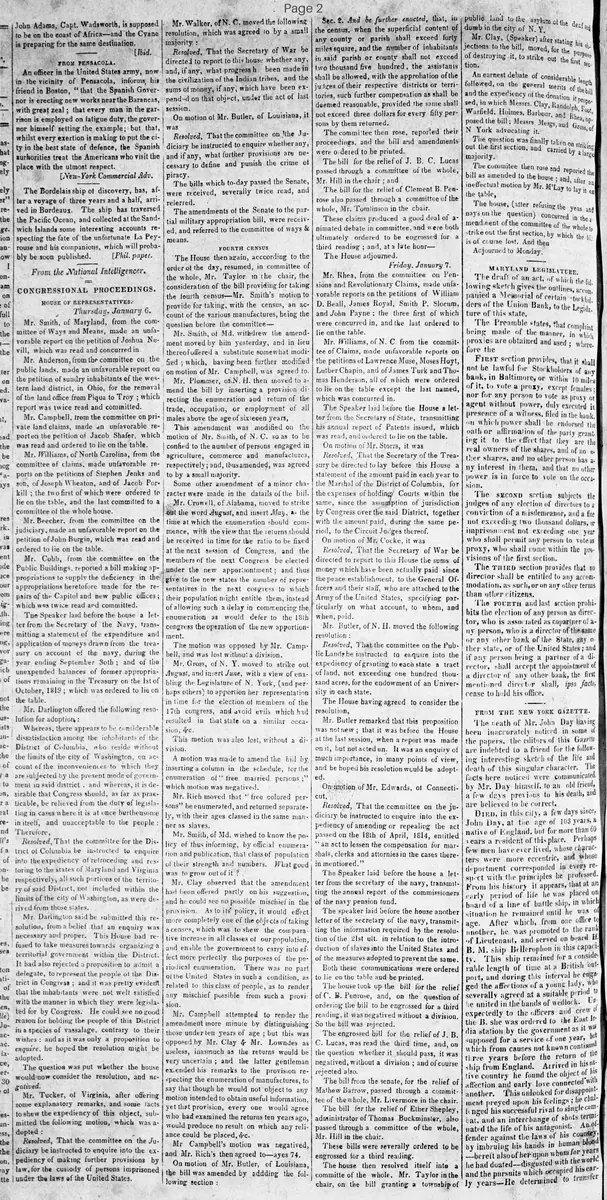
Report on U.S. House of Representatives proceedings on January 6-7, covering unfavorable committee reports on petitions, resolutions on District governance, Indian affairs, piracy, and custody of prisoners; debates and amendments to the fourth census bill; and actions on relief bills, with several rejected.
Merged-components note: Continuation of the congressional proceedings article within page 2.
Clipping
OCR Quality
Full Text
CONGRESSIONAL PROCEEDINGS.
HOUSE OF REPRESENTATIVES.
Thursday, January 6.
Mr. Smith, of Maryland, from the committee of Ways and Means, made an unfavorable report on the petition of Joshua Nevill, which was read and concurred in.
Mr. Anderson, from the committee on the public lands, made an unfavorable report on the petition of sundry inhabitants of the western land district, in Ohio, for the removal of the land office from Piqua to Troy; which report was twice read and committed.
Mr. Campbell, from the committee on private land claims, made an unfavorable report on the petition of Jacob Shafer, which was read and ordered to lie on the table.
Mr. Williams, of North Carolina, from the committee of claims, made unfavorable reports on the petitions of Stephen Jenks and son, of Joseph Wheaton, and of Jacob Porkill; the two first of which were ordered to lie on the table, and the last committed to a committee of the whole house.
Mr. Beecher, from the committee on the judiciary, made an unfavorable report on the petition of John Burgin, which was read and ordered to lie on the table.
Mr. Cobb, from the committee on the Public Buildings, reported a bill making appropriations to supply the deficiency in the appropriations heretofore made for the repairs of the Capitol and new public offices; which was twice read and committed.
The Speaker laid before the house a letter from the Secretary of the Navy, transmitting a statement of the expenditure and application of moneys drawn from the treasury on account of the navy, during the year ending September 30th; and of the unexpended balances of former appropriations remaining in the Treasury on the 1st of October, 1819; which was ordered to lie on the table.
Mr. Darlington offered the following resolution for adoption:
Whereas, there appears to be considerable dissatisfaction among the inhabitants of the District of Columbia, who reside without the limits of the city of Washington, on account of the inconveniences to which they are subjected by the present mode of government in said district. and whereas, it is desirable that Congress should, as far as practicable, be relieved from the duty of legislating in cases where it is at once burthensome in itself, and unacceptable to the people: Therefore,
Resolved. That the committee for the District of Columbia be instructed to enquire into the expediency of retroceding and restoring to the states of Maryland and Virginia respectively, all such portions of the territory of said District, not included within the limits of the city of Washington, as were derived from those states.
Mr. Darlington said he submitted this resolution, from a belief that an enquiry was necessary and proper. This House had refused to take measures towards organizing a territorial government within the District. It had also rejected a proposition to admit a delegate, to represent the people of the District in Congress; and it was pretty evident that the inhabitants were not well satisfied with the manner in which they were legislated for by Congress. He could see no good reason for holding the people of this District in a species of vassalage, contrary to their wishes: and as it was only a proposition to enquire, he hoped the resolution might be adopted.
The question was put whether the house would now consider the resolution, and negatived.
Mr. Tucker, of Virginia, after offering some explanatory remarks, and some facts to shew the expediency of this object, submitted the following motion, which was adopted:
Resolved, That the committee on the Judiciary be instructed to enquire into the expediency of making further provisions by law, for the custody of persons imprisoned under the laws of the United States.
Mr. Walker, of N. C. moved the following resolution, which was agreed to by a small majority:
Resolved, That the Secretary of War be directed to report to this house whether any, and, if any, what progress has been made in the civilization of the Indian tribes, and the sums of money, if any, which have been expended on that object, under the act of last session.
On motion of Mr. Butler, of Louisiana, it was
Resolved, That the committee on the Judiciary be instructed to enquire whether any, and if any, what further provisions are necessary to define and punish the crime of piracy.
The bills which to-day passed the Senate, were received, severally twice read, and referred.
The amendments of the Senate to the partial military appropriation bill, were received, and referred to the committee of ways & means.
FOURTH CENSUS
The House then again, according to the order of the day, resumed, in committee of the whole, Mr. Taylor in the chair, the consideration of the bill providing for taking the fourth census--Mr. Smith's motion to provide for taking, with the census, an account of the various manufactures, being the question before the committee-
Mr. Smith, of Md. withdrew the amendment moved by him yesterday, and in lieu thereof offered a substitute somewhat modified; which, having been further modified on motion of Mr. Campbell, was agreed to.
Mr. Plummer, of N. H. then moved to amend the bill by inserting a provision directing the enumeration and return of the trade, occupation, or employment of all males above the age of sixteen years,
This amendment was modified on the motion of Mr. Smith, of N. C. so as to be confined to the number of persons engaged in agriculture, commerce and manufactures, respectively; and, thus amended, was agreed to by a small majority.
Some other amendments of a minor character were made in the details of the bill.
Mr. Crowell, of Alabama, moved to strike out the word August, and insert May, as the time at which the enumeration should commence, with the view that the returns should be received in time for the ratio to be fixed at the next session of Congress, and the members of the next Congress be elected under the new apportionment; and thus give to the new states the number of representatives in the next congress to which their population might entitle them, instead of allowing such a delay in commencing the enumeration as would defer to the 18th congress the operation of the new apportionment.
The motion was opposed by Mr. Campbell, and was lost without a division.
Mr. Gross, of N. Y. moved to strike out August, and insert June, with a view of enabling the Legislature of N. York, (and perhaps others) to apportion her representation in time for the election of members of the 17th congress, and avoid evils which had resulted in that state on a similar occasion, &c.
This motion was also lost, without a division.
A motion was made to amend the bill by inserting a column in the schedule, for the enumeration of "free married persons"
which motion was negatived.
Mr. Rich moved that "free colored persons" be enumerated, and returned separately, with their ages classed in the same manner as slaves,
Mr. Smith, of Md. wished to know the policy of thus informing, by official enumeration and publication, that class of population of their strength and numbers. What good was to grow out of it?
Mr. Clay observed that the amendment had been offered partly on his suggestion, and he could see no possible mischief in the provision. As to its policy, it would effect more completely one of the objects of taking a census, which was to shew the comparative increase in all classes of our population, and enable the government to carry into effect more perfectly the purposes of the periodical enumeration. There was no part of the United States in such a condition, as related to this class of people, as to render any mischief possible from such a provision.
Mr. Campbell attempted to render the amendment more minute by distinguishing those under ten years of age; but this was opposed by Mr. Clay & Mr. Lowndes as useless, inasmuch as the returns would be very uncertain; and the latter gentleman extended his remarks to the provision respecting the enumeration of manufactures, to say that though he would not object to any motion intended to obtain useful information, yet that provision, every one would agree who had examined the returns ten years ago, would produce no result on which any reliance could be placed, &c.
Mr. Campbell's motion was negatived, and Mr. Rich's then agreed to--ayes 74.
On motion of Mr. Butler, of Louisiana, the bill was amended by adding the following section:
Sec. 2. And be it further enacted, that, in the census, when the superficial content of any county or parish shall exceed forty miles square, and the number of inhabitants in said parish or county shall not exceed two thousand five hundred, the assistants shall be allowed, with the approbation of the judges of their respective districts or territories, such further compensation as shall be deemed reasonable, provided the same shall not exceed three dollars for every fifty persons by them returned.
The committee then rose, reported their proceedings, and the bill and amendments were ordered to be printed.
The bill for the relief of J. B. C. Lucas passed through a committee of the whole, Mr. Hill in the chair; and
The bill for the relief of Clement B. Penrose also passed through a committee of the whole, Mr. Tomlinson in the chair.
These claims produced a good deal of animated debate in committee, and were both ultimately ordered to be engrossed for a third reading; and, at a late hour--
The House adjourned.
Friday, January 7.
Mr. Rhea, from the committee on Pensions and Revolutionary Claims, made unfavorable reports on the petitions of William D. Beall, James Royal, Smith P. Slocum, and John Payne; the three first of which were concurred in, and the last ordered to lie on the table.
Mr. Williams, of N. C. from the committee of Claims, made unfavorable reports on the petitions of Lawrence Muse, Moses Hoyt, Luther Chapin, and of James Turk and Thomas Henderson. all of which were ordered to lie on the table except the last named, which was concurred in.
The Speaker laid before the House a letter from the Secretary of State, transmitting his annual report of Patents issued, which was read, and ordered to lie on the table.
On motion of Mr. Storrs. it was
Resolved, That the Secretary of the Treasury be directed to lay before this House a statement of the amount paid in each year to the Marshal of the District of Columbia, for the expenses of holding Courts within the same, since the assumption of jurisdiction by Congress over the said District, together with the amount paid, during the same period, to the Circuit Judges thereof.
On motion of Mr. Cocke, it was
Resolved, That the Secretary of War be directed to report to this House the sums of money which have been actually paid since the peace establishment, to the General Officers and their staff, who are attached to the Army of the United States, specifying particularly on what account, to whom, and when, paid.
Mr. Butler, of N. H. moved the following resolution:
Resolved, That the committee on the Public Lands be instructed to enquire into the expediency of granting to each state a tract of land, not exceeding one hundred thousand acres, for the endowment of an University in each state.
The House having agreed to consider the resolution,
Mr. Butler remarked that this proposition was not new; that it was before the House at the last session, when a report was made on it, but not acted on. It was an enquiry of much importance, in many points of view, and he hoped his resolution would be adopted.
On motion of Mr, Edwards, of Connecticut,
Resolved, That the committee on the judiciary be instructed to enquire into the expediency of amending or repealing the act passed on the 18th of April, 1814, entitled "an act to lessen the compensation for marshals, clerks and attorneys in the cases therein mentioned."
The Speaker laid before the house a letter from the secretary of the navy, transmitting the annual report of the commissioners of the navy pension fund.
The speaker laid before the house another letter of the secretary of the navy, transmitting the information required by the resolution of the 21st ult. in relation to the introduction of slaves into the United States and of the measures adopted to prevent the same.
Both these communications were ordered to lie on the table and be printed.
The house took up the bill for the relief of C. B. Penrose, and, on the question of ordering the bill to be engrossed for a third reading, it was negatived without a division.
So the bill was rejected.
The engrossed bill for the relief of J. B. C. Lucas, was read the third time, and, on the question whether it should pass, it was negatived, without a division; and of course rejected also.
The bill from the senate, for the relief of Mathew Barrow, passed through a committee of the whole, Mr. Livermore in the chair.
The bill for the relief of Ether Shepley, administrator of Thomas Buckminster, also passed through a committee of the whole, Mr. Hill in the chair.
These bills were severally ordered to be engrossed for a third reading.
The house then resolved itself into a committee of the whole. Mr. Taylor in the chair, on the bill granting a township of
public land to the asylum of the deaf and dumb in the city of N. Y.
Mr. Clay, (Speaker) after stating his objections to the bill, moved, for the purpose of destroying it, to strike out the first section.
An earnest debate of considerable length followed, on the general merits of the bill and the expediency of the donation it proposed, in which Messrs. Clay, Randolph, Foot, Warfield, Holmes, Barbour, and Rhea, opposed the bill; Messrs. Meigs, and Gross, of N. York advocating it.
The question was finally taken on striking out the first section, and carried by a large majority.
The committee then rose and reported the bill as amended to the house; and, after an ineffectual motion by Mr. M'Lane to lay it on the table,
The house. (after refusing the yeas and nays on the question) concurred in the amendment of the committee of the whole to strike out the first section, by which the bill is of course lost. And then
Adjourned to Monday.
What sub-type of article is it?
What keywords are associated?
What entities or persons were involved?
Where did it happen?
Domestic News Details
Primary Location
Washington
Event Date
Thursday, January 6 And Friday, January 7
Key Persons
Outcome
multiple unfavorable reports concurred in or tabled; resolutions on district retrocession negatived but others adopted; census bill amended and ordered printed; relief bills for j. b. c. lucas and c. b. penrose rejected; bill for deaf and dumb asylum defeated by striking key section; other bills advanced.
Event Details
The House received unfavorable committee reports on various petitions related to lands, claims, and buildings; considered letters from secretaries; debated and voted on resolutions concerning District of Columbia governance, prisoner custody, Indian civilization, piracy punishment, university land grants, and marshal compensation; resumed debate on fourth census bill with amendments for manufactures, occupations, timing, and free colored persons enumeration; handled relief bills with debates leading to rejections or advancements; debated and defeated bill granting land to New York deaf and dumb asylum.