Thank you for visiting SNEWPapers!
Sign up free
Atlanta Daily World
Atlanta, Fulton County, Georgia
What is this article about?
Louis Lautier reports on NAACP charges of racial discrimination in D.C. police promotions, highlighting Southern congressmen's influence on the department, praise during appropriations hearings, budget increases, staffing shortages, and strategies to maintain patrols amid recruitment challenges.
Clipping
OCR Quality
Full Text
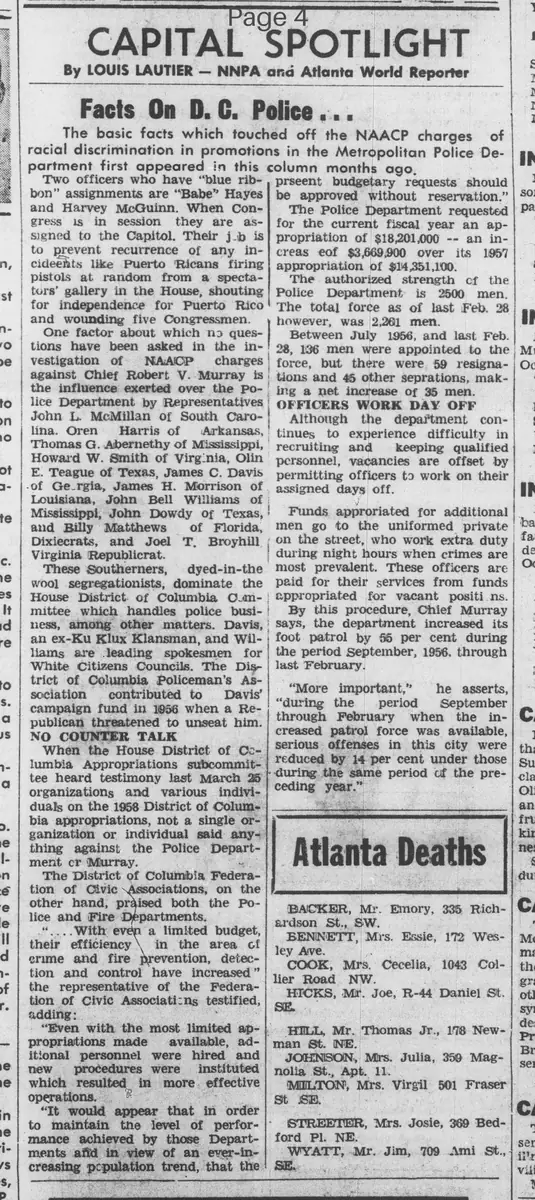
By LOUIS LAUTIER - NNPA and Atlanta World Reporter
Facts On D. C. Police ...
The basic facts which touched off the NAACP charges of racial discrimination in promotions in the Metropolitan Police Department first appeared in this column months ago.
Two officers who have "blue ribbon" assignments are "Babe" Hayes and Harvey McGuinn. When Congress is in session they are assigned to the Capitol. Their job is to prevent recurrence of any incidents like Puerto Ricans firing pistols at random from a spectators' gallery in the House, shouting for independence for Puerto Rico and wounding five Congressmen.
One factor about which no questions have been asked in the investigation of NAACP charges against Chief Robert V. Murray is the influence exerted over the Police Department by Representatives John L. McMillan of South Carolina, Oren Harris of Arkansas, Thomas G. Abernethy of Mississippi, Howard W. Smith of Virginia, Olin E. Teague of Texas, James C. Davis of Georgia, James H. Morrison of Louisiana, John Bell Williams of Mississippi, John Dowdy of Texas, and Billy Matthews of Florida, Dixiecrats, and Joel T. Broyhill Virginia Republicrat.
These Southerners, dyed-in-the-wool segregationists, dominate the House District of Columbia Committee which handles police business, among other matters. Davis, an ex-Ku Klux Klansman, and Williams are leading spokesmen for White Citizens Councils. The District of Columbia Policeman's Association contributed to Davis' campaign fund in 1956 when a Republican threatened to unseat him.
NO COUNTER TALK
When the House District of Columbia Appropriations subcommittee heard testimony last March 25 organizations and various individuals on the 1958 District of Columbia appropriations, not a single organization or individual said anything against the Police Department or Murray.
The District of Columbia Federation of Civic Associations, on the other hand, praised both the Police and Fire Departments.
"With even a limited budget, their efficiency in the area of crime and fire prevention, detection and control have increased" the representative of the Federation of Civic Associations testified, adding:
"Even with the most limited appropriations made available, additional personnel were hired and new procedures were instituted which resulted in more effective operations."
It would appear that in order to maintain the level of performance achieved by those Departments and in view of an ever-increasing population trend, that the present budgetary requests should be approved without reservation."
The Police Department requested for the current fiscal year an appropriation of $18,201,000 -- an increase of $3,669,900 over its 1957 appropriation of $14,351,100.
The authorized strength of the Police Department is 2500 men.
The total force as of last Feb. 28 however, was 2,261 men.
Between July 1956, and last Feb. 28, 136 men were appointed to the force, but there were 59 resignations and 45 other separations, making a net increase of 35 men.
OFFICERS WORK DAY OFF
Although the department continues to experience difficulty in recruiting and keeping qualified personnel, vacancies are offset by permitting officers to work on their assigned days off.
Funds appropriated for additional men go to the uniformed private on the street, who work extra duty during night hours when crimes are most prevalent. These officers are paid for their services from funds appropriated for vacant positions.
By this procedure, Chief Murray says, the department increased its foot patrol by 55 per cent during the period September, 1956 through last February.
"More important," he asserts, "during the period September through February when the increased patrol force was available, serious offenses in this city were reduced by 14 per cent under those during the same period of the preceding year."
What sub-type of article is it?
What themes does it cover?
What keywords are associated?
What entities or persons were involved?
Where did it happen?
Story Details
Key Persons
Location
Washington D.C.
Event Date
1956 1957
Story Details
NAACP charges racial discrimination in D.C. police promotions; Southern segregationist congressmen influence department via House committee; no criticism during March 25, 1957 appropriations hearing; police praised for efficiency despite budget limits; staffing shortages managed by overtime, leading to increased patrols and reduced crime.