Thank you for visiting SNEWPapers!
Sign up free
Editorial
August 20, 1818
Daily National Intelligencer
Washington, District Of Columbia
What is this article about?
The editorial defends American literary and political writings against European critics, praising documents like the Declaration of Independence, Washington's Farewell Address, and state papers as superior, while criticizing the Edinburgh Review's dismissal and noting efforts to promote American works in London.
Clipping
OCR Quality
98%
Excellent
Full Text
AMERICAN LITERATURE.
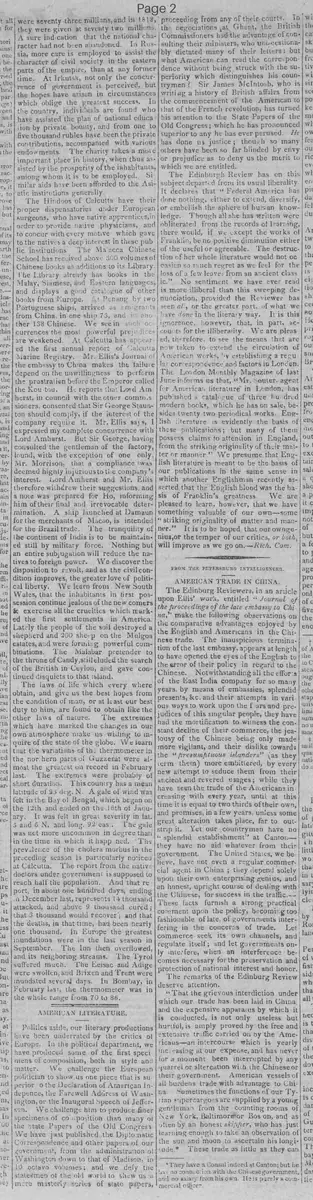
Politics aside, our literary productions have been underrated by the critics of Europe. In the political department, we have produced some of the first specimens of composition, both in style and matter. We challenge the European politician to show us one piece that is superior to the Declaration of American Independence, the Farewell Address of Washington, or the Inaugural Speech of Jefferson. We challenge him to produce finer specimens of composition than many of the state Papers of the Old Congress. We have just published the Diplomatic Correspondence and other papers of our government, from the administration of Washington down to that of Madison, in 10 octavo volumes: and we defy the statesmen of the old world to shew us a more masterly series of state papers, proceeding from any of their courts. In the negociations at Ghent, the British Commissioners had the advantage of consulting their ministers, who unquestionably dictated many of their letters: but what American can read the correspondence without being struck with the superiority which distinguishes his countrymen? Sir James McIntosh, who is writing a history of British affairs from the commencement of the American to that of the French revolution, has turned his attention to the State Papers of the Old Congress; which he has pronounced superior to any he has ever perused. He has done us justice; though so many others have been so far blinded by envy or prejudice as to deny us the merit to which we are entitled.
The Edinburgh Review has on this subject departed from its usual liberality. It declares that "Federal America has done nothing, either to extend, diversify, or embellish the sphere of human knowledge. Though all she has written were obliterated from the records of learning, there would, if we except the works of Franklin, be no positive diminution either of the useful or agreeable. The destruction of her whole literature would not occasion so much regret as we feel for the loss of a few leaves from an ancient classic." No sentiment we have ever read is more illiberal than this sweeping denunciation, provided the Reviewer has seen all, or the greater part, of what we have done in the literary way. It is this ignorance, however, that, in part, accounts for the illiberality. We are pleased, therefore, to see the means that are now taken to extend the circulation of American works, by establishing a regular correspondence and factors in London. The London Monthly Magazine of last June informs us that, "Mr. Souter, agent for America, literature in London, has published a catalogue of three hundred modern books, which he has on sale, besides twenty two periodical works. English literature is evidently the basis of these publications; but many of them possess claims to attention in England, from the striking originality of their matter or manner." We presume that English literature is meant to be the basis of our publications in the same sense in which another Englishman recently asserted that the English blood was the basis of Franklin's greatness. We are pleased to learn, however, that we have something valuable of our own—some "striking originality of matter and manner." It is to be hoped that our own genius, or the temper of our critics, or both, will improve as we go on.—Rich. Com.
Politics aside, our literary productions have been underrated by the critics of Europe. In the political department, we have produced some of the first specimens of composition, both in style and matter. We challenge the European politician to show us one piece that is superior to the Declaration of American Independence, the Farewell Address of Washington, or the Inaugural Speech of Jefferson. We challenge him to produce finer specimens of composition than many of the state Papers of the Old Congress. We have just published the Diplomatic Correspondence and other papers of our government, from the administration of Washington down to that of Madison, in 10 octavo volumes: and we defy the statesmen of the old world to shew us a more masterly series of state papers, proceeding from any of their courts. In the negociations at Ghent, the British Commissioners had the advantage of consulting their ministers, who unquestionably dictated many of their letters: but what American can read the correspondence without being struck with the superiority which distinguishes his countrymen? Sir James McIntosh, who is writing a history of British affairs from the commencement of the American to that of the French revolution, has turned his attention to the State Papers of the Old Congress; which he has pronounced superior to any he has ever perused. He has done us justice; though so many others have been so far blinded by envy or prejudice as to deny us the merit to which we are entitled.
The Edinburgh Review has on this subject departed from its usual liberality. It declares that "Federal America has done nothing, either to extend, diversify, or embellish the sphere of human knowledge. Though all she has written were obliterated from the records of learning, there would, if we except the works of Franklin, be no positive diminution either of the useful or agreeable. The destruction of her whole literature would not occasion so much regret as we feel for the loss of a few leaves from an ancient classic." No sentiment we have ever read is more illiberal than this sweeping denunciation, provided the Reviewer has seen all, or the greater part, of what we have done in the literary way. It is this ignorance, however, that, in part, accounts for the illiberality. We are pleased, therefore, to see the means that are now taken to extend the circulation of American works, by establishing a regular correspondence and factors in London. The London Monthly Magazine of last June informs us that, "Mr. Souter, agent for America, literature in London, has published a catalogue of three hundred modern books, which he has on sale, besides twenty two periodical works. English literature is evidently the basis of these publications; but many of them possess claims to attention in England, from the striking originality of their matter or manner." We presume that English literature is meant to be the basis of our publications in the same sense in which another Englishman recently asserted that the English blood was the basis of Franklin's greatness. We are pleased to learn, however, that we have something valuable of our own—some "striking originality of matter and manner." It is to be hoped that our own genius, or the temper of our critics, or both, will improve as we go on.—Rich. Com.
What sub-type of article is it?
American Literature
Cultural Nationalism
What keywords are associated?
American Literature
European Critics
State Papers
Edinburgh Review
Diplomatic Correspondence
Originality
Ghent Negotiations
What entities or persons were involved?
Declaration Of American Independence
Washington
Jefferson
Old Congress
Franklin
Sir James Mcintosh
Edinburgh Review
Mr. Souter
Editorial Details
Primary Topic
Defense Of American Literary Productions Against European Critics
Stance / Tone
Proud And Defiant
Key Figures
Declaration Of American Independence
Washington
Jefferson
Old Congress
Franklin
Sir James Mcintosh
Edinburgh Review
Mr. Souter
Key Arguments
American Political Writings Superior To European Equivalents
State Papers Of Old Congress And Diplomatic Correspondence Unmatched
Edinburgh Review's Criticism Illiberal And Ignorant
American Works Show Striking Originality
Efforts To Promote American Literature In London Promising