Thank you for visiting SNEWPapers!
Sign up free
Story
November 17, 1875
The Central Presbyterian
Richmond, Virginia
What is this article about?
Dr. B. W. Richardson explains how passions like anger, fear, hatred, and grief severely impact physical health, while love, pure ambition, and avarice can sustain or preserve it when not debased.
Clipping
OCR Quality
98%
Excellent
Full Text
The Passions that Induce Disease.
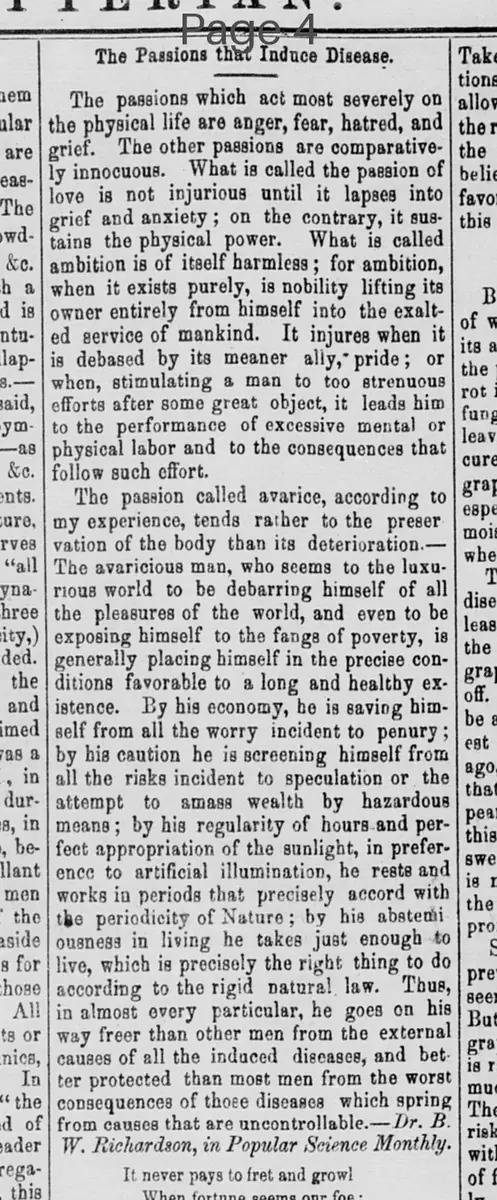
The passions which act most severely on the physical life are anger, fear, hatred, and grief. The other passions are comparatively innocuous. What is called the passion of love is not injurious until it lapses into grief and anxiety; on the contrary, it sustains the physical power. What is called ambition is of itself harmless; for ambition, when it exists purely, is nobility lifting its owner entirely from himself into the exalted service of mankind. It injures when it is debased by its meaner ally, pride; or when, stimulating a man to too strenuous efforts after some great object, it leads him to the performance of excessive mental or physical labor and to the consequences that follow such effort.
The passion called avarice, according to my experience, tends rather to the preservation of the body than its deterioration. The avaricious man, who seems to the luxurious world to be debarring himself of all the pleasures of the world, and even to be exposing himself to the fangs of poverty, is generally placing himself in the precise conditions favorable to a long and healthy existence. By his economy, he is saving himself from all the worry incident to penury; by his caution he is screening himself from all the risks incident to speculation or the attempt to amass wealth by hazardous means; by his regularity of hours and perfect appropriation of the sunlight, in preference to artificial illumination, he rests and works in periods that precisely accord with the periodicity of Nature: by his abstemiousness in living he takes just enough to live, which is precisely the right thing to do according to the rigid natural law. Thus, in almost every particular, he goes on his way freer than other men from the external causes of all the induced diseases, and better protected than most men from the worst consequences of those diseases which spring from causes that are uncontrollable.—Dr. B. W. Richardson, in Popular Science Monthly.
The passions which act most severely on the physical life are anger, fear, hatred, and grief. The other passions are comparatively innocuous. What is called the passion of love is not injurious until it lapses into grief and anxiety; on the contrary, it sustains the physical power. What is called ambition is of itself harmless; for ambition, when it exists purely, is nobility lifting its owner entirely from himself into the exalted service of mankind. It injures when it is debased by its meaner ally, pride; or when, stimulating a man to too strenuous efforts after some great object, it leads him to the performance of excessive mental or physical labor and to the consequences that follow such effort.
The passion called avarice, according to my experience, tends rather to the preservation of the body than its deterioration. The avaricious man, who seems to the luxurious world to be debarring himself of all the pleasures of the world, and even to be exposing himself to the fangs of poverty, is generally placing himself in the precise conditions favorable to a long and healthy existence. By his economy, he is saving himself from all the worry incident to penury; by his caution he is screening himself from all the risks incident to speculation or the attempt to amass wealth by hazardous means; by his regularity of hours and perfect appropriation of the sunlight, in preference to artificial illumination, he rests and works in periods that precisely accord with the periodicity of Nature: by his abstemiousness in living he takes just enough to live, which is precisely the right thing to do according to the rigid natural law. Thus, in almost every particular, he goes on his way freer than other men from the external causes of all the induced diseases, and better protected than most men from the worst consequences of those diseases which spring from causes that are uncontrollable.—Dr. B. W. Richardson, in Popular Science Monthly.
What sub-type of article is it?
Medical Curiosity
Curiosity
What themes does it cover?
Moral Virtue
What keywords are associated?
Passions
Disease
Anger
Fear
Hatred
Grief
Ambition
Avarice
Health
What entities or persons were involved?
Dr. B. W. Richardson
Story Details
Key Persons
Dr. B. W. Richardson
Story Details
Passions like anger, fear, hatred, and grief severely harm physical health; love sustains it unless turning to grief; pure ambition is harmless but can injure via pride or overexertion; avarice promotes longevity through economy, caution, regularity, and abstemiousness.