Thank you for visiting SNEWPapers!
Sign up free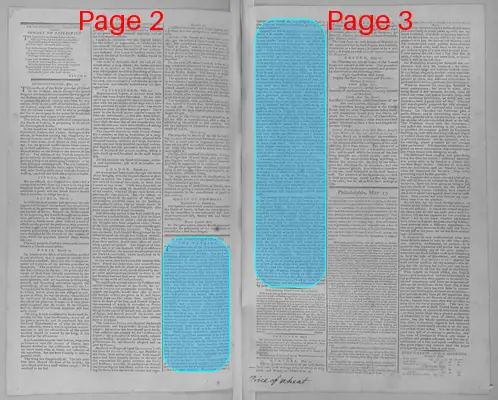
Gazette Of The United States
New York, New York County, New York
What is this article about?
An editorial from the Connecticut Courant argues against British advice for Americans to focus solely on agriculture, advocating instead for developing domestic manufactures to achieve economic independence, create a home market, and reduce dependency on imports from Britain.
Merged-components note: Continuation of the same opinion piece advocating for American economic independence through manufactures and critiquing British advice.
Clippings
1 of 2
OCR Quality
Full Text
THE PATRIOT.
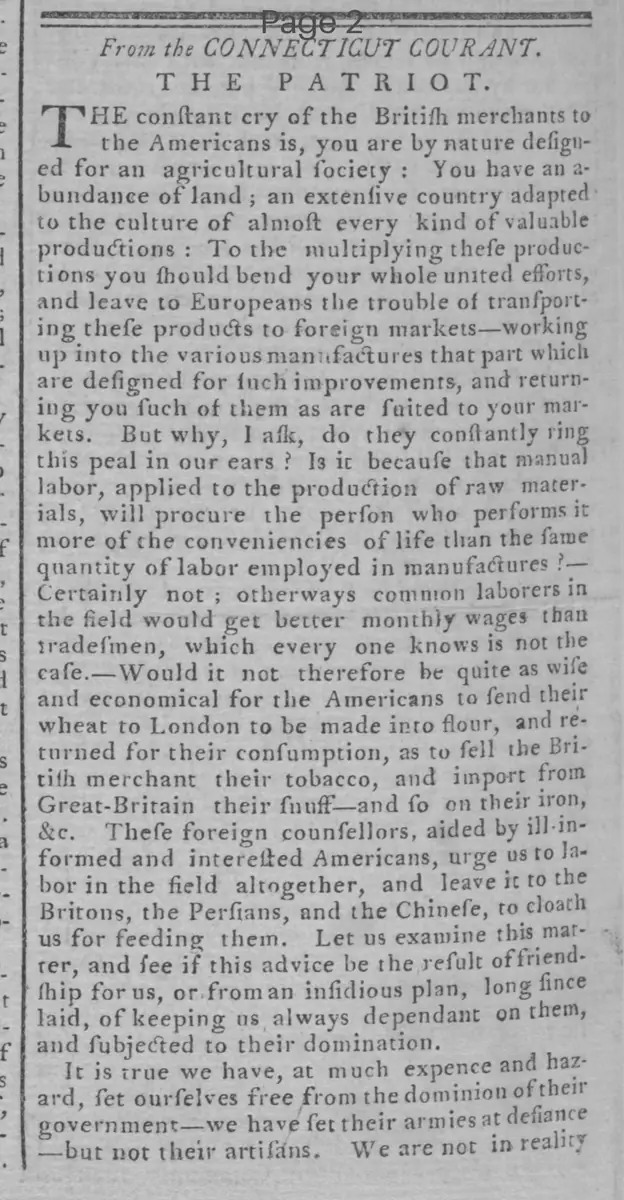
The constant cry of the British merchants to the Americans is, you are by nature designed for an agricultural society: You have an abundance of land; an extensive country adapted to the culture of almost every kind of valuable productions: To the multiplying these productions you should bend your whole united efforts, and leave to Europeans the trouble of transporting these products to foreign markets—working up into the various manufactures that part which are designed for such improvements, and returning you such of them as are suited to your markets. But why, I ask, do they constantly ring this peal in our ears? Is it because that manual labor, applied to the production of raw materials, will procure the person who performs it more of the conveniences of life than the same quantity of labor employed in manufactures?— Certainly not; otherwise common laborers in the field would get better monthly wages than tradesmen, which every one knows is not the case.—Would it not therefore be quite as wise and economical for the Americans to send their wheat to London to be made into flour, and returned for their consumption, as to sell the British merchant their tobacco, and import from Great-Britain their snuff—and so on their iron, &c. These foreign counsellors, aided by ill-informed and interested Americans, urge us to labor in the field altogether, and leave it to the Britons, the Persians, and the Chinese, to clothe us for feeding them. Let us examine this matter, and see if this advice be the result of friendship for us, or from an insidious plan, long since laid, of keeping us always dependent on them, and subjected to their domination.
It is true we have, at much expense and hazard, set ourselves free from the dominion of their government—but not their artisans. We are not in reality independent whilst we are obliged to look to them for our necessary cloathing, or even superfluous ornaments.
Suppose the whole population of this country, which is so rapidly increasing, were devoted to husbandry—what depredations would be made in our forests! How soon would our fields be clothed with every kind of grain—and our pastures filled with cattle, feeding on a thousand hills! This would be charming—no fear of a famine—every one would have food for asking for it—but what price would our provisions bring, and what is to be done with the surplus of them? Why say these wise men from the East, (and their humble retainers of this country) let the Europeans come and fetch them away, or starve.—
This is very good—and pray what are we to do if their crops should not happen to fail them—or when their kings should be tired of war, and consent that their subjects be permitted to cultivate their own fields in safety; will these foreigners, out of mere charity, come and take your superfluous crops off your hands? Will they give you a generous price for your wheat, &c.? I presume not. Pray let me ask these politicians, these friends from the other side the water, who are so alarmed lest we injure ourselves, by engaging improvidently in manufactures, why grain is dearer in England than in America.—
Our lands do not produce so many bushels on the acre as theirs—we give higher for labor, and yet we undersell them so much in market, that their farmers would be ruined if a free importation from this country was admitted. I shall probably be told that rents in that country are higher, and that causes the difference; but I demand, why are rents higher there than here? Why because the products of land will sell so much higher there than here. And why do they sell so much higher there than here? Is it for exportation? No such thing—It is because of the multitude of their mechanics and artizans, who create a constant demand for home consumption.
A home market is always the best, abating extraordinary demands that may arise from the accidental failure of crops in a foreign country; or the ruinous depredations of an enemy. The average price of wheat in England, I suppose may be stated at 6s. to 6s. 6d. sterling the bushel. When it ariseth to 7s. the bushel, their ports are opened for importation, lest the dearness of bread should injure their manufactures; but when it falls to the usual standard, their importations are prohibited, lest the farming interest should suffer.
The average price of wheat in America, taken at the farmers' houses, may be rated at 3 to 5/6 of a dollar; tho at the ports of exportation it may average one dollar. But if our country was as full of manufacturers as Great-Britain, our grain would be principally wanted for home consumption, and the price would be raised to 5s. 3d. or even 6s. sterling the bushel. The farmer would then save not only the transportation to the sea-port towns; but the subsequent storage, shipping coastwise, freight, insurance, &c. to Europe; and the price and rent of lands would rise in proportion. But this is not the whole advantage—if we can make our own cloathing, it will soon reduce the price materially, and enable them to make a saving in their purchases as well as on the sales of their crops, so that the farming interest is most intimately concerned in the success of our manufactures. Whenever wool becomes as plenty in this country as it is in England, the price of woolen goods made here will be as low as those of the same quality are in that country; and the expence of purchasing, package, storage, shipping charges, freight and insurance will be a clear saving to this country. This cannot be rated at less than 20 per cent. on all our importations.—Think of these things my countrymen, and let your Patriotism appear by your conduct.
What sub-type of article is it?
What keywords are associated?
What entities or persons were involved?
Editorial Details
Primary Topic
Advocacy For American Manufactures And Economic Independence From Britain
Stance / Tone
Pro Domestic Manufacturing And Anti British Economic Dependency
Key Figures
Key Arguments