Thank you for visiting SNEWPapers!
Sign up free
The Memphis Appeal
Memphis, Shelby County, Tennessee
What is this article about?
Progress report on the construction of a massive bridge across the Mississippi River between Arkansas and Tennessee. The first caisson is sunk 55 feet below low water; the second, nearly ready, will sink to 100 feet. Details include materials from various sources, 250 workers, and engineering challenges.
Clipping
OCR Quality
Full Text
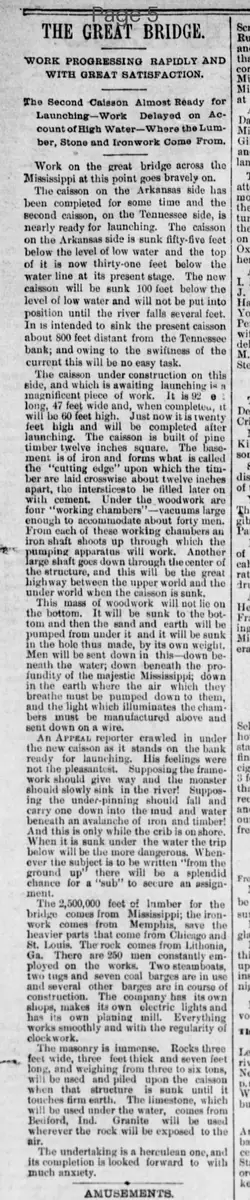
WORK PROGRESSING RAPIDLY AND WITH GREAT SATISFACTION.
The Second Caisson Almost Ready for Launching—Work Delayed on Account of High Water—Where the Lumber, Stone and Ironwork Come From.
Work on the great bridge across the Mississippi at this point goes bravely on. The caisson on the Arkansas side has been completed for some time and the second caisson, on the Tennessee side, is nearly ready for launching. The caisson on the Arkansas side is sunk fifty-five feet below the level of low water and the top of it is now thirty-one feet below the water line at its present stage. The new caisson will be sunk 100 feet below the level of low water and will not be put into position until the river falls several feet. It is intended to sink the present caisson about 50 feet distant from the Tennessee bank; and owing to the swiftness of the current this will be no easy task.
The caisson under construction on this side, and which is awaiting launching is a magnificent piece of work. It is 92 feet long, 47 feet wide and, when completed, it will be 60 feet high. Just now it is twenty feet high and will be completed after launching. The caisson is built of pine timber twelve inches square. The basement is of iron and forms what is called the "cutting edge" upon which the timber are laid crosswise about twelve inches apart, the interstices to be filled later on with cement. Under the woodwork are four "working chambers"—vacuums large enough to accommodate about forty men. From each of these working chambers an iron shaft shoots up through which the pumping apparatus will work. Another large shaft goes down through the center of the structure, and this will be the great highway between the upper world and the under world when the caisson is sunk.
This mass of woodwork will not lie on the bottom. It will be sunk to the bottom and then the sand and earth will be pumped from under it and it will be sunk in the hole thus made, by its own weight. Men will be sent down in this—down beneath the water; down beneath the profundity of the majestic Mississippi; down in the earth where the air which they breathe must be pumped down to them, and the light which illuminates the chambers must be manufactured above and sent down on a wire.
An Appeal reporter crawled in under the new caisson as it stands on the bank ready for launching. His feelings were not the pleasantest. Supposing the frame-work should give way and the monster should slowly sink in the river! Supposing the under-pinning should fall and carry one down into the mud and water beneath an avalanche of iron and timber! And this is only while the crib is on shore. When it is sunk under the water the trip below will be the more dangerous. Whenever the subject is to be written "from the ground up" there will be a splendid chance for a "sub" to secure an assignment.
The 2,500,000 feet of lumber for the bridge comes from Mississippi; the iron-work comes from Memphis, save the heavier parts that come from Chicago and St. Louis. The rock comes from Lithonia Ga. There are 250 men constantly employed on the works. Two steamboats, two tugs and seven coal barges are in use and several other barges are in course of construction. The company has its own shops, makes its own electric lights and has its own planing mill. Everything works smoothly and with the regularity of clockwork.
The masonry is immense. Rocks three feet wide, three feet thick and seven feet long, and weighing from three to six tons, will be used and piled upon the caisson when that structure is sunk until it touches firm earth. The limestone, which will be used under the water, comes from Bedford, Ind. Granite will be used wherever the rock will be exposed to the air.
The undertaking is a herculean one, and its completion is looked forward to with much anxiety.
What sub-type of article is it?
What themes does it cover?
What keywords are associated?
Where did it happen?
Story Details
Location
Across The Mississippi River Between Arkansas And Tennessee
Story Details
Construction of a great bridge across the Mississippi progresses with the first caisson sunk 55 feet below low water and the second nearly ready to launch and sink to 100 feet. Details on caisson design, materials from Mississippi, Memphis, Chicago, St. Louis, Lithonia Ga., Bedford Ind.; 250 men employed; challenges from high water and swift current.