Thank you for visiting SNEWPapers!
Sign up free
The New Hampshire Gazette And General Advertiser
Portsmouth, Exeter, Rockingham County, New Hampshire
What is this article about?
During Edward III's siege of Calais after Crecy, famine forces surrender. Mayor Eustace St. Pierre and five others volunteer to face execution to save the citizens. Sir Walter Mauny escorts them; Queen Philippa intervenes, convincing Edward to pardon and reward their heroic sacrifice.
Merged-components note: This is a continuation of the historical narrative 'A TRUE STORY' about Edward III and the siege of Calais, split across pages 1 and 2. Merged into a single story component.
Clippings
1 of 2
OCR Quality
Full Text
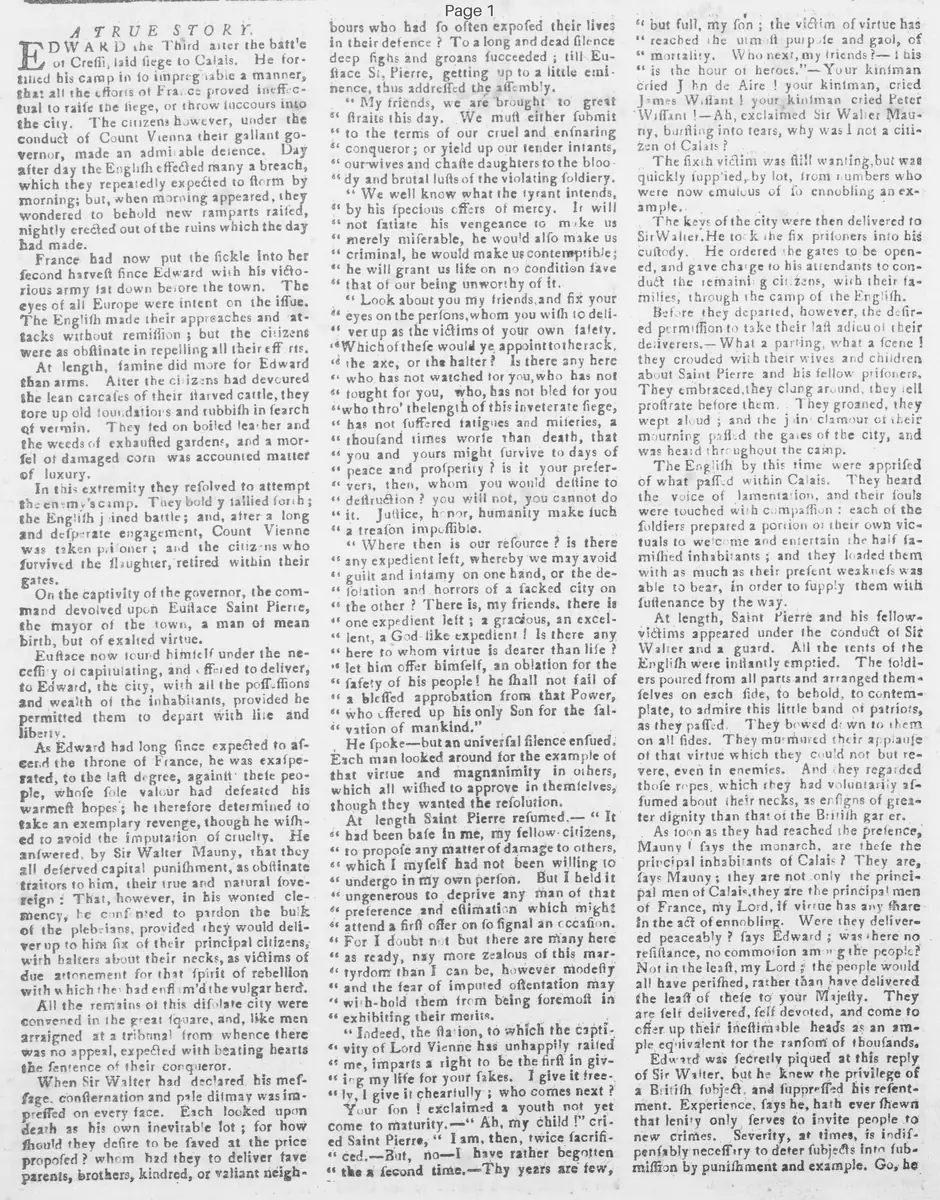
EDWARD the Third after the battle of Crecy, laid siege to Calais. He fortified his camp in so impregnable a manner, that all the efforts of France proved ineffectual to raise the siege, or throw succours into the city. The citizens however, under the conduct of Count Vienne their gallant governor, made an admirable defence. Day after day the English effected many a breach, which they repeatedly expected to storm by morning; but, when morning appeared, they wondered to behold new ramparts raised, nightly erected out of the ruins which the day had made.
France had now put the sickle into her second harvest since Edward with his victorious army laid down before the town. The eyes of all Europe were intent on the issue. The English made their approaches and attacks without remission; but the citizens were as obstinate in repelling all their efforts. At length, famine did more for Edward than arms. After the citizens had devoured the lean carcasses of their starved cattle, they tore up old foundations and rubbish in search of vermin. They fed on boiled leather and the weeds of exhausted gardens, and a morsel of damaged corn was accounted matter of luxury.
In this extremity they resolved to attempt the enemy's camp. They boldly sallied forth; the English joined battle; and, after a long and desperate engagement, Count Vienne was taken prisoner: and the citizens who survived the slaughter, retired within their gates.
On the captivity of the governor, the command devolved upon Eustace Saint Pierre, the mayor of the town, a man of mean birth, but of exalted virtue. Eustace now found himself under the necessity of capitulating, and offered to deliver, to Edward, the city, with all the possessions and wealth of the inhabitants, provided he permitted them to depart with life and liberty.
As Edward had long since expected to ascend the throne of France, he was exasperated, to the last degree, against these people, whose sole valour had defeated his warmest hopes: he therefore determined to take an exemplary revenge, though he wished to avoid the imputation of cruelty. He answered, by Sir Walter Mauny, that they all deserved capital punishment, as obstinate traitors to him, their true and natural sovereign: That, however, in his wonted clemency, he consented to pardon the bulk of the plebeians, provided they would deliver up to him six of their principal citizens, with halters about their necks, as victims of due atonement for that spirit of rebellion with which they had enslaved the vulgar herd.
All the remains of this desolate city were convened in the great square, and, like men arraigned at a tribunal from whence there was no appeal, expected with beating hearts the sentence of their conqueror.
When Sir Walter had declared his message, consternation and pale dismay was impressed on every face. Each looked upon death as his own inevitable lot: for how should they desire to be saved at the price proposed? whom had they to deliver save parents, brothers, kindred, or valiant neighbours who had so often exposed their lives in their defence? To a long and dead silence deep sighs and groans succeeded: till Eustace St. Pierre, getting up to a little eminence, thus addressed the assembly.
"My friends, we are brought to great straits this day. We must either submit to the terms of our cruel and ensnaring conqueror: or yield up our tender infants, our wives and chaste daughters to the bloody and brutal lusts of the violating soldiery. We well know what the tyrant intends, by his specious offers of mercy. It will not satiate his vengeance to make us merely miserable, he would also make us criminal, he would make us contemptible; he will grant us life on no condition save that of our being unworthy of it.
"Look about you my friends, and fix your eyes on the persons, whom you wish to deliver up as the victims of your own safety. Which of these would ye appoint to the rack, the axe, or the halter? Is there any here who has not watched for you, who has not fought for you, who has not bled for you, who thro' the length of this inveterate siege, has not suffered fatigues and miseries, a thousand times worse than death, that you and yours might survive to days of peace and prosperity? is it your preserver, then, whom you would destine to destruction? you will not, you cannot do it. Justice, honour, humanity make such a treason impossible.
"Where then is our resource? is there any expedient left, whereby we may avoid guilt and infamy on one hand, or the desolation and horrors of a sacked city on the other? There is, my friends, there is one expedient left; a gracious, an excellent, a God-like expedient! Is there any here to whom virtue is dearer than life? let him offer himself, an oblation for the safety of his people! he shall not fail of a blessed approbation from that Power, who offered up his only Son for the salvation of mankind."
He spoke--but an universal silence ensued. Each man looked around for the example of that virtue and magnanimity in others, which all wished to approve in themselves, though they wanted the resolution.
At length Saint Pierre resumed.-- "It had been base in me, my fellow-citizens, to propose any matter of damage to others, which I myself had not been willing to undergo in my own person. But I held it ungenerous to deprive any man of that preference and estimation which might attend a first offer on so signal an occasion. For I doubt not but there are many here as ready, nay more zealous of this martyrdom than I can be, however modesty and the fear of imputed ostentation may withhold them from being foremost in exhibiting their merits.
"Indeed, the station, to which the captivity of Lord Vienne has unhappily raised me, imparts a right to be the first in giving my life for your sakes. I give it freely, I give it cheerfully; who comes next?"
"Your son!" exclaimed a youth not yet come to maturity.--"Ah, my child!" cried Saint Pierre. "I am, then, twice sacrificed.--But, no--I have rather begotten the second time.--Thy years are few, but full, my son: the victim of virtue has reached the utmost purple and goal, of mortality. Who next, my friends?--This is the hour of heroes."--"Your kinsman," cried John de Aire! "your kinsman," cried James Want! "your kinsman," cried Peter Wissant!--"Ah," exclaimed Sir Walter Mauny, bursting into tears, "why was I not a citizen of Calais?"
The sixth victim was still wanting, but was quickly supplied, by lot, from numbers who were now emulous of so ennobling an example.
The keys of the city were then delivered to Sir Walter. He took the six prisoners into his custody. He ordered the gates to be opened, and gave charge to his attendants to conduct the remaining citizens, with their families, through the camp of the English.
Before they departed, however, they desired permission to take their last adieu of their deliverers.--What a parting, what a scene! they crowded with their wives and children about Saint Pierre and his fellow prisoners. They embraced, they clung around, they fell prostrate before them. They groaned, they wept aloud; and the joint clamour of their mourning passed the gates of the city, and was heard throughout the camp.
The English by this time were apprised of what passed within Calais. They heard the voice of lamentation, and their souls were touched with compassion: each of the soldiers prepared a portion of their own victuals to welcome and entertain the half-famished inhabitants: and they loaded them with as much as their present weakness was able to bear, in order to supply them with sustenance by the way.
At length, Saint Pierre and his fellow-victims appeared under the conduct of Sir Walter and a guard. All the tents of the English were instantly emptied. The soldiers poured from all parts and arranged themselves on each side, to behold, to contemplate, to admire this little band of patriots, as they passed. They bowed down to them on all sides. They murmured their applause of that virtue which they could not but revere, even in enemies. And they regarded those ropes, which they had voluntarily assumed about their necks, as ensigns of greater dignity than that of the British garter.
As soon as they had reached the presence, "Mauny," says the monarch, "are these the principal inhabitants of Calais?" "They are," says Mauny: "they are not only the principal men of Calais, they are the principal men of France, my Lord, if virtue has any share in the act of ennobling." "Were they delivered peaceably?" says Edward; "was there no resistance, no commotion among the people?" "Not in the least, my Lord: the people would all have perished, rather than have delivered the least of these to your Majesty. They are self delivered, self devoted, and come to offer up their inestimable heads as an ample equivalent for the ransom of thousands."
Edward was secretly piqued at this reply of Sir Walter, but he knew the privilege of a British subject, and suppressed his resentment. "Experience," says he, "hath ever shewn that lenity only serves to invite people to new crimes. Severity, at times, is indispensably necessary to deter subjects into submission by punishment and example. Go," cried to the officers, "lead these men to execution."
Addressing himself to Saint Pierre, "Your rebellion against me, the natural heir of your crown, is highly aggravated by your presumptuous affront of my power." "We have nothing to ask of your Majesty," said Eustace, "save what you cannot refuse us." "What is that?" "Your esteem, my Lord." (said Eustace, and went out with his companions.)
At this instant a sound of triumph was heard throughout the Camp. The queen had just arrived, with a powerful reinforcement of those gallant soldiers, at the head of whom she had conquered Scotland, and taken their king captive.
Sir Walter Mauny was to receive her Majesty, and briefly informed her of the particulars respecting the six victims.
As soon as he had been welcomed by Edward and his court, she desired a private audience. "My Lord," said she, "the question I am to enter upon is not touching the lives of a few mechanics, it respects a matter more estimable than the lives of all the natives of France. it respects the honor of the English nation. it respects the glory of my Edward, my husband, my king.
"You think you have sentenced six of your enemies to death. No, my Lord, they have sentenced themselves. and their execution would be the execution of their own orders. not the orders of Edward.
"They have behaved themselves worthily, they have behaved themselves greatly ; I cannot but respect. while I envy, while I hate them, for leaving us To share in the honour of this action, save that of granting a poor, an indispensable pardon.
"I admit they have deserved every thing that is evil at your hands, They have proved the most inveterate and efficacious of your enemies. They alone have withstood the rapid course of your conquests, and have with-held from you the crown to which you were born. Is it therefore that you would reward them? that you would gratify their desires, that you would indulge their ambition, and enwreath them with everlasting glory and applause ?
"But, if such a death would exalt mechanics over the fame of the most illustrious heroes, how would the name of my Edward, with all his triumph and honours, be tarnished thereby ! Would it not be said. that magnanimity and virtue are grown odious in the eyes of the monarch of Britain ? and that the objects, groom he destines to the punishment of felons, are the very men who deserve the praise and esteem of mankind ? The Stage on which they should suffer. would be to them the stage of honor ; but a Stage of shame to Edward, a reproach to his conquests, a dark and indelible disgrace to his name.
"No, my Lord. Let us rather disappoint the fancy ambition of these burghers, who wish to invest themselves with glory at our expence. We cannot, wholly deprive them of the merit of a sacrifice so nobly intended. but we may cut them short of their desires : in the place of that death by which their glory would be consummate, let us bury them under gifts, let us put them to shame with praise ; we shall thereby defeat them of that popular opinion which never fails to attend those who suffer in the cause of virtue.
"I am convinced; you have prevailed ; be it so," cried Edward, "prevent the execution ; have them instantly before us !"
They came, when the Queen, with an aspect and accents diffusing sweetness, thus bespoke them.—
"Natives of France. and inhabitants of Calais, you have put us to vast expence of blood and treasure in the recovery of our just and natural inheritance ; but you acted up to the best of an erroneous judgment, and we admire and honour in you that valor and virtue, by which we are so long kept out of our rightful possessions.
"You noble burghers, you excellent citizens ! tho you were tenfold the enemies of our person and our throne, we can feel nothing on our part, save respect and affection for you. You have been unfortunately misled
"We loose your chains, we snatch you from scaffold. and we thank you for that lesson of humiliation which you teach us, when you shew us that excellence is not of blood, of title. or station; that virtue gives a dignity superior to that of kings ; and that those, whom the Almighty informs with sentiments like yours, are justly and eminently gain'd above all human distinctions.
"You are now free to depart to your kinsfolk, your countrymen, to all those whose lives and liberties you have so nobly redeemed. provided you refuse not to carry with you the due tokens of our esteem.
"Yet we would rather bind you, to ourselves, by every endearing obligation ; and for this purpose, we offer to you your choice of the gifts and honours that Edward has to bestow. Rivals for fame, but always friends to virtue, we wish that England were entitled to call you her sons."
"Ah my country," exclaimed Saint Pierre, "it is now that I tremble for you. Edward could only win your cities, but Philippa conquers hearts."
What sub-type of article is it?
What themes does it cover?
What keywords are associated?
What entities or persons were involved?
Where did it happen?
Story Details
Key Persons
Location
Calais
Event Date
After The Battle Of Crecy
Story Details
After a prolonged siege and famine, Calais citizens, led by Mayor Eustace St. Pierre, send six burghers with nooses to appease Edward III and save the town. Despite Edward's intent to execute them, Queen Philippa persuades him to pardon and honor their virtuous sacrifice.