Thank you for visiting SNEWPapers!
Sign up free
The Cass County Republican
Dowagiac, Cass County, Michigan
What is this article about?
Reports on U.S. Congress proceedings in Senate and House from March 14-16, covering petitions, bills on military, slavery, gold, chaplains, and other matters, with several passed or referred.
Clipping
OCR Quality
Full Text
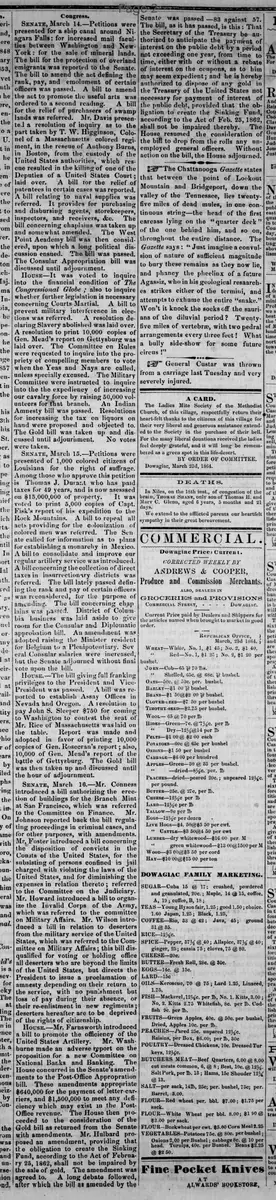
Senate, March 14.—Petitions were presented for a ship canal around Niagara Falls; for increased mail facilities between Washington and New York; for the sale of mineral lands. The bill for the protection of overland emigrants was reported to the Senate. The bill to amend the act defining the rank, pay, and emolument of certain officers was passed. A bill to amend the act to promote the useful arts was ordered to a second reading. A bill for the relief of purchasers of swamp lands was referred. Mr. Davis presented a resolution of inquiry as to the part taken by T. W. Higginson, Colonel of a Massachusetts colored regiment, in the rescue of Anthony Burns, in Boston, from the custody of the United States authorities, which rescue resulted in the killing of one of the Deputies of a United States Court; laid over. A bill for the relief of patentees in certain cases was reported. A bill relating to naval supplies was referred. It provides for purchasing and disbursing agents, storekeepers, inspectors, and receivers, &c. The bill concerning chaplains was taken up and somewhat amended. The West Point Academy bill was then considered, upon which a long political discussion ensued. The bill was passed. The Consular Appropriation bill was discussed until adjournment.
House.—It was voted to inquire into the financial condition of The Congressional Globe; also to inquire whether further legislation is necessary concerning Courts-Martial. A bill to prevent military interference in elections was referred. A resolution declaring Slavery abolished was laid over. A resolution to print 10,000 copies of Gen. Mead's report on Gettysburg was laid over. The Committee on Rules were requested to inquire into the propriety of compelling members to vote when the Yeas and Nays are called, unless specially excused. The Military Committee were instructed to inquire into the expediency of increasing our cavalry force by raising 50,000 volunteers for that branch. An Indian Amnesty bill was passed. Resolutions for increasing the tax on liquors on hand were proposed and objected to. The Gold bill was taken up and discussed until adjournment. No votes were taken.
Senate, March 15.—Petitions were presented of 1,000 colored citizens of Louisiana for the right of suffrage. Among those who approve this petition is Thomas J. Durant who has paid taxes for 49 years, and is now assessed on $15,000,000 of property. It was voted to print 5,000 copies of Capt. Fisk's report of his expedition to the Rock Mountains. A bill to repeal all acts providing for the colonization of colored men was referred. The Senate called for information as to plans for establishing a monarchy in Mexico. A bill to consolidate and improve our regular artillery service was introduced. A bill concerning the collection of direct taxes in insurrectionary districts was referred. The bill lately passed defining the rank and pay of certain officers was reconsidered, for the purpose of amending. The bill concerning chaplains was passed. District of Columbia business was laid aside to give room for the Consular and Diplomatic approbation bill. An amendment was adopted raising the Minister resident for Belgium to a Plenipotentiary. Several Consular salaries were increased, but the Senate adjourned without final vote upon the bill.
House.—The bill giving full franking privileges to the President and Vice-President was passed. A bill was reported to establish Assay Offices in Nevada and Oregon. A resolution to pay John S. Sleeper $750 for coming to Washington to contest the seat of Mr. Rice of Massachusetts was laid on the table. Report was made and adopted in favor of printing 10,000 copies of Gen. Rosecrans' report; also, 10,000 of Gen. Mead's report of the battle of Gettysburg. The Gold bill was then taken up and discussed until the hour of adjournment.
Senate, March 16.—Mr. Conness introduced a bill authorizing the erection of buildings for the Branch Mint at San Francisco, which was referred to the Committee on Finance. Mr. Johnson reported back the bill regulating proceedings in criminal cases, and for other purposes, with amendments. Mr. Foster introduced a bill concerning the disposition of convicts in the Courts of the United States, for the subsisting of persons confined in jail charged with violating the laws of the United States, and for diminishing the expenses in relation thereto; referred to the Committee on the Judiciary. Mr. Howard introduced a bill to organize the Invalid Corps of the Army, which was referred to the committee on Military Affairs. Mr. Wilson introduced a bill in relation to deserters from the military service of the United States, which was referred to the Committee on Military Affairs; this bill disqualified for voting or holding office all deserters who are beyond the limits of the United States, but directs the President to issue a proclamation of amnesty depending on their return to the service, with no punishment but loss of pay during their absence, or their re-enlistment in new regiments; deserters hereafter are to be deprived of the rights of citizenship.
House.—Mr. Farnsworth introduced a bill to promote the efficiency of the United States Artillery. Mr. Washburne made an adverse report on the proposition for a new Committee on National Banks and Banking. The House concurred in the Senate's amendments to the Post-Office Appropriation bill. These amendments appropriate $640,000 for the payment of letter-carriers, and $1,500,000 to meet any deficiency which may exist in the Post Office revenue. The House then proceeded to the consideration of the Gold bill as returned from the Senate with amendments. Mr. Hubbard proposed an amendment, providing that its obligation to create the Sinking Fund, according to the Act of February 25, 1862, shall not be impaired by the sale of gold. The amendment was agreed to. A long debate followed, after which the bill as amended by the Senate was passed—83 against 57.
The bill, as it has passed, is this: That the Secretary of the Treasury be authorized to anticipate the payment of interest on the public debt by a period not exceeding one year, from time to time, either with or without a rebate of interest on the coupons, as to him may seem expedient; and he is hereby authorized to dispose of any gold in the Treasury of the United States not necessary for payment of interest of the public debt, provided that the obligation to create the Sinking Fund, according to the Act of Feb. 25, 1862, shall not be impaired thereby.
The House resumed the consideration of the bill to drop from the rolls any unemployed general officers. Without action on the bill, the House adjourned.
What sub-type of article is it?
What keywords are associated?
What entities or persons were involved?
Where did it happen?
Domestic News Details
Primary Location
Washington
Event Date
March 14 16
Key Persons
Outcome
several bills passed including those on officers' rank and pay, chaplains, west point academy, indian amnesty, franking privileges, post-office appropriations, and the gold bill (83-57); others referred, laid over, or discussed without vote.
Event Details
Detailed account of U.S. Senate and House sessions on March 14-16, including petitions for suffrage, canals, mail; bills on military matters (deserters, artillery, Invalid Corps), slavery abolition resolution, gold and sinking fund, consular appropriations, and reports on battles like Gettysburg.