Thank you for visiting SNEWPapers!
Sign up free
The State Guard
Wetumpka, Elmore County, Alabama
What is this article about?
In April 1848, a Washington correspondent discusses subsided public anger over a slave kidnapping case, criticizes abolitionist Rep. Joshua Giddings' inflammatory congressional remarks defending fugitive slaves, praises Southern citizens' restraint compared to Northern riots, and urges stronger laws to protect slaveholders' rights amid Northern judicial failures.
Clipping
OCR Quality
Full Text
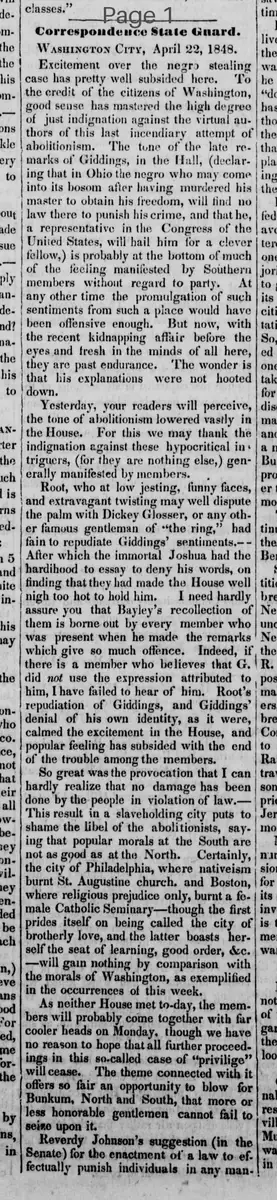
Washington City, April 22, 1848.
Excitement over the negro stealing case has pretty well subsided here. To the credit of the citizens of Washington, good sense has mastered the high degree of just indignation against the virtual authors of this last incendiary attempt of abolitionism. The tone of the late remarks of Giddings, in the Hall, (declaring that in Ohio the negro who may come into its bosom after having murdered his master to obtain his freedom, will find no law there to punish his crime, and that he, a representative in the Congress of the United States, will hail him for a clever fellow.) is probably at the bottom of much of the feeling manifested by Southern members without regard to party. At any other time the promulgation of such sentiments from such a place would have been offensive enough. But now, with the recent kidnapping affair before the eyes and fresh in the minds of all here, they are past endurance. The wonder is that his explanations were not hooted down.
Yesterday, your readers will perceive, the tone of abolitionism lowered vastly in the House. For this we may thank the indignation against these hypocritical intriguers, (for they are nothing else,) generally manifested by members.
Root, who at low jesting, funny faces, and extravagant twisting may well dispute the palm with Dickey Glosser, or any other famous gentleman of the ring, had fain to repudiate Giddings' sentiments. After which the immortal Joshua had the hardihood to essay to deny his words, on finding that they had made the House well nigh too hot to hold him. I need hardly assure you that Bayley's recollection of them is borne out by every member who was present when he made the remarks which give so much offence. Indeed, if there is a member who believes that G. did not use the expression attributed to him, I have failed to hear of him. Root's repudiation of Giddings, and Giddings denial of his own identity, as it were, calmed the excitement in the House, and popular feeling has subsided with the end of the trouble among the members.
So great was the provocation that I can hardly realize that no damage has been done by the people in violation of law. This result in a slaveholding city puts to shame the libel of the abolitionists, saying that popular morals at the South are not as good as at the North. Certainly, the city of Philadelphia, where nativism burnt St. Augustine church, and Boston, where religious prejudice only, burnt a female Catholic Seminary—though the first prides itself on being called the city of brotherly love, and the latter boasts herself the seat of learning, good order, &c.—will gain nothing by comparison with the morals of Washington, as exemplified in the occurrences of this week.
As neither House met to-day, the members will probably come together with far cooler heads on Monday, though we have no reason to hope that all further proceedings in this so-called case of "privilege" will cease. The theme connected with it offers so fair an opportunity to blow for Bunkum, North and South, that more or less honorable gentlemen cannot fail to seize upon it.
Reverdy Johnson's suggestion (in the Senate) for the enactment of a law to effectually punish individuals in any manner interfering with the rights of slave holders in this District to their slaves, will probably be carried out, if he exerts himself to keep the subject before Congress. Otherwise, the spirit of abolitionism will defeat it. This affair will probably end in the adoption of well-matured measures on the part of Southern States, to compel, in some way or other, the observance of the compromises of the Constitution as to the right of slaveholders to reclaim runaway negroes, finding refuge in non-slaveholding States. It is notorious that in almost all cases of late years, Northern courts of law have failed to protect and insure the slave holder in the recovery of his runaway slave. This Washington kidnapping matter is in a manner the result of the action of the Northern courts, proving that the South must do something to cure the evil, or for the future submit to whatever abolitionism wills, in the way of slavery.
B.
What sub-type of article is it?
What themes does it cover?
What keywords are associated?
What entities or persons were involved?
Letter to Editor Details
Author
B.
Recipient
State Guard
Main Argument
the recent slave kidnapping in washington highlights abolitionist hypocrisy, as seen in giddings' offensive congressional remarks; southern citizens showed moral restraint, and stronger laws are needed to enforce constitutional protections for slaveholders against northern interference.
Notable Details