Thank you for visiting SNEWPapers!
Sign up free
Virginia Argus
Richmond, Virginia
What is this article about?
Report from Fort Stoddart on British naval and troop movements threatening Mobile Point and Fort Bowyer in February 1815, including landings, heavy firing, and shortages of provisions amid fears of severe suffering.
Clipping
OCR Quality
Full Text
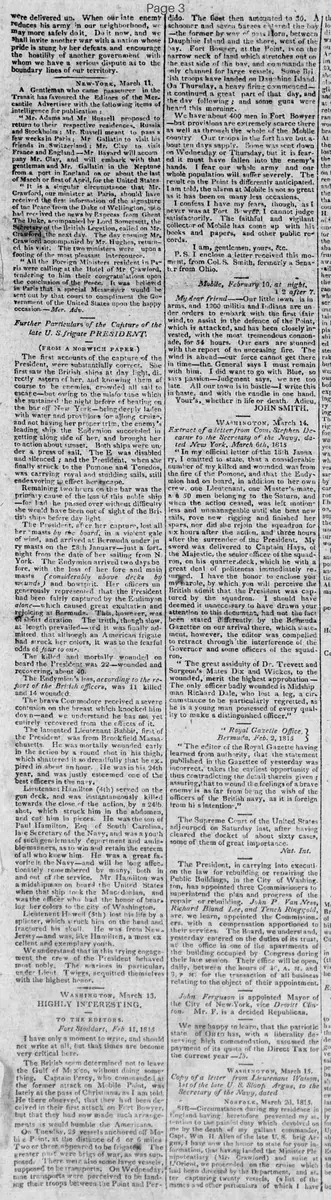
HIGHLY INTERESTING.
TO THE EDITORS.
Fort Stoddart, Feb 11, 1815
I have only a moment to write, and should not write at all, but that times are become very critical here.
The British seem determined not to leave the Gulf of Mexico, without doing something. Captain Percy, who commanded at the former attack on Mobile Point, was lately at the pass of Christiana, as I am told. He there observed, that they had been deceived in their first attack on Fort Bowyer, but that they had now made such arrangements as would humble the Americans.
On Tuesday, 25 vessels anchored off Mobile Point, at the distance of 6 or 7 miles. Two or three appeared to be frigates. The greater part were brigs of war, as was supposed. There were also some large vessels, supposed to be transports. On Wednesday, nine transports were perceived to be landing their troops between the Point and Perdido. The fleet then amounted to 30. A schooner and seven barges entered the bay—the former by way of pass Horn, between Dauphine Island and the shore, west of the bay. Fort Bowyer, at the Point, is on the narrow neck of land which stretches out on the east side of the bay, and commands the only channel for large vessels. Some British troops have landed on Dauphine Island.
On Thursday, a heavy firing commenced—it continued a great part of that day, and the day following; and some guns were heard this morning.
We have about 400 men in Fort Bowyer—but provisions are extremely scarce there as well as through the whole of the Mobile country. Our troops in the fort have but about ten days supply. Some was sent down on Wednesday or Thursday, but it is feared it must have fallen into the enemy's hands. I fear our whole army and our whole population will suffer severely. The result on the Point is differently anticipated. I am told, the alarm at Mobile is not so great as it has been on many less occasions.
I confess I have my fears, though, as I never was at Fort Bowyer, I cannot judge satisfactorily. The faithful and vigilant collector of Mobile has come up with his books and papers, and other public records.
I am, gentlemen, yours, &c.
P.S. I enclose a letter received this moment, from Col. S. Smith, formerly a Senator from Ohio.
Mobile, February 10, at night, 12 after 7.
My dear friend—Our little town is in arms, and 1200 militia and Indians are under orders to embark with the first fair wind, to assist in the defence of the Point, which is attacked, and has been closely invested, with the most tremendous cannonade, for 54 hours. Our ears are stunned with the report of an unceasing fire. The wind is ahead—our force cannot get there in time—the General says I must remain with him. I did want to go with Blue, so says passion—Judgment says, we are too late. All our town is in bustle. I write this in haste, and with the candle in one hand.
Your's, whether in life or death. Adieu,
JOHN SMITH,
What sub-type of article is it?
What keywords are associated?
What entities or persons were involved?
Where did it happen?
Domestic News Details
Primary Location
Fort Bowyer
Event Date
Feb 11, 1815
Key Persons
Outcome
provisions scarce with only ten days supply at fort bowyer; fears of severe suffering for army and population; ongoing heavy firing with no final result reported.
Event Details
British fleet of 30 vessels including frigates, brigs, and transports anchored off Mobile Point; troops landed between Point and Perdido and on Dauphine Island; schooner and barges entered bay; heavy firing commenced Thursday and continued; 400 men defend Fort Bowyer; 1200 militia and Indians in Mobile prepare to assist but delayed by wind.