Thank you for visiting SNEWPapers!
Sign up free
Editorial
July 16, 1936
Mcallen Daily Monitor
Mcallen, Brownsville, Harlingen, Hidalgo County, Cameron County, Texas
What is this article about?
The editorial discusses a Texas Supreme Court ruling affirming the state railroad commission's authority to regulate commercial trucks, including warrantless searches. It supports such oversight for highway safety and order, criticizing attempts to halt inspections and urging legislative solutions instead of court challenges.
Clipping
OCR Quality
95%
Excellent
Full Text
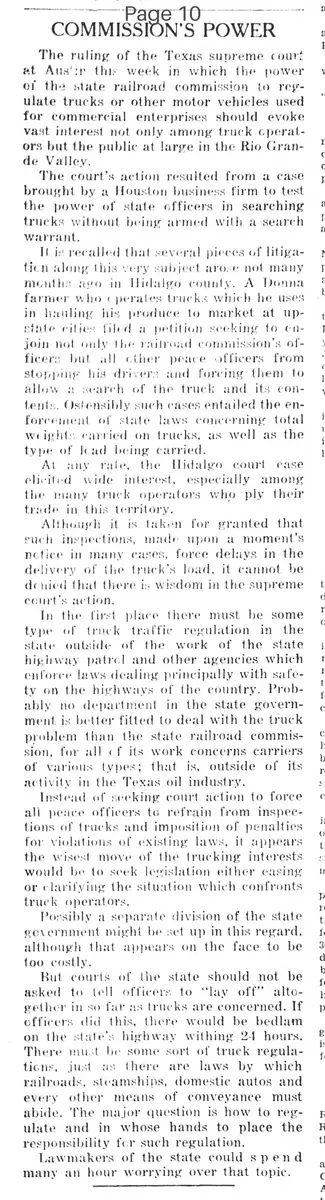
COMMISSION'S POWER
The ruling of the Texas supreme court at Austin this week in which the power of the state railroad commission to regulate trucks or other motor vehicles used for commercial enterprises should evoke vast interest not only among truck operators but the public at large in the Rio Grande Valley.
The court's action resulted from a case brought by a Houston business firm to test the power of state officers in searching trucks without being armed with a search warrant.
It is recalled that several pieces of litigation along this very subject arose not many months ago in Hidalgo county. A Donna farmer who operates trucks which he uses in hauling his produce to market at up-state cities filed a petition seeking to enjoin not only the railroad commission's officers but all other peace officers from stopping his drivers and forcing them to allow a search of the truck and its contents. Ostensibly such cases entailed the enforcement of state laws concerning total weight carried on trucks, as well as the type of load being carried.
At any rate, the Hidalgo court case elicited wide interest, especially among the many truck operators who ply their trade in this territory.
Although it is taken for granted that such inspections, made upon a moment's notice in many cases, force delays in the delivery of the truck's load, it cannot be denied that there is wisdom in the supreme court's action.
In the first place there must be some type of truck traffic regulation in the state outside of the work of the state highway patrol and other agencies which enforce laws dealing principally with safety on the highways of the country. Probably no department in the state government is better fitted to deal with the truck problem than the state railroad commission, for all of its work concerns carriers of various types; that is, outside of its activity in the Texas oil industry.
Instead of seeking court action to force all peace officers to refrain from inspections of trucks and imposition of penalties for violations of existing laws, it appears the wisest move of the trucking interests would be to seek legislation either easing or clarifying the situation which confronts truck operators.
Possibly a separate division of the state government might be set up in this regard, although that appears on the face to be too costly.
But courts of the state should not be asked to tell officers to "lay off" altogether in so far as trucks are concerned. If officers did this, there would be bedlam on the state's highway within 24 hours.
There must be some sort of truck regulations, just as there are laws by which railroads, steamships, domestic autos and every other means of conveyance must abide. The major question is how to regulate and in whose hands to place the responsibility for such regulation.
Lawmakers of the state could spend many an hour worrying over that topic.
The ruling of the Texas supreme court at Austin this week in which the power of the state railroad commission to regulate trucks or other motor vehicles used for commercial enterprises should evoke vast interest not only among truck operators but the public at large in the Rio Grande Valley.
The court's action resulted from a case brought by a Houston business firm to test the power of state officers in searching trucks without being armed with a search warrant.
It is recalled that several pieces of litigation along this very subject arose not many months ago in Hidalgo county. A Donna farmer who operates trucks which he uses in hauling his produce to market at up-state cities filed a petition seeking to enjoin not only the railroad commission's officers but all other peace officers from stopping his drivers and forcing them to allow a search of the truck and its contents. Ostensibly such cases entailed the enforcement of state laws concerning total weight carried on trucks, as well as the type of load being carried.
At any rate, the Hidalgo court case elicited wide interest, especially among the many truck operators who ply their trade in this territory.
Although it is taken for granted that such inspections, made upon a moment's notice in many cases, force delays in the delivery of the truck's load, it cannot be denied that there is wisdom in the supreme court's action.
In the first place there must be some type of truck traffic regulation in the state outside of the work of the state highway patrol and other agencies which enforce laws dealing principally with safety on the highways of the country. Probably no department in the state government is better fitted to deal with the truck problem than the state railroad commission, for all of its work concerns carriers of various types; that is, outside of its activity in the Texas oil industry.
Instead of seeking court action to force all peace officers to refrain from inspections of trucks and imposition of penalties for violations of existing laws, it appears the wisest move of the trucking interests would be to seek legislation either easing or clarifying the situation which confronts truck operators.
Possibly a separate division of the state government might be set up in this regard, although that appears on the face to be too costly.
But courts of the state should not be asked to tell officers to "lay off" altogether in so far as trucks are concerned. If officers did this, there would be bedlam on the state's highway within 24 hours.
There must be some sort of truck regulations, just as there are laws by which railroads, steamships, domestic autos and every other means of conveyance must abide. The major question is how to regulate and in whose hands to place the responsibility for such regulation.
Lawmakers of the state could spend many an hour worrying over that topic.
What sub-type of article is it?
Legal Reform
Economic Policy
Infrastructure
What keywords are associated?
Truck Regulation
Railroad Commission
Supreme Court Ruling
Warrantless Searches
Highway Safety
Legislative Reform
What entities or persons were involved?
Texas Supreme Court
State Railroad Commission
Houston Business Firm
Hidalgo County
Donna Farmer
Editorial Details
Primary Topic
Texas Supreme Court Ruling On Railroad Commission's Truck Regulation Powers
Stance / Tone
Supportive Of Regulation And Legislative Solutions
Key Figures
Texas Supreme Court
State Railroad Commission
Houston Business Firm
Hidalgo County
Donna Farmer
Key Arguments
Supreme Court Affirms Railroad Commission's Power To Regulate Trucks And Conduct Warrantless Searches
Inspections Cause Delays But Are Necessary For Safety And Order
Railroad Commission Is Well Suited To Handle Truck Regulation
Trucking Interests Should Seek Legislation Rather Than Court Injunctions Against Inspections
Complete Halt To Inspections Would Cause Chaos On Highways
Regulation Is Essential Like For Other Transport Modes