Thank you for visiting SNEWPapers!
Sign up free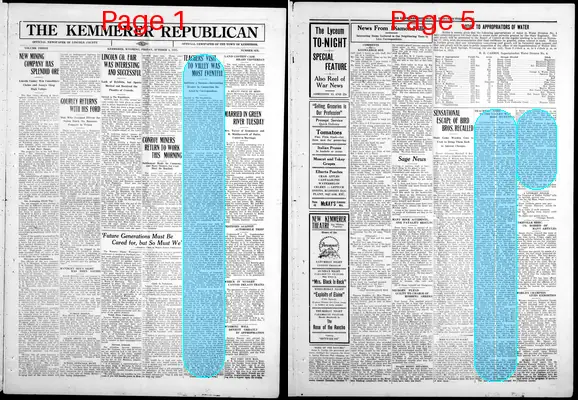
The Kemmerer Republican
Kemmerer, Lincoln County, Wyoming
What is this article about?
The third annual teachers' institute in Afton, Wyoming, from September 20-25, attracted over 100 educators for sessions on teaching essentials, citizenship, and the European war, plus visits to an elk farm, creamery, geyser, and social events like dances and a play.
Merged-components note: Story continued across pages 1 and 5; merged based on explicit 'Continued on Page Five' cue and matching topic.
Clippings

1 of 2
OCR Quality
Full Text
TO VALLEY WAS
MOST EVENTFUL
Institute a Success-Interesting Events In Connection Related by Correspondent.
Special to The Republican.
AFTON, September 25.-Afton has been honored the past week with the convention of teachers who came into the valley to attend the third annual teachers' institute. Early Monday morning, the 20th, twelve automobiles left for Cokeville, where it was whispered, about fifty school marms awaited transportation, and more than one young man wished for the time being that he was a chauffeur. Along about 4 o'clock they began to arrive, and it didn't matter very much which way one happened to be going one was sure to meet a bevy of young ladies. At first it was wondered where all the visitors were going to stay, for certainly there was no hotel that could accommodate so many at one time, but upon inquiry it was learned that the big-hearted residents of Afton had prepared for the comfort and entertainment of the visitors and if table's didn't have an extra place at it during mealtime it was no fault of Mr. Majors'.
Tuesday morning work began in earnest. Institute opened as per schedule, with about a hundred teachers in attendance. Bishop L. C. Jensen opened the session with invocation and an address. Dr. J. O. Creagor of the State University then talked on the "Essentials of Teaching," emphasizing the fact that all should be expert in their line of business; if they had chosen the teaching profession as a means of livelihood they should at least be expert in it. He also said that methods of teaching changed; that they were not the same now as they were 20 or 30 years ago; that if they were we would not be making any progress in the profession, but merely stand still. He said that the school curriculum should be sifted down until those things that had some utility value were being taught. By utility value he explained that he meant that at some time, some place, somewhere, these subjects that the boy or girl was learning would have some direct or indirect bearing upon the human or social needs of the race. Social needs are constantly changing, therefore the school curriculum must necessarily change; select the non-essentials and the obsolete from the course of study and replace them with something that has a utility value.
An open discussion was held, in which all teachers were invited to take part. All agreed that the essential subjects, such as English, history, spelling, reading, arithmetic and science should be required of all students before graduation and that each student should be master of them. After a short recess departmental work was taken up. Dr. Creagor gave work for the high school and upper grades and Miss Adsit work for the primary and lower grades. Dr. Creagor said in a talk to his division that the real aim of high school work was that it made students better citizens. He defined a good citizen as a man who makes his own living and a little more; a man who lives his own life and a little more; a man who does his own thinking and a little more. All these things tend to bring about greater social efficiency, which is the big item in this business of life.
Prof. A. L. Burgoon of Diamondville read an interesting paper in the afternoon, dwelling on the value of an education, as estimated in dollars and cents. "An education," said Professor Burgoon, "provides individuals with power which in turn enables them to battle with the world in a more efficient way."
Prof. Jack Major of the Star Valley high school, gave a very interesting talk on the European war. Mr. Major has been following this situation since it started on the Continent. He pointed out the fact very clearly that we, as an American people, are inclined to look at the present war through the eyes of the other side; that is, if our ancestors happen to be English we favor the allies and so on. But we should take the attitude of an American and look at this great war through the eyes of an American. Mr. Major added that figures show that Germany has the smaller number of men and the allies have the larger number, but that Germany has been preparing for war since 1871; that Germany has a system of compulsory military service which requires that every male citizen between the ages of 18 and 21 shall serve three years in military training. Thus, she has drawn from every station of life men who have had military training for this great war she is waging. As an American the American people should ask themselves the question of how they are going to get off if the United States should become involved in the present war. No doubt there would be a million men enlisted before nightfall, but these million men would be the cream of the population, while the men who make up the greater half of the population or the slums, would stay at home. Mr. Major cited Mr. Roosevelt's article in the Outlook, and said that it was a fine article, that there was more truth in it than some people
(Continued on Page Five,)
TEACHERS' VISIT
TO THE VALLEY WAS
MOST EVENTFUL
(Continued From Page One.)
cared to admit.
Mr. Major also said
that he wasn't a prophet or a seven-
day wonder, but that from what he
had read and studied, that he was of
the opinion that the present European
war would last something like18
months more.
T. B. McDonough. of the state de-
partment of public instruction, gave
an address Thursday. Mr. McDon-
oung explained the newlaw relating
to the registration of certificates and
also gave the assembly some idea of
the work that was being carried on in
his department.
Bishop Lowe addressed the teachers
and complimented them upon the work
they were doing and upon the work
they were going to do for the boys
and girls who were growing up.
Bishop Lowe said that he believed a
great deal depended upon the teach-
ers and thatthey could do a great
deal toward making students better
citizens. After his talk he very
kindly invited the convention to visit
his elk farm and view his magnificent
collection of elk. All were unani-
mously in favor and all journeyed
over to the farm. The bishop has
some very beautiful animals. includ-
ing one monstrous elk which has a
magnificent set of horns. Many ko-
dak pictures were taken of the ani-
mals.
At the institute Professor Burch of
Kemmerer led an open discussion for
the teachers on certain rules connect-
ed with school work.
Governor Kendrick and Dr. Duni-
way addressed those assembled at in-
stitute. The governor spoke upon the
influence of the teachers over their
students; of the opportunities offered
by the great state of Wyoming and
emphasized the fact that the children
should be taught patriotism, both to
the state and to the country.
The high school choir. under the
direction of Mr. Allred. rendered nu-
merous musical selections. Mrs.
Hood and Miss Hood favored with se-
lections. also Miss Roberts and the
boys' quartet. Miss Ada Collins of
Kemmerer gave a delightful reading
Dach number was much enjoyed.
In connection with the institute an
expedition was made to the Burton
creamery. which is one of the largest
cheese factories in the United States.
This creamery makes a carload of
cheese everysix days. The factory
uses 1,000,000 pounds of milk every
month and the payroll is $25,000 a
year, including employe and pro-
ducer. Each producer brings milk to
the creamery each morning at the
hour designated by the management.
Here it is weighed and tested. The
weight is recorded and a sample of
the milk taken and placed in a bottle
bearing the producer's check.At the
end of the week each producer re-
ceives a statement of the milk, gfving
the weight and purity for the week,
thus he knows just what percentage
of butter fat themilk is yielding, and
whether or not it is up to the stand-
ard. The creamery is doing a large
business and is working full time each
week. Everything is most sanitary
and the equipment is modern and up-
to-date. Mr. Burton very generously
served buttermilk, sweet cream and
fresh cheese to the visitors. He also
explained fully the process of butter-
and cheese making. and some of the
fair teachers rolled up their sleeves
and tried it for themselves.
Wednesday evening an auto party
motored out to Cottonwood Lake. The
party included Miss Seyfert, Misx
Christmas. Miss Anderson. Miss Gow-
ans. Miss Collins. Miss Swanson. Miss
Hardman. Miss Shreve and Miss Ruth
Adsit of the University of Wyoming
who was the honor guest.
Friday morning a party drove up to
the Swift creek geyser. They went
up in"white tops" and had a wonder-
ful time. Those included in the party
were Mrs. Pickell. Mrs. Stanley. Miss
Stanley. Miss Anderson. Miss Shreve.
Miss Hardman. Miss Wilson and Miss
Collins.
Mrs. Burton. early one morning,
four o'clock in fact. took the Misses
Hardman. Shreve. Swanson and Col-
lins on a hike. The girls climbed to
the top of a steep mountain and ford-
ed several streams. They returned
back in time to mect with institute at
8:30 and said they had been walking
all the time.
Thursday evening thevisiting
teachers were the guests of local tal-
ent who were giving a home talent
play at the opera house. Dr. Duni-
way and Attorney and Mrs. Preston
occunied a box. The members of the
company didthemselves honor in
every way and Star Valley is to be
congratulatedupon the dramatic
talent it has at its command.
The fair association arranged for
a dance each evening given in the
pavilion, which has the best hardwood
floor in the state. The hall was
crowded to it's capacity each evening
and again the teachers were the
honored guests.
A great deal of praise is due Mrs.
Nicholson for bringing the institute
into Star Valley and the able way in
which it was conducted. Praise is also
due Jack Major who so ably assisted
Mrs. Nicholson in providing for the
comfort and entertainment of the
visiting teachers. The Misses Bernice
and Esther Nicholson accompanied
Mrs. Nicholson on the trip and will
remain in the valley until she has at-
tended to other matters connected
with school work.
All who attended institute from out
side points are loud in their praise of
the beautiful little valley which lies
so isolated from railroad points, but
the roads were in good shape and the
people so congenial that they were
more than pleased. The only draw-
back at all was that it began raining
Thursday and everyone became more
or less concerned about how they were
going to get out. Those leaving Fri-
day by way of Montpelier and by
Cokeville found the roads packed very
firm and had no trouble at all but
those who left Saturday and Sunday
after the big rain, found the roads in
a muddy condition.
Following is a list of the teachers
who attended the institute and their
addresses:
What sub-type of article is it?
What themes does it cover?
What keywords are associated?
What entities or persons were involved?
Where did it happen?
Story Details
Key Persons
Location
Afton, Star Valley, Wyoming
Event Date
September 20 25
Story Details
The third annual teachers' institute in Afton featured speeches on teaching essentials, citizenship, education's value, and the European war; open discussions; departmental work; visits to an elk farm, creamery, lake, geyser, and hikes; musical performances; a play; and dances, all hosted by locals with great hospitality.