Thank you for visiting SNEWPapers!
Sign up free
Literary
April 22, 1940
Mcallen Daily Press
Mcallen, Hidalgo County, Texas
What is this article about?
In Chapter Sixteen of 'The Killer Speaks,' narrator Bill Strickland rides with Captain McDonald to the station, encounters skeptical Coroner Silver, and discusses the murder of Alfred Markham, kidnapping, crime theories, and the upcoming inquest over coffee while awaiting the morning paper's release.
Clipping
OCR Quality
95%
Excellent
Full Text
MONDAY, APRIL 22,
THE KILLER SPEAKS
By RICHARD HOUGHTON
WRITTEN FOR AND RELEASED BY CENTRAL PRESS ASSOCIATION
READ THIS FIRST:
I, Bill Strickland, am suspected in the murder of my friend, Alfred Markham, rich young jeweler, at a party at the Rio Vista club. Captain of Detectives Clyde McDonald is convinced of my innocence, but young Coroner Silver doubts me.
CHAPTER SIXTEEN
AS WE rode back from the club in the captain's car I noticed by the clock on the Valley Bank that it was past midnight, but I was not in a position to refuse his suggestion that I return to the station with him for a talk.
At the police station we found Coroner Silver standing at the desk talking with the sergeant. He turned as we entered. He was as immaculately dressed as ever. I wondered if business interfered much with his parties. His eyebrows lifted when he saw me.
"Well," greeted the captain, "what brings you here, Silver?"
The coroner frowned. "A suicide." He did not elaborate. "I see you have the man you were after."
"The man you were after, not the man I was after," McDonald corrected him with a smile. "He came to the station of his own accord—after escaping from a kidnapper."
"Kidnapper!"
"Right."
"But—"
"I know it sounds improbable," I told him. "I was knocked out by someone who was in the garden an hour after Mr. Markham's death. Louise Markham and a reporter from The Morning Eagle found me today, bound and gagged. You'll read all about it in the morning paper." I looked at the clock. "I believe it's just going to press now."
"Hang the papers! Isn't there any way we can keep them out of this, Captain?"
Captain McDonald shrugged his big shoulders. "I'm afraid Belzer is two jumps ahead of us again. He somehow got Miss Louise Markham to help him, so there wasn't much I could do after I found out. It was too late, anyway. I didn't learn about it until a couple of hours ago."
"But we can't have the press interfering."
The captain removed his cigar and looked at it thoughtfully. It was badly mangled, but like most of his cigars, had never been lighted. "After all, I'll have to confess that Belzer has sometimes been a help to us. I'm willing to overlook this little escapade of his, especially if I find he's dug up any new facts for us. I'm curious to read what he's written." The captain, too, looked at the clock. "As Strickland says, The Morning Eagle will soon be off the press. Suppose we go somewhere for a cup of coffee, and wait?"
If the coroner had any objections he swallowed them. He must have thought he and I would be a strange looking pair. I, too, was wearing a tuxedo, but it must have looked like a car had run over me. I had soaked and dried. My trousers and coat were filthy with dirt. One knee was slit where Belzer had examined the bullet wound.
Although the doctor, too, had assured me that the bullet had merely creased my leg, it still stung.
We found a coffee shop that was almost deserted. The sallow-faced waiters gave me hardly a second glance. She'd probably seen Captain McDonald in queer company before.
"You'll be at the inquest tomorrow, Strickland," the coroner informed me in an off-hand tone as he raised his coffee cup.
Perhaps it was meant to be a question, but it sounded like an order.
"Of course, but will I be required to testify? It would seem that if I am under suspicion, anything I said might be held against me."
"You are in a rather bad spot as far as I am concerned. Suppose you ask the advice of an attorney!"
"No one has charged Strickland with anything," the captain snorted indignantly. "I tell you, Silver, it's all foolishness."
"Perhaps so. On the other hand, a man is foolish to take chances."
I settled the argument. "Harry McGuire is an attorney friend of mine. I'll see him in the morning."
"In the meantime," the captain said, "we, of course, have your assurance that you'll attend the inquest?"
I looked at the coroner. "I have no intention of running away. I might mention that I've received a threat, however. I can't guarantee I won't be the victim of another kidnapping."
They were both surprised. When I had told them about the note thrown in through the window at the Markham place, Captain McDonald quickly assured me that he would have an officer guard my studio on Laurel street. I protested that it wasn't necessary, but I withdrew my protest when the thought suddenly occurred to me that perhaps he intended to guard me anyway. Perhaps he didn't trust me as much as he made out.
It was an uncomfortable feeling. I finished my coffee at a gulp and lighted a cigarette. My fingers trembled slightly.
"Captain McDonald thinks this was an almost perfect crime," I said, "planned far in advance. What is your theory, Coroner Silver?"
"I don't believe it was carefully planned. It may be a so-called 'almost perfect crime,' but that kind of crime, in which few clues are left, usually is committed on the spur of the moment. The carefully planned crime generally has so many angles that in arranging it the criminal leaves more clues than he covers up. It becomes so complicated that it gets away from him.
"On the other hand, a murder committed in a fit of rage, for example, is done in the ordinary course of events of the day. There may be no strange preparations. If no one witnesses the killing, the clues usually are confined to those at the scene of the crime and they are so few that it is possible to cover most of them up. That would make an 'almost perfect crime,' in my opinion."
"But there seemed to be no clues at the scene of this crime," I reminded him. "There was the body, which had been dragged along the gravel walk. There was a broken croquet mallet with blood on it."
"Oh, but I feel certain that those were not carefully planned but planted there to confuse us. Captain McDonald's theory would indicate. A hurried attempt had been made to cover the crime. It was done in great haste, as though by someone frightened.
"The murderer started to throw the body away. He had already thrown the knife—probably in the river. There is little hope of recovering that. There also is a stool missing from the rose arbor. Perhaps it would furnish fingerprints if we could find it. And Captain McDonald reports that the wire that was torn down has disappeared. I believe it will be found when the bed of the river is dragged.
"Everything was clumsily done but the river was handy. It was done quickly and thoroughly."
The captain was skeptical but curious. "How do you account for the fact that the body was dragged toward the clubhouse?"
"You found the body in a particularly clear, moonlit space by the lily pond. I would say that the murderer dragged it there in order to have light by which to search the clothes."
"What about the man who attacked Strickland?"
"I'm sorry, but I must be skeptical there. Did anyone see the man?"
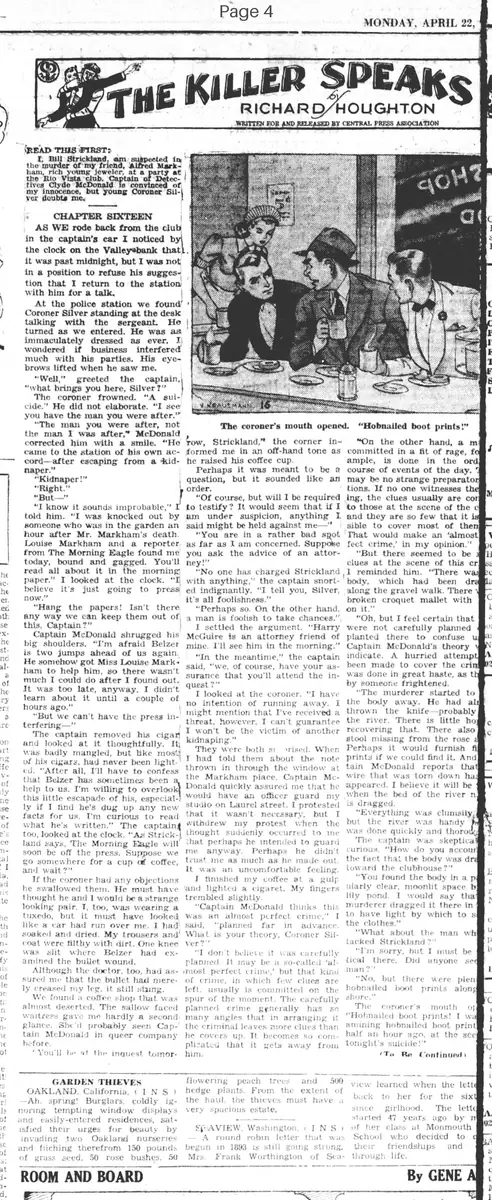
"No, but there were plenty of hobnailed boot prints along the shore."
The coroner's mouth opened.
"Hobnailed boot prints! I was examining hobnailed boot prints half an hour ago, at the scene of tonight's suicide."
(To Be Continued)
THE KILLER SPEAKS
By RICHARD HOUGHTON
WRITTEN FOR AND RELEASED BY CENTRAL PRESS ASSOCIATION
READ THIS FIRST:
I, Bill Strickland, am suspected in the murder of my friend, Alfred Markham, rich young jeweler, at a party at the Rio Vista club. Captain of Detectives Clyde McDonald is convinced of my innocence, but young Coroner Silver doubts me.
CHAPTER SIXTEEN
AS WE rode back from the club in the captain's car I noticed by the clock on the Valley Bank that it was past midnight, but I was not in a position to refuse his suggestion that I return to the station with him for a talk.
At the police station we found Coroner Silver standing at the desk talking with the sergeant. He turned as we entered. He was as immaculately dressed as ever. I wondered if business interfered much with his parties. His eyebrows lifted when he saw me.
"Well," greeted the captain, "what brings you here, Silver?"
The coroner frowned. "A suicide." He did not elaborate. "I see you have the man you were after."
"The man you were after, not the man I was after," McDonald corrected him with a smile. "He came to the station of his own accord—after escaping from a kidnapper."
"Kidnapper!"
"Right."
"But—"
"I know it sounds improbable," I told him. "I was knocked out by someone who was in the garden an hour after Mr. Markham's death. Louise Markham and a reporter from The Morning Eagle found me today, bound and gagged. You'll read all about it in the morning paper." I looked at the clock. "I believe it's just going to press now."
"Hang the papers! Isn't there any way we can keep them out of this, Captain?"
Captain McDonald shrugged his big shoulders. "I'm afraid Belzer is two jumps ahead of us again. He somehow got Miss Louise Markham to help him, so there wasn't much I could do after I found out. It was too late, anyway. I didn't learn about it until a couple of hours ago."
"But we can't have the press interfering."
The captain removed his cigar and looked at it thoughtfully. It was badly mangled, but like most of his cigars, had never been lighted. "After all, I'll have to confess that Belzer has sometimes been a help to us. I'm willing to overlook this little escapade of his, especially if I find he's dug up any new facts for us. I'm curious to read what he's written." The captain, too, looked at the clock. "As Strickland says, The Morning Eagle will soon be off the press. Suppose we go somewhere for a cup of coffee, and wait?"
If the coroner had any objections he swallowed them. He must have thought he and I would be a strange looking pair. I, too, was wearing a tuxedo, but it must have looked like a car had run over me. I had soaked and dried. My trousers and coat were filthy with dirt. One knee was slit where Belzer had examined the bullet wound.
Although the doctor, too, had assured me that the bullet had merely creased my leg, it still stung.
We found a coffee shop that was almost deserted. The sallow-faced waiters gave me hardly a second glance. She'd probably seen Captain McDonald in queer company before.
"You'll be at the inquest tomorrow, Strickland," the coroner informed me in an off-hand tone as he raised his coffee cup.
Perhaps it was meant to be a question, but it sounded like an order.
"Of course, but will I be required to testify? It would seem that if I am under suspicion, anything I said might be held against me."
"You are in a rather bad spot as far as I am concerned. Suppose you ask the advice of an attorney!"
"No one has charged Strickland with anything," the captain snorted indignantly. "I tell you, Silver, it's all foolishness."
"Perhaps so. On the other hand, a man is foolish to take chances."
I settled the argument. "Harry McGuire is an attorney friend of mine. I'll see him in the morning."
"In the meantime," the captain said, "we, of course, have your assurance that you'll attend the inquest?"
I looked at the coroner. "I have no intention of running away. I might mention that I've received a threat, however. I can't guarantee I won't be the victim of another kidnapping."
They were both surprised. When I had told them about the note thrown in through the window at the Markham place, Captain McDonald quickly assured me that he would have an officer guard my studio on Laurel street. I protested that it wasn't necessary, but I withdrew my protest when the thought suddenly occurred to me that perhaps he intended to guard me anyway. Perhaps he didn't trust me as much as he made out.
It was an uncomfortable feeling. I finished my coffee at a gulp and lighted a cigarette. My fingers trembled slightly.
"Captain McDonald thinks this was an almost perfect crime," I said, "planned far in advance. What is your theory, Coroner Silver?"
"I don't believe it was carefully planned. It may be a so-called 'almost perfect crime,' but that kind of crime, in which few clues are left, usually is committed on the spur of the moment. The carefully planned crime generally has so many angles that in arranging it the criminal leaves more clues than he covers up. It becomes so complicated that it gets away from him.
"On the other hand, a murder committed in a fit of rage, for example, is done in the ordinary course of events of the day. There may be no strange preparations. If no one witnesses the killing, the clues usually are confined to those at the scene of the crime and they are so few that it is possible to cover most of them up. That would make an 'almost perfect crime,' in my opinion."
"But there seemed to be no clues at the scene of this crime," I reminded him. "There was the body, which had been dragged along the gravel walk. There was a broken croquet mallet with blood on it."
"Oh, but I feel certain that those were not carefully planned but planted there to confuse us. Captain McDonald's theory would indicate. A hurried attempt had been made to cover the crime. It was done in great haste, as though by someone frightened.
"The murderer started to throw the body away. He had already thrown the knife—probably in the river. There is little hope of recovering that. There also is a stool missing from the rose arbor. Perhaps it would furnish fingerprints if we could find it. And Captain McDonald reports that the wire that was torn down has disappeared. I believe it will be found when the bed of the river is dragged.
"Everything was clumsily done but the river was handy. It was done quickly and thoroughly."
The captain was skeptical but curious. "How do you account for the fact that the body was dragged toward the clubhouse?"
"You found the body in a particularly clear, moonlit space by the lily pond. I would say that the murderer dragged it there in order to have light by which to search the clothes."
"What about the man who attacked Strickland?"
"I'm sorry, but I must be skeptical there. Did anyone see the man?"
"No, but there were plenty of hobnailed boot prints along the shore."
The coroner's mouth opened.
"Hobnailed boot prints! I was examining hobnailed boot prints half an hour ago, at the scene of tonight's suicide."
(To Be Continued)
What sub-type of article is it?
Prose Fiction
What themes does it cover?
Death Mortality
Political
What keywords are associated?
Murder Investigation
Suspicion
Kidnapping
Inquest
Crime Theory
Coroner
Detective Captain
Hobnailed Boots
What entities or persons were involved?
By Richard Houghton Written For And Released By Central Press Association
Literary Details
Title
Chapter Sixteen
Author
By Richard Houghton Written For And Released By Central Press Association
Form / Style
First Person Detective Narrative
Key Lines
"I Know It Sounds Improbable," I Told Him. "I Was Knocked Out By Someone Who Was In The Garden An Hour After Mr. Markham's Death. Louise Markham And A Reporter From The Morning Eagle Found Me Today, Bound And Gagged."
"Captain Mcdonald Thinks This Was An Almost Perfect Crime," I Said, "Planned Far In Advance. What Is Your Theory, Coroner Silver?"
"I Don't Believe It Was Carefully Planned. It May Be A So Called 'Almost Perfect Crime,' But That Kind Of Crime, In Which Few Clues Are Left, Usually Is Committed On The Spur Of The Moment."
"Hobnailed Boot Prints! I Was Examining Hobnailed Boot Prints Half An Hour Ago, At The Scene Of Tonight's Suicide."