Thank you for visiting SNEWPapers!
Sign up free
Editorial
August 27, 1798
The Gazette
Portland, Cumberland County, Maine
What is this article about?
An editorial advocating for the United States to build a strong navy to defend against French aggression during the war with France, proposing purchase of ships, a land tax for funding, gradual emancipation of slaves, and alliance with Britain; warns of French threats to southern states and praises leaders like Adams and Washington.
Clipping
OCR Quality
98%
Excellent
Full Text
POLITICS.
OBSERVATIONS UPON THE WAR WITH FRANCE.
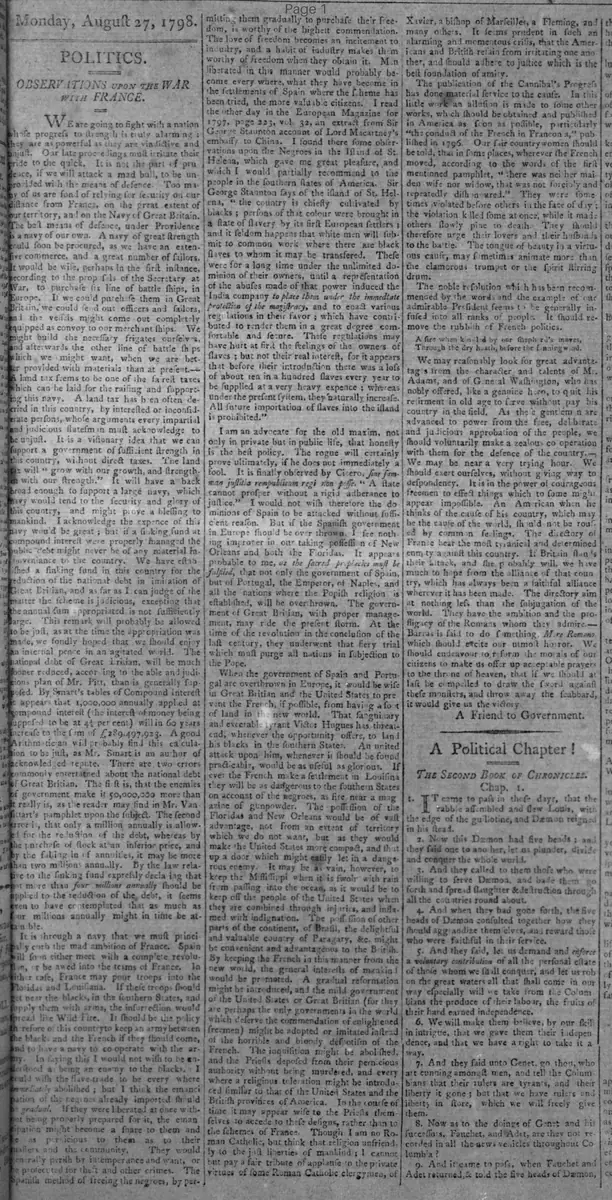
WE are going to fight with a nation whose progress to strength is truly alarming: They are as powerful as they are vindictive and unjust. Our late proceedings must irritate their pride to the quick. It is not the part of prudence, if we will attack a mad bull, to be unprepared with the means of defence. Too many of us are fond of relying on security on our distance from France, on the great extent of our territory, and on the Navy of Great Britain. The best means of defence, under Providence, is a navy of our own. A navy of great strength could soon be procured, as we have an extensive commerce and a great number of sailors. It would be wise, perhaps in the first instance, according to the proposal of the Secretary at War, to purchase six line of battle ships, in Europe. If we could purchase them in Great Britain, we could send out officers and sailors, and the vessels might come out completely equipped as convoy to our merchant ships. We might build the necessary frigates ourselves, and afterwards the other line of battle ships which we might want, when we are better provided with materials than at present.
A land tax seems to be one of the fairest taxes which can be laid for the raising and supporting this navy. A land tax has been often decried in this country, by interested or inconsiderate persons, whose arguments every impartial and judicious statesman must acknowledge to be unjust. It is a visionary idea that we can support a government of sufficient strength in this country, without direct taxes. The land tax will "grow with our growth, and strengthen with our strength." It will have a back broad enough to support a large navy, which navy would tend to the security and glory of this country, and might prove a blessing to mankind. I acknowledge the expense of this navy would be great: but if a stocking fund at compound interest were properly managed the public debt might never be of any material inconvenience to the country. We have established a sinking fund in this country for the reduction of the national debt in imitation of Great Britain, and as far as I can judge of the matter the scheme is judicious, excepting that the annual sum appropriated is not sufficiently large. This remark will probably be allowed to be just, as at the time the appropriation was made, we fondly hoped that we should enjoy an internal peace in an agitated world. The national debt of Great Britain, will be much sooner reduced, according to the able and judicious plan of Mr. Pitt, than is generally supposed. By Smart's tables of Compound Interest it appears that 1,000,000 annually applied at compound interest (the interest of money being supposed to be at 4 per cent) will in 60 years increase to the sum of 89,497,923. A good Arithmetician will probably find this calculation to be just, as Mr. Smart is an author of acknowledged repute. There are, two errors commonly entertained about the national debt of Great Britain. The first is, that the enemies of government make it 50,000,000 more than it really is, as the reader may find in Mr. Vansittart's pamphlet upon the subject. The second error is, that only a million annually is allowed for the reduction of the debt, whereas by the purchase of stock at an inferior price, and by the falling in of annuities, it may be more than two millions annually. By the law relative to the sinking fund expressly declaring that not more than four millions annually should be applied to the reduction of the debt, it seems even to have contemplated that as much as four millions annually might in time be attainable.
It is through a navy that we must principally curb the mad ambition of France. Spain will soon either meet with a complete revolution, or be awed into the terms of France. In either case, France may pour troops into the Floridas and Louisiana. If these troops should get near the blacks, in the southern States, and supply them with arms, the insurrection would spread like wild fire. It should be the policy therefore of this country to keep an army between the blacks and the French if they should come, and to have a navy to co-operate with the army. In saying this I would not wish to be understood as being an enemy to the blacks. I could wish the slave-trade to be everywhere immediately abolished; but I think the emancipation of the negroes already imported should be gradual. If they were liberated at once without being properly prepared for it, the emancipation might become a curse to them and as pernicious to them as to their masters and the community. They would generally perish by intemperance and want, or be prosecuted for theft and other crimes. The Spanish method of freeing the negroes, by permitting them gradually to purchase their freedom, is worthy of the highest commendation. The love of freedom becomes an incitement to industry, and a habit of industry makes them worthy of freedom when they obtain it. Men liberated in this manner would probably become everywhere, what they have become in the settlements of Spain where the scheme has been tried, the more valuable citizens. I read the other day in the European Magazine for 1797, page 223, vol. 32, an extract from Sir George Staunton account of Lord Macartney's embassy to China. I found there some observations upon the Negroes in the Island of St. Helena, which gave me great pleasure, and which I would partially recommend to the people in the southern States of America. Sir George Staunton says of the island of St. Helena, "the country is chiefly cultivated by blacks; persons of that colour were brought in a state of slavery by its first European settlers; and it seldom happens that white men will submit to common work where there are black slaves to whom it may be transferred. These were for a long time under the unlimited dominion of their owners, until a representation of the abuses made of that power induced the India company to place them under the immediate protection of the magistracy, and to enact various regulations in their favor; which have contributed to render them in a great degree comfortable and secure. These regulations may have hurt at first the feelings of the owners of slaves; but not their real interest, for it appears that before their introduction there was a loss of about ten in a hundred slaves every year to be supplied at a very heavy expense; whereas under the present system, they naturally increase. All future importation of slaves into the island is prohibited."
I am an advocate for the old maxim, not only in private but in public life, that honesty is the best policy. The rogue will certainly prove ultimately, if he does not immediately a fool. It is finally observed by Cicero, in eumani justitia rempublicam regi non potest. "A state cannot prosper without a rigid adherence to justice." I would not wish therefore the dominions of Spain to be attacked without sufficient reason. But if the Spanish government in Europe should be overthrown, I see nothing improper in our taking possession of New Orleans and both the Floridas. It appears probable to me, as the sacred prophecies must be fulfilled, that not only the government of Spain, but of Portugal, the Emperor, of Naples, and all the nations where the Popish religion is established, will be overthrown. The government of Great Britain, with proper management, may ride the present storm. At the time of the revolution in the conclusion of the last century, they underwent that fiery trial which must purge all nations in subjection to the Pope.
When the government of Spain and Portugal are overthrown in Europe, it would be wise in Great Britain and the United States to prevent the French, if possible, from having a foot of land in the new world. That sanguinary and execrable tyrant Victor Hugues has threatened, whenever the opportunity offers, to land his blacks in the southern States. An united attack upon him, whenever it should be found practicable, would be as useful as glorious. If ever the French make a settlement in Louisiana they will be as dangerous to the southern States on account of the negroes, as fire near a magazine of gunpowder. The possession of the Floridas and New Orleans would be of vast advantage, not from an extent of territory which we do not want, but as they would make the United States more compact, and shut up a door which might easily let in a dangerous enemy. It may be as vain, however, to keep the Mississippi when it is worn with rain from passing into the ocean, as it would be to keep off the people of the United States when they are combined through injuries, and inflamed with indignation. The possession of other parts of the continent, of Brazil, the delightful and valuable country of Paraguay, &c. might be convenient and advantageous to the British. By keeping the French in this manner from the new world, the general interests of mankind would be promoted. A gradual reformation might be introduced, and the mild government of the United States or Great Britain (for they are perhaps the only governments in the world which deserve the commendation of enlightened freemen) might be adopted or imitated instead of the horrible and bloody despotism of the French. The inquisition might be abolished, and the Priests deposed from their pernicious authority without being murdered, and everywhere a religious toleration might be introduced similar to that of the United States and the British provinces of America. In the course of time it may appear wise to the Priests themselves to accede to these designs, rather than to the schemes of France. Though I am no Roman Catholic, but think that religion unfriendly to the just liberties of mankind; I cannot but pay a fair tribute of applause to the private virtues of some Roman Catholic clergymen, of Xavier, a bishop of Marseilles, a Fleming, and many others. It seems prudent in such an alarming and momentous crisis, that the Americans and British refrain from irritating one another, and should adhere to justice which is the best foundation of amity.
The publication of the Cannibal's Progress has done material service to the cause. In this little work an allusion is made to some other works, which should be obtained and published in America as soon as possible, particularly "the conduct of the French in Franconia," published in 1796. Our fair country women should be told, that in some places, wherever the French moved, according to the words of the first mentioned pamphlet. "there was neither maiden wife nor widow, that was not forcibly and repeatedly dishonored." They were sometimes violated before others in the face of day; the violation killed some at once, while it made others slowly pine to death. They should therefore urge their lovers and their husbands to the battle. The tongue of beauty in a virtuous cause, may sometimes animate more than the clamorous trumpet or the spirit-stirring drum.
The noble resolution which has been recommended by the word, and the example of our admirable President seems to be generally infused into all ranks of people. It should remove the rubbish of French politics.
A fire when kindled by our shepherd's moves,
Through the dry heath, before the winning wind.
We may reasonably look for great advantages from the character and talents of Mr. Adams, and of General Washington, who has nobly offered, like a genuine hero, to quit his retirement in old age to serve without pay his country in the field. As these gentlemen are advanced to power from the free, deliberate and judicious approbation of the people, we should voluntarily make a zealous co-operation with them for the defence of the country.
We may be near a very trying hour. We should exert ourselves, without giving way to despondency. - It is in the power of courageous freemen to effect things which to some might appear impossible. An American when he thinks of the cause of his country, which may be the cause of the world, should not be roused by common feelings. The directory of France hear the most tyrannical and determined enmity against this country. If Britain stands their attack, and she probably will, we have much to hope from the alliance of that country, which has always been a faithful alliance wherever it has been made. The directory aim at nothing less than the subjugation of the world. They have the ambition and the profligacy of the Romans whom they admire.-- Barras is said to do something, more Romano which should excite our utmost horror. We should endeavour to reform the morals of our citizens to make us offer up acceptable prayers to the throne of heaven, that if we should at last be compelled to draw the sword against these monsters, and throw away the scabbard, it would give us the victory.
A Friend to Government.
OBSERVATIONS UPON THE WAR WITH FRANCE.
WE are going to fight with a nation whose progress to strength is truly alarming: They are as powerful as they are vindictive and unjust. Our late proceedings must irritate their pride to the quick. It is not the part of prudence, if we will attack a mad bull, to be unprepared with the means of defence. Too many of us are fond of relying on security on our distance from France, on the great extent of our territory, and on the Navy of Great Britain. The best means of defence, under Providence, is a navy of our own. A navy of great strength could soon be procured, as we have an extensive commerce and a great number of sailors. It would be wise, perhaps in the first instance, according to the proposal of the Secretary at War, to purchase six line of battle ships, in Europe. If we could purchase them in Great Britain, we could send out officers and sailors, and the vessels might come out completely equipped as convoy to our merchant ships. We might build the necessary frigates ourselves, and afterwards the other line of battle ships which we might want, when we are better provided with materials than at present.
A land tax seems to be one of the fairest taxes which can be laid for the raising and supporting this navy. A land tax has been often decried in this country, by interested or inconsiderate persons, whose arguments every impartial and judicious statesman must acknowledge to be unjust. It is a visionary idea that we can support a government of sufficient strength in this country, without direct taxes. The land tax will "grow with our growth, and strengthen with our strength." It will have a back broad enough to support a large navy, which navy would tend to the security and glory of this country, and might prove a blessing to mankind. I acknowledge the expense of this navy would be great: but if a stocking fund at compound interest were properly managed the public debt might never be of any material inconvenience to the country. We have established a sinking fund in this country for the reduction of the national debt in imitation of Great Britain, and as far as I can judge of the matter the scheme is judicious, excepting that the annual sum appropriated is not sufficiently large. This remark will probably be allowed to be just, as at the time the appropriation was made, we fondly hoped that we should enjoy an internal peace in an agitated world. The national debt of Great Britain, will be much sooner reduced, according to the able and judicious plan of Mr. Pitt, than is generally supposed. By Smart's tables of Compound Interest it appears that 1,000,000 annually applied at compound interest (the interest of money being supposed to be at 4 per cent) will in 60 years increase to the sum of 89,497,923. A good Arithmetician will probably find this calculation to be just, as Mr. Smart is an author of acknowledged repute. There are, two errors commonly entertained about the national debt of Great Britain. The first is, that the enemies of government make it 50,000,000 more than it really is, as the reader may find in Mr. Vansittart's pamphlet upon the subject. The second error is, that only a million annually is allowed for the reduction of the debt, whereas by the purchase of stock at an inferior price, and by the falling in of annuities, it may be more than two millions annually. By the law relative to the sinking fund expressly declaring that not more than four millions annually should be applied to the reduction of the debt, it seems even to have contemplated that as much as four millions annually might in time be attainable.
It is through a navy that we must principally curb the mad ambition of France. Spain will soon either meet with a complete revolution, or be awed into the terms of France. In either case, France may pour troops into the Floridas and Louisiana. If these troops should get near the blacks, in the southern States, and supply them with arms, the insurrection would spread like wild fire. It should be the policy therefore of this country to keep an army between the blacks and the French if they should come, and to have a navy to co-operate with the army. In saying this I would not wish to be understood as being an enemy to the blacks. I could wish the slave-trade to be everywhere immediately abolished; but I think the emancipation of the negroes already imported should be gradual. If they were liberated at once without being properly prepared for it, the emancipation might become a curse to them and as pernicious to them as to their masters and the community. They would generally perish by intemperance and want, or be prosecuted for theft and other crimes. The Spanish method of freeing the negroes, by permitting them gradually to purchase their freedom, is worthy of the highest commendation. The love of freedom becomes an incitement to industry, and a habit of industry makes them worthy of freedom when they obtain it. Men liberated in this manner would probably become everywhere, what they have become in the settlements of Spain where the scheme has been tried, the more valuable citizens. I read the other day in the European Magazine for 1797, page 223, vol. 32, an extract from Sir George Staunton account of Lord Macartney's embassy to China. I found there some observations upon the Negroes in the Island of St. Helena, which gave me great pleasure, and which I would partially recommend to the people in the southern States of America. Sir George Staunton says of the island of St. Helena, "the country is chiefly cultivated by blacks; persons of that colour were brought in a state of slavery by its first European settlers; and it seldom happens that white men will submit to common work where there are black slaves to whom it may be transferred. These were for a long time under the unlimited dominion of their owners, until a representation of the abuses made of that power induced the India company to place them under the immediate protection of the magistracy, and to enact various regulations in their favor; which have contributed to render them in a great degree comfortable and secure. These regulations may have hurt at first the feelings of the owners of slaves; but not their real interest, for it appears that before their introduction there was a loss of about ten in a hundred slaves every year to be supplied at a very heavy expense; whereas under the present system, they naturally increase. All future importation of slaves into the island is prohibited."
I am an advocate for the old maxim, not only in private but in public life, that honesty is the best policy. The rogue will certainly prove ultimately, if he does not immediately a fool. It is finally observed by Cicero, in eumani justitia rempublicam regi non potest. "A state cannot prosper without a rigid adherence to justice." I would not wish therefore the dominions of Spain to be attacked without sufficient reason. But if the Spanish government in Europe should be overthrown, I see nothing improper in our taking possession of New Orleans and both the Floridas. It appears probable to me, as the sacred prophecies must be fulfilled, that not only the government of Spain, but of Portugal, the Emperor, of Naples, and all the nations where the Popish religion is established, will be overthrown. The government of Great Britain, with proper management, may ride the present storm. At the time of the revolution in the conclusion of the last century, they underwent that fiery trial which must purge all nations in subjection to the Pope.
When the government of Spain and Portugal are overthrown in Europe, it would be wise in Great Britain and the United States to prevent the French, if possible, from having a foot of land in the new world. That sanguinary and execrable tyrant Victor Hugues has threatened, whenever the opportunity offers, to land his blacks in the southern States. An united attack upon him, whenever it should be found practicable, would be as useful as glorious. If ever the French make a settlement in Louisiana they will be as dangerous to the southern States on account of the negroes, as fire near a magazine of gunpowder. The possession of the Floridas and New Orleans would be of vast advantage, not from an extent of territory which we do not want, but as they would make the United States more compact, and shut up a door which might easily let in a dangerous enemy. It may be as vain, however, to keep the Mississippi when it is worn with rain from passing into the ocean, as it would be to keep off the people of the United States when they are combined through injuries, and inflamed with indignation. The possession of other parts of the continent, of Brazil, the delightful and valuable country of Paraguay, &c. might be convenient and advantageous to the British. By keeping the French in this manner from the new world, the general interests of mankind would be promoted. A gradual reformation might be introduced, and the mild government of the United States or Great Britain (for they are perhaps the only governments in the world which deserve the commendation of enlightened freemen) might be adopted or imitated instead of the horrible and bloody despotism of the French. The inquisition might be abolished, and the Priests deposed from their pernicious authority without being murdered, and everywhere a religious toleration might be introduced similar to that of the United States and the British provinces of America. In the course of time it may appear wise to the Priests themselves to accede to these designs, rather than to the schemes of France. Though I am no Roman Catholic, but think that religion unfriendly to the just liberties of mankind; I cannot but pay a fair tribute of applause to the private virtues of some Roman Catholic clergymen, of Xavier, a bishop of Marseilles, a Fleming, and many others. It seems prudent in such an alarming and momentous crisis, that the Americans and British refrain from irritating one another, and should adhere to justice which is the best foundation of amity.
The publication of the Cannibal's Progress has done material service to the cause. In this little work an allusion is made to some other works, which should be obtained and published in America as soon as possible, particularly "the conduct of the French in Franconia," published in 1796. Our fair country women should be told, that in some places, wherever the French moved, according to the words of the first mentioned pamphlet. "there was neither maiden wife nor widow, that was not forcibly and repeatedly dishonored." They were sometimes violated before others in the face of day; the violation killed some at once, while it made others slowly pine to death. They should therefore urge their lovers and their husbands to the battle. The tongue of beauty in a virtuous cause, may sometimes animate more than the clamorous trumpet or the spirit-stirring drum.
The noble resolution which has been recommended by the word, and the example of our admirable President seems to be generally infused into all ranks of people. It should remove the rubbish of French politics.
A fire when kindled by our shepherd's moves,
Through the dry heath, before the winning wind.
We may reasonably look for great advantages from the character and talents of Mr. Adams, and of General Washington, who has nobly offered, like a genuine hero, to quit his retirement in old age to serve without pay his country in the field. As these gentlemen are advanced to power from the free, deliberate and judicious approbation of the people, we should voluntarily make a zealous co-operation with them for the defence of the country.
We may be near a very trying hour. We should exert ourselves, without giving way to despondency. - It is in the power of courageous freemen to effect things which to some might appear impossible. An American when he thinks of the cause of his country, which may be the cause of the world, should not be roused by common feelings. The directory of France hear the most tyrannical and determined enmity against this country. If Britain stands their attack, and she probably will, we have much to hope from the alliance of that country, which has always been a faithful alliance wherever it has been made. The directory aim at nothing less than the subjugation of the world. They have the ambition and the profligacy of the Romans whom they admire.-- Barras is said to do something, more Romano which should excite our utmost horror. We should endeavour to reform the morals of our citizens to make us offer up acceptable prayers to the throne of heaven, that if we should at last be compelled to draw the sword against these monsters, and throw away the scabbard, it would give us the victory.
A Friend to Government.
What sub-type of article is it?
War Or Peace
Foreign Affairs
Military Affairs
What keywords are associated?
War With France
U.S. Navy
Land Tax
Slave Emancipation
French Aggression
British Alliance
National Defense
Public Debt
What entities or persons were involved?
France
Great Britain
United States
Mr. Pitt
Mr. Adams
General Washington
Victor Hugues
Spain
Blacks/Negroes
Editorial Details
Primary Topic
Observations Upon The War With France And The Need For A U.S. Navy
Stance / Tone
Strongly Pro Defense And Anti French, Supportive Of Government And Alliance With Britain
Key Figures
France
Great Britain
United States
Mr. Pitt
Mr. Adams
General Washington
Victor Hugues
Spain
Blacks/Negroes
Key Arguments
Build A Strong U.S. Navy By Purchasing Ships From Europe To Defend Against French Aggression
Impose A Land Tax To Fund The Navy As It Grows With The Nation
Establish A Sinking Fund To Manage Public Debt Inspired By Britain's Model
Prevent French Troops From Reaching Southern States To Avoid Slave Insurrections
Advocate Gradual Emancipation Of Slaves To Prepare Them For Freedom
Seize Floridas And New Orleans If Spanish Government Falls To Block French Expansion
Promote Alliance Between U.S. And Britain Against French Despotism
Urge Moral Reform And Support For Leaders Like Adams And Washington
Condemn French Atrocities To Rally Public Support For War