Thank you for visiting SNEWPapers!
Sign up free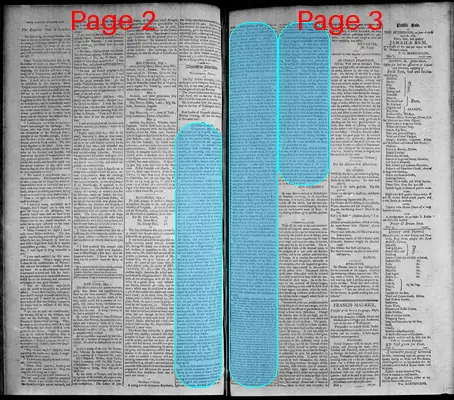
Alexandria Advertiser And Commercial Intelligencer
Alexandria, Virginia
What is this article about?
In a May 1, 1802, letter from Georgetown, the former U.S. Secretary of the Navy defends the legality of purchasing six navy yards under a 1799 act to build 74-gun ships, accusing a congressional Committee of Investigation majority of partisan suppression of his response and unfair condemnation.
Merged-components note: This is a single letter to the public/editor that was split across pages 2 and 3 due to page boundaries; merging based on sequential reading order and direct textual continuation.
Clippings

1 of 2
OCR Quality
Full Text
Georgetown, May 1, 1802.
A committee of congress, styled, ' the committee of Investigation,' was appointed early in the present session, for purposes which the resolution of the appointment will best explain. A majority of this committee after consuming nearly five months, in enquiring into the frauds alledged to have been committed by former administrations, have at length at the close of the session, made a report, when it is too late to vindicate in debate on the floor of congress, the fair fame of men who have performed meritorious service for their country from the foul aspersion contained in the report.
From the chairman of this committee I received a letter at 3 o'clock on the 27th of April, dated that day, desiring to know by what authority six navy yards had been purchased, while I was secretary of the navy; and observing that my answer must be in writing, and must be delivered to him by 10 o'clock the next morning, as the committee would report in the course of the day. The subject was familiar to me—no time for deliberation was necessary—I answered him the same evening; but as it would be willing to an unreasonable length, a newspaper address to insert my answer here, I omit it contenting myself with the single observation, that I doubted not the explanation it contained would satisfy minds, and conversant with public affairs that not a single navy yard had been purchased, nor a single shilling of money expended on their improvement, without full and ample legal authority.
This letter produced no effect on the majority of the committee—it has been previously determined that the purchase of navy yards should at all events be condemned, and it was urged in vain by gentlemen on the committee, who concurred not with the majority, & whose utmost abhorrence could not fail to be excited by the conduct of that majority, that the letter should at least be suffered to accompany the report to congress. that the defence might be as public as the accusation—But it suited not the views of the majority, this would have been fair proceeding, and that the poison it was their purpose to instil into the public mind. Should be attended by its antidote, and the letter was suppressed. From this instance of the uncandid course of the majority of this committee, in relation to a person on the spot to answer them, a just estimate may be made of the treatment which former servants of the public absent. and at a distance from the seat of government have experienced at their hands.
A report of a majority of a committee of congress is not condemnation; it is not even proof of guilt. No person fortunately for the free citizens of the United States, has lost the power of creating even the slightest probability that such reports will soon lose the power of creating even the slightest vestige of suspicion of guilt, in the persons they shall accuse. I lament more than I do, the too great power these reports have of creating even the slightest vestige of suspicion of guilt, in the persons they shall accuse.
As far as their power extended, the majority of this committee, have gone, to rob me of that, which is dearer than fortune or life—reputation—in reward to the neglect and infinite injury of my private concerns, devoted and most zealously exerted
I have devoted nearly a small portion of my life to the public service. From their unjust decision, both will be heard and will not be suppressed; and where reason and justice will prevail. Before the tribunal of the public I am as sure of an acquittal the most complete and the most honorable, because my conduct has been right, as I am, that those men, who, to indulge party rancor, have dared to accuse me, will quickly find that public delusion is rapidly on the decline. It is for these men to reflect on the estimation in which their present conduct will be held, when this delusion shall have passed entirely away.
But it is time to attend to the report of the majority of the committee, with their reasons for an unqualified condemnation of the late secretary of the navy. After quoting the act, directing six 74 gun ships to be built within the U. States, and not to be built or purchased as they wish to have the act or certified; and two other acts, which had no more connection with the building of ships, than of houses—one of them authorizing two docks to be erected for the purpose as expressed in the act, of repairing ships, meaning dry docks, into which ships might enter without unloading, and be set dry at the fall of the tide, or after the water should be pumped out, and be repaired without the expensive operation of heaving down, things totally dissimilar from building yards. And the other authorizing a purchase of timber, not for the use of six 74 gun ships, as these gentlemen certainly meant to imply, if they understood their own meaning; but, as expressly stated in the act itself, to be preserved for the future use of the navy. (all the acts were passed in Feb. '99)—I say after quoting these several acts, these gentlemen proceed, under this authority only (meaning the three acts): the then secretary of the navy, expended the sum of 135,846 dollars in the purchase of six navy yards. For this expenditure the committee conceive that no authority was given by law, nor any appropriation made, except for the two docks above mentioned, as the sum of 1,000,000 dollars, was appropriated by the act of '99 for building or purchasing the ships only—and the sum of two hundred thousand dollars for the purchase of timber. As public ships of war, had been before built under a similar authority for the use of the United States, at private yards; and as congress did, at the same time that they authorized the building or purchasing the ships, provide for the erection of two docks only, the committee are of opinion that our navy yards, were purchased without authority and the money misapplied which was paid for them?
The then secretary of the navy informs these sagacious gentlemen, the majority of the committee, that it never was contended or imagined, that the acts for procuring timber for future use, and for erecting docks, conferred any power to buy or even to hire building yards, or as they are more frequently called, navy yards—the whole power to any such yards, was communicated by the single act, directing that six 74 gun ships should be built within the United States, not built or purchased as they represent the act—If this act did not confer the power to purchase the yards, then the purchase was made without the authority of law, and the report of the majority of the committee, tho' malignant is correct.
The short question then before the public is did this act confer the power to purchase yards? I will not labor to establish a self-evident position. Is there a man of common reason in the United States, who will believe that an act of congress directing a thing to be done by the executive and appropriating money for doing it does not confer on the executive full and ample legal authority not only to do the thing but without to do every thing which is incidental to it—every thing the act could not be performed? In the present instance, an act had passed directing that ships should be built—there was not a stick of timber nor an article of any kind in the public arsenals necessary to be employed in their building—they could not be built without the necessary materials—the act then intended to confer and did confer complete power to procure the materials. So of yards in which to build the ships—there was not one yard in the United States public or private, fit for building ships of such a size—it was essential that such yards should be procured, and the act intended to give, and did give, full power to procure them—and to procure them by hire, or by purchase as should best comport with the public interest: the argument of the committee, that it would have been legal to hire, and was not legal to purchase, because under the preceding acts and instructions yards had been hired and had not been purchased, is really too puerile, to merit serious refutation, and I am not disposed to trifle with the public. So much on the legality of the purchase of navy yards—and as the majority of the committee have attacked the measure on the ground of its illegality only:
What sub-type of article is it?
What themes does it cover?
What keywords are associated?
What entities or persons were involved?
Letter to Editor Details
Recipient
To The Public
Main Argument
the purchase of six navy yards was legally authorized by the 1799 act directing the building of six 74-gun ships within the united states, which conferred full power to procure necessary incidental facilities; the congressional committee's majority acted with partisan bias by suppressing the author's explanatory letter and issuing an unfair report.
Notable Details