Thank you for visiting SNEWPapers!
Sign up free
Richmond Enquirer
Richmond, Richmond County, Virginia
What is this article about?
From Hanover, VA, March 25, 1835: Reports renomination of Col. Goodall by Administration supporters and dissects John Robertson's Whig speech, refuting claims on printing expenses, bank deposits, French treaty, and appropriations while decrying his Nullification stance. (248 characters)
Clipping
OCR Quality
Full Text
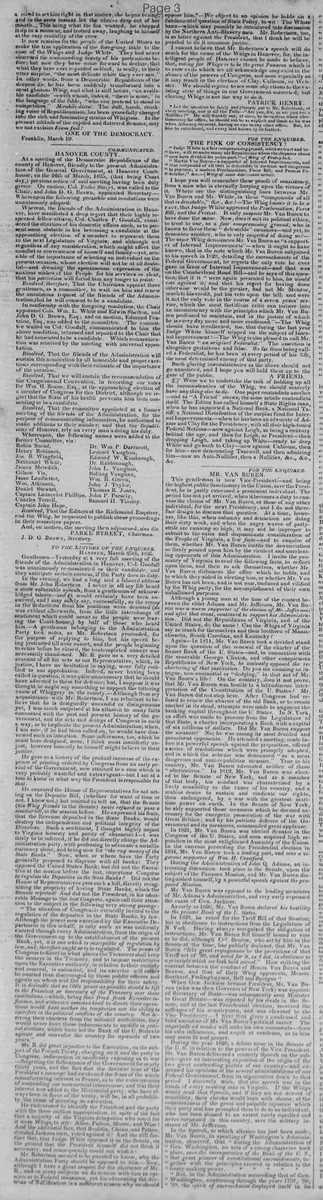
Hanover, March 25th, 1835.
Gentlemen—Yesterday at a very full meeting of the friends of the Administration in Hanover, Col. Goodall was unanimously re-nominated as their candidate, and they anticipate certain success, if the Party does its duty.
In the evening, we had a long and a labored address from Mr. John Robertson. I never in all my life heard a more vulnerable speech, from a gentleman of acknowledged talents—and it would certainly have been answered, and I may safely say, successfully, as the errors in the deductions from his positions were detected (as was evident afterwards, from the little interchange of sentiment which could occur as the people were leaving the Court-house,) by half of those who heard him. A gentleman belonging to the Administration Party took notes, as Mr. Robertson proceeded, for the purpose of replying to him, but his speech being protracted till near sunset, and the people beginning to retire before he closed, the contemplated answer was necessarily abandoned. Mr. R. gave us a very detailed account of all his acts as our Representative, which, in justice, I have no hesitation in saying, were fully entitled to our approbation. Indeed, never having been called in question, it was quite unnecessary that he should have adverted to them for defence; but, I suppose it was thought he might say something to support the tottering cause of Whiggery in the county. Although from my acquaintance with Mr. Robertson, I am reluctant to believe that he is designedly uncandid or disingenuous yet, I was much surprised at his allusion to many facts connected with the past and present history of the government, and the acts and doings of Congress in such a way, as to implicate the present Administration; when, I am sure, if he had been called on, he would have disavowed such an intention. Some inferences, too, which he must have designed, were, I think most manifestly unjust, however honestly he himself might believe in their justice.
He gave us a history of the gradual increase of the expense of printing ordered by Congress from an early period of the Government, now attained to a sum which is very probably wasteful and extravagant—but I am at a loss to know in what way the President is responsible for that.
He censured the House of Representatives for not acting on the Deposite Bill, (whether for want of time or not, I know not,) but omitted to tell us, that the Senate (his Whig friends in the Senate) twice refused to pass a similar bill, at the session before. He expressed his fears that the Revenue deposited in the State Banks, would destroy the independence and political integrity of the Directors. Such a sentiment, I thought highly unjust to Virginia honesty and purity of character. It was fairly to be inferred, if he did not directly charge the Administration party, with professing to advocate a metallic currency alone, and being now for "the rag money of the State Banks." Now, when or where have the Party generally proposed to dispense with all banks? They opposed the United States Bank; but did not the Executive at the session before the last, importune Congress to regulate the Deposites in the State Banks? Did not the House of Representatives pass such a bill, directly recognizing the propriety of having State Banks, which the Senate rejected? And did not the President, in his admirable Message to the last Congress, again call their attention to the subject in the following very strong passage:
"The attention of Congress is earnestly invited to the regulation of the deposites in the State Banks, by law. Although the power now exercised by the Executive Department in this behalf, is only such as was uniformly exerted through every Administration, from the origin of the Government up to the establishment of the present Bank, yet, it is one which is susceptible of regulation by law, and, therefore ought so to be regulated." The power of Congress to direct in what places the Treasurer shall keep the moneys in the Treasury, and to impose restrictions upon the Executive authority, in relation to their custody and removal, is unlimited, and its exercise will rather be courted than discouraged by those public officers and agents on whom rest the responsibility for their safety. It is desirable that as little power as possible should be left to the President or Secretary of the Treasury over those institutions—which, being thus freed from Executive influence, and without a common head to direct their operations would have neither the temptation nor the ability to interfere in the political conflicts of the country. Not deriving their charters from the national authorities, they would never have those inducements to meddle in general elections, which have led the Bank of the U. States to agitate and convulse the country for upwards of two years."
Mr. R. did great injustice to the Executive, on the subject of the French Treaty, charging on it and the party in Congress, indiscretion in needlessly exposing us to war—forgetting the forbearance of the Government for nearly thirty years, and the fact that the decisive tone of the President's message had awakened the fears of the whole manufacturing interest in France, as to the consequences of suspending our commercial intercourse; and that their interest now added to the Ministerial party, who have always been in favor of the treaty, will be, in all probability, the cause of securing its execution.
He endeavored to identify the President and the party with the three million appropriation, in spite of the fact that a majority of the Virginia delegation who voted for it were Whigs, to wit: Allen, Fulton, Moore, and Wise! And the additional fact, that Bouldin, Chinn, and Patton decided Jackson men, voted against it! And the still further fact, that Judge White opposed it in the Senate, on the ground that the President himself did not think it necessary, and consequently could not wish it!
Mr. Robertson seemed to be puzzled to know, why the Administration Party should be opposed to him—Now, although I have a great respect for the character of Mr. R., and on many subjects we do concur with him in opinion as to Federal measures, yet his advocating the doctrine of Nullification is a sufficient reason why we should oppose him.—We object to an opinion he holds on a fundamental question of State Policy, to wit: The White basis—which may possibly be introduced into discussion by the Northern Anti-Slavery men. Mr. Robertson, too, is so bitter against the President, that I think he will be puzzled to do him common justice.
I cannot believe that Mr. Robertson's speech will do much for the cause of the Whigs in Hanover; for, the intelligent people of Hanover cannot be made to believe, that, voting for Whigs is to be the great Panacea which is to cure evils which we all acknowledge may exist in the abuses of the powers of Congress, and more especially as it may result in the election of Clay, Calhoun, or Webster. "We should rejoice to see some objections to the existing state of things in our Government corrected; but electing Whigs is not the way to do it."
PATRICK HENRY.
Let the question be fairly and plumply put to Mr. Robertson, at every meeting, and at all the Polls—“Are you, Sir, or are you not a Nullifier?” He will frankly say, at once, he is—unless when electioneering for office, he should not be as explicit and frank as he was when Attorney-General, having no eye to any other office. But, let him be catechised, and every bird known by its feather.
What sub-type of article is it?
What themes does it cover?
What keywords are associated?
What entities or persons were involved?
Letter to Editor Details
Author
Patrick Henry
Recipient
To The Editors Of The Enquirer
Main Argument
the letter reports on a hanover meeting renominating col. goodall as the administration candidate and critiques whig candidate john robertson's speech for inaccuracies on government finances, bank deposits, the french treaty, and appropriations, while defending the jackson administration and opposing robertson due to his nullification views and bitterness toward the president.
Notable Details