Thank you for visiting SNEWPapers!
Sign up free
The Providence Journal, And Town And Country Advertiser
Providence, Providence County, Rhode Island
What is this article about?
In February 1799, President John Adams nominated William Vans Murray as Minister Plenipotentiary to France, contingent on assurances of proper reception. French Foreign Minister Talleyrand's letter affirmed willingness to receive US envoys respectfully and negotiate differences. Adams later nominated Oliver Ellsworth, Patrick Henry, and Murray as envoys extraordinary, with similar conditions.
Clipping
OCR Quality
Full Text
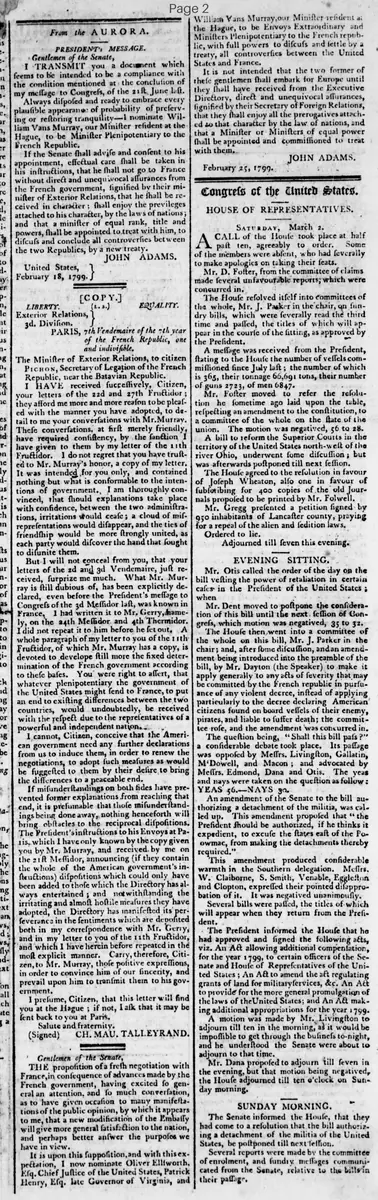
PRESIDENT'S MESSAGE.
Gentlemen of the Senate,
I TRANSMIT you a document which seems to be intended to be a compliance with the condition mentioned at the conclusion of my message to Congress, of the 21st June last. Always disposed and ready to embrace every plausible appearance of probability of preserving or restoring tranquility--I nominate William Vans Murray, our Minister resident at the Hague, to be Minister Plenipotentiary to the French Republic. If the Senate shall advise and consent to his appointment, effectual care shall be taken in his instructions, that he shall not go to France without direct and unequivocal assurances from the French government, signified by their minister of Exterior Relations, that he shall be received in character : shall enjoy the privileges attached to his character, by the laws of nations: and that a minister of equal rank, title and powers, shall be appointed to treat with him, to discuss and conclude all controversies between the two Republics, by a new treaty.
JOHN ADAMS.
United States,
February 18, 1799.
[COPY.]
LIBERTY. (z.s.) EQUALITY.
Exterior Relations, 3d. Division.
PARIS, 7th Vendemaire of the 8th year of the French Republic, one and indivisible.
The Minister of Exterior Relations, to citizen Pinchon, Secretary of Legation of the French Republic, near the Batavian Republic.
I HAVE received successively, Citizen, your letters of the 22d and 27th Fructidor ; they afford me more and more reason to be pleased with the manner you have adopted, to detail to me your conversations with Mr. Murray. These conversations, at first merely friendly, have required consistency, by the sanction I have given to them by my letter of the 11th Fructidor. I do not regret that you have trusted to Mr. Murray's honor, a copy of my letter. It was intended for you only, and contained nothing but what is conformable to the intentions of government. I am thoroughly convinced, that should explanations take place with confidence, between the two administrations, irritations would cease; a cloud of misrepresentations would disappear, and the ties of friendship would be more strongly united, as each party would discover the hand that ought to disunite them.
But I will not conceal from you, that your letters of the 2d and 3d Vendemaire, just received, surprise me much. What Mr. Murray is still dubious of, has been explicitly declared, even before the President's message to Congress of the 3d Messidor last, was known in France, I had written it to Mr. Gerry, namely, on the 24th Messidor and 4th Thermidor. I did not repeat it to him before he set out. A whole paragraph of my letter to you of the 11th Fructidor, of which Mr. Murray has a copy, is devoted to develope still more the fixed determination of the French government according to these bases. You were right to assert, that whatever plenipotentiary the government of the United States might send to France, to put an end to existing differences between the two countries, would undoubtedly, be received with the respect due to the representatives of a powerful and independent nation.
I cannot, Citizen, conceive that the American government need any further declarations from us to induce them, in order to renew the negotiations, to adopt such measures as would be suggested to them by their desire to bring the differences to a peaceable end. If misunderstandings on both sides have prevented former explanations from reaching that end, it is presumable that those misunderstandings being done away, nothing henceforth will bring obstacles to the reciprocal dispositions. The President's instructions to his Envoys at Paris, which I have only known by the copy given you by Mr. Murray, and received by me on the 21st Messidor, announcing (if they contain the whole of the American government's instructions) dispositions which could only have been added to those which the Directory has always entertained; and notwithstanding the irritating and almost hostile measures they have adopted, the Directory has manifested its perseverance in the sentiments which are deposited both in my correspondence with Mr. Gerry, and in my letter to you of the 11th Fructidor, and which I have herein before repeated in the most explicit manner. Carry, therefore, Citizen, to Mr. Murray, those positive expressions, in order to convince him of our sincerity, and prevail upon him to transmit them to his government.
I presume, Citizen, that this letter will find you at the Hague ; if not, I ask that it may be sent back to you at Paris.
Salute and fraternity.
(Signed) CH. MAU. TALLEYRAND.
Gentlemen of the Senate,
THE proposition of a fresh negotiation with France, in consequence of advances made by the French government, having excited so general an attention, and so much conversation, as to have given occasion to many manifestations of the public opinion, by which it appears to me, that a new modification of the Embassy will give more general satisfaction to the nation, and perhaps better answer the purposes we have in view.
It is upon this supposition, and with this expectation, I now nominate Oliver Ellsworth, Esq. Chief Justice of the United States, Patrick Henry, Esq. late Governor of Virginia, and William Vans Murray, our Minister resident at the Hague, to be Envoys Extraordinary and Ministers Plenipotentiary to the French republic, with full powers to discuss and settle by a treaty, all controversies between the United States and France.
It is not intended that the two former of these gentlemen shall embark for Europe until they shall have received from the Executive Directory, direct and unequivocal assurances, signified by their Secretary of Foreign Relations, that they shall enjoy all the prerogatives attached to that character by the law of nations, and that a Minister or Ministers of equal power shall be appointed and commissioned to treat with them.
JOHN ADAMS.
February 25, 1799.
What sub-type of article is it?
What keywords are associated?
What entities or persons were involved?
Where did it happen?
Foreign News Details
Primary Location
France
Event Date
February 18, 1799 February 25, 1799
Key Persons
Outcome
renewed diplomatic negotiations proposed between us and france, with assurances of respectful reception for us envoys and appointment of equal french counterparts to discuss and settle controversies by treaty.
Event Details
President Adams transmits a French document complying with prior conditions and nominates Murray as Minister Plenipotentiary to France, conditional on assurances. Talleyrand's letter to Pinchon affirms French government's willingness to receive US plenipotentiaries respectfully, expresses desire to end differences through confident explanations, and instructs conveyance of sincerity to Murray. Adams subsequently nominates Ellsworth, Henry, and Murray as envoys extraordinary, with embarkation conditional on direct assurances from the French Directory.