Thank you for visiting SNEWPapers!
Sign up free
Letter to Editor
March 31, 1792
Gazette Of The United States
New York, New York County, New York
What is this article about?
A letter critiques Vice-President John Adams' voting in the Senate on the representation bill, questioning if he adopted and violated a rule to support House-passed bills in ties, emphasizing the need for explanation to uphold his office's integrity.
Clipping
OCR Quality
95%
Excellent
Full Text
FROM THE NATIONAL GAZETTE.
BY MR. P. FRENEAU.
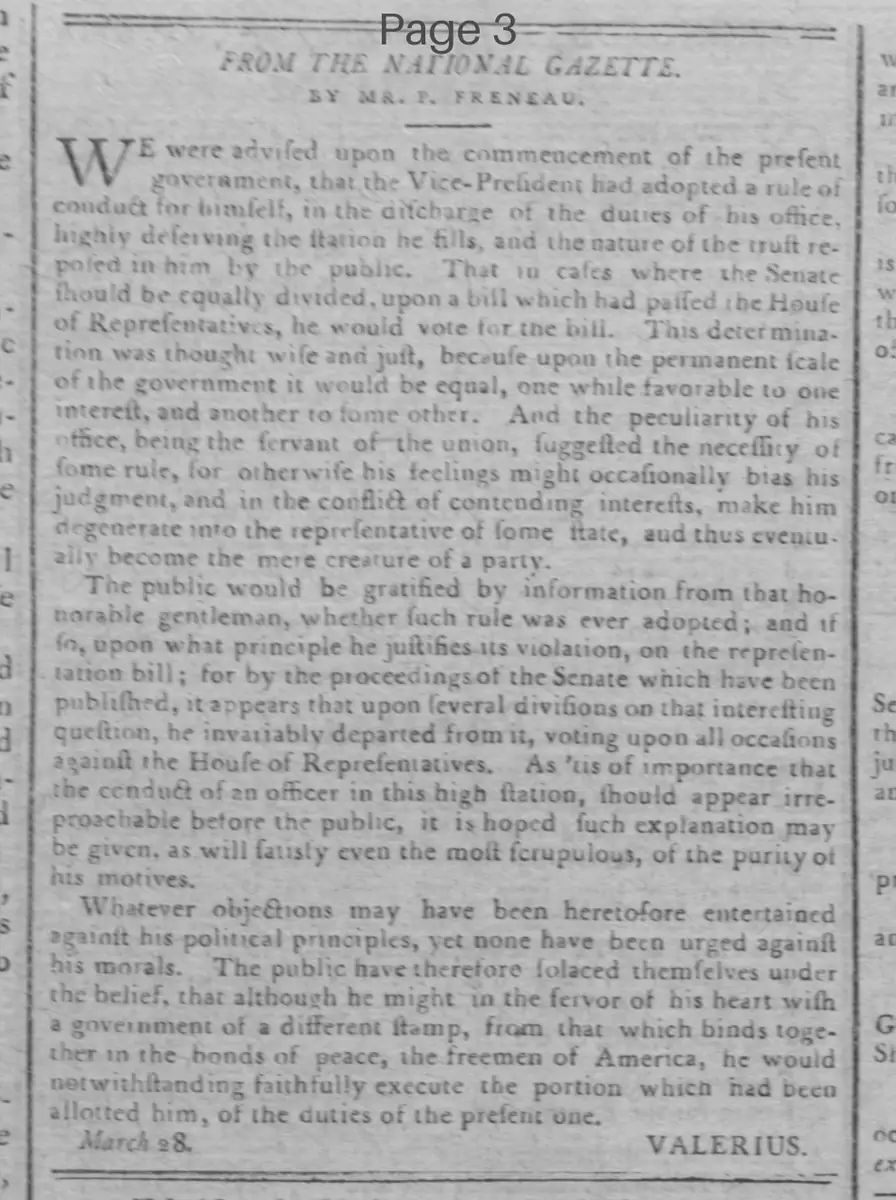
WE were advised upon the commencement of the present government, that the Vice-President had adopted a rule of conduct for himself, in the discharge of the duties of his office, highly deserving the station he fills, and the nature of the trust reposed in him by the public. That in cases where the Senate should be equally divided, upon a bill which had passed the House of Representatives, he would vote for the bill. This determination was thought wise and just, because upon the permanent scale of the government it would be equal, one while favorable to one interest, and another to some other. And the peculiarity of his office, being the servant of the union, suggested the necessity of some rule, for otherwise his feelings might occasionally bias his judgment, and in the conflict of contending interests, make him degenerate into the representative of some state, and thus eventually become the mere creature of a party.
The public would be gratified by information from that honorable gentleman, whether such rule was ever adopted; and if so, upon what principle he justifies its violation, on the representation bill; for by the proceedings of the Senate which have been published, it appears that upon several divisions on that interesting question, he invariably departed from it, voting upon all occasions against the House of Representatives. As it is of importance that the conduct of an officer in this high station, should appear irreproachable before the public, it is hoped such explanation may be given, as will satisfy even the most scrupulous, of the purity of his motives.
Whatever objections may have been heretofore entertained against his political principles, yet none have been urged against his morals. The public have therefore solaced themselves under the belief, that although he might in the fervor of his heart wish a government of a different stamp, from that which binds together in the bonds of peace, the freemen of America, he would notwithstanding faithfully execute the portion which had been allotted him, of the duties of the present one.
March 28.
VALERIUS.
BY MR. P. FRENEAU.
WE were advised upon the commencement of the present government, that the Vice-President had adopted a rule of conduct for himself, in the discharge of the duties of his office, highly deserving the station he fills, and the nature of the trust reposed in him by the public. That in cases where the Senate should be equally divided, upon a bill which had passed the House of Representatives, he would vote for the bill. This determination was thought wise and just, because upon the permanent scale of the government it would be equal, one while favorable to one interest, and another to some other. And the peculiarity of his office, being the servant of the union, suggested the necessity of some rule, for otherwise his feelings might occasionally bias his judgment, and in the conflict of contending interests, make him degenerate into the representative of some state, and thus eventually become the mere creature of a party.
The public would be gratified by information from that honorable gentleman, whether such rule was ever adopted; and if so, upon what principle he justifies its violation, on the representation bill; for by the proceedings of the Senate which have been published, it appears that upon several divisions on that interesting question, he invariably departed from it, voting upon all occasions against the House of Representatives. As it is of importance that the conduct of an officer in this high station, should appear irreproachable before the public, it is hoped such explanation may be given, as will satisfy even the most scrupulous, of the purity of his motives.
Whatever objections may have been heretofore entertained against his political principles, yet none have been urged against his morals. The public have therefore solaced themselves under the belief, that although he might in the fervor of his heart wish a government of a different stamp, from that which binds together in the bonds of peace, the freemen of America, he would notwithstanding faithfully execute the portion which had been allotted him, of the duties of the present one.
March 28.
VALERIUS.
What sub-type of article is it?
Persuasive
Political
Investigative
What themes does it cover?
Politics
Constitutional Rights
What keywords are associated?
Vice President Conduct
Senate Voting Rule
Representation Bill
Political Integrity
House Of Representatives
What entities or persons were involved?
Valerius.
Letter to Editor Details
Author
Valerius.
Main Argument
the vice-president should explain whether he adopted a rule to vote for house-passed bills in senate ties and, if so, why he violated it by voting against the house on the representation bill multiple times.
Notable Details
References Published Senate Proceedings
Emphasizes Vice President's Role As Servant Of The Union
Notes No Prior Objections To His Morals Despite Political Differences