Thank you for visiting SNEWPapers!
Sign up free
Henderson Daily Dispatch
Henderson, Vance County, North Carolina
What is this article about?
On Dec. 18, President Roosevelt vetoed the Logan-Walter bill in Washington, warning it would cause chaos and paralysis in government, especially impacting defense functions amid controversy over uniform procedures for federal agency reviews. Override vote expected to be close.
Merged-components note: Continuation of President Vetoes Logan-Walter Bill from page 1 to page 7.
Clippings
1 of 2
OCR Quality
Full Text
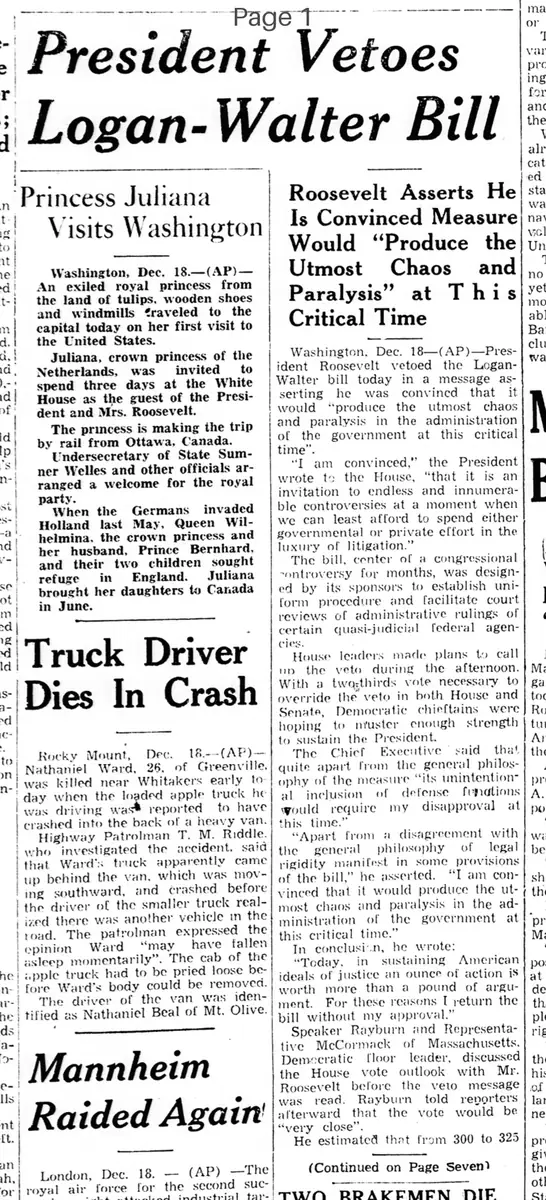
Roosevelt Asserts He Is Convinced Measure Would "Produce the Utmost Chaos and Paralysis" at This Critical Time
Washington. Dec. 18 (AP)-President Roosevelt vetoed the Logan-Walter bill today in a message asserting he was convinced that it would "produce the utmost chaos and paralysis in the administration of the government at this critical time". "I am convinced," the President wrote to the House, "that it is an invitation to endless and innumerable controversies at a moment when we can least afford to spend either governmental or private effort in the luxury of litigation." The bill, center of a congressional controversy for months, was designed by its sponsors to establish uniform procedure and facilitate court reviews of administrative rulings of certain quasi-judicial federal agencies. House leaders made plans to call up the veto during the afternoon. With a two-thirds vote necessary to override the veto in both House and Senate, Democratic chieftains were hoping to muster enough strength to sustain the President. The Chief Executive said that quite apart from the general philosophy of the measure "its unintentional inclusion of defense functions would require my disapproval at this time." "Apart from a disagreement with the general philosophy of legal rigidity manifest in some provisions of the bill," he asserted. "I am convinced that it would produce the utmost chaos and paralysis in the administration of the government at this critical time." In conclusion, he wrote: "Today, in sustaining American ideals of justice an ounce of action is worth more than a pound of argument. For these reasons I return the bill without my approval." Speaker Rayburn and Representative McCormack of Massachusetts, Democratic floor leader, discussed the House vote outlook with Mr. Roosevelt before the veto message was read. Rayburn told reporters afterward that the vote would be "very close". He estimated that from 300 to 325
(Continued on Page Seven)
President Vetoes
Logan-Walter Bill
(Continued from Page One)
The message was called up
on the tenth day allowed him in which
to act on the bill or allow it to become law without his signature since the
session ended.
The Senate had passed it by a margin of only two
votes—25 to 23—with 44 senators absent.
By Chief Executive.
What sub-type of article is it?
What keywords are associated?
What entities or persons were involved?
Where did it happen?
Domestic News Details
Primary Location
Washington
Event Date
Dec. 18
Key Persons
Outcome
president vetoed the bill; house leaders planned to call up the veto; two-thirds vote needed to override in both house and senate; democratic leaders hoped to sustain the veto; vote estimated very close, 300 to 325.
Event Details
President Roosevelt vetoed the Logan-Walter bill, asserting it would produce utmost chaos and paralysis in government administration at a critical time, invite endless controversies, and unintentionally include defense functions. The bill aimed to establish uniform procedure and facilitate court reviews of administrative rulings of certain quasi-judicial federal agencies. It had been controversial for months. The veto message was sent to the House on the tenth day allowed. The Senate passed it 25 to 23 with 44 absent.