Thank you for visiting SNEWPapers!
Sign up free
Rhode Island Republican
Newport, Newport County, Rhode Island
What is this article about?
Editorial in Rhode-Island Republican defends Thomas Paine against Federalist attacks, portraying Jefferson's letter as a courteous response to Paine's wish to return to America rather than an invitation. It emphasizes Paine's patriotic contributions, advocates tolerance for his deism, and criticizes Federalist maneuvers to sow division.
Merged-components note: This is a continuation of the same editorial across pages, as indicated by the text flow and sequential reading order.
Clippings
1 of 2
OCR Quality
Full Text
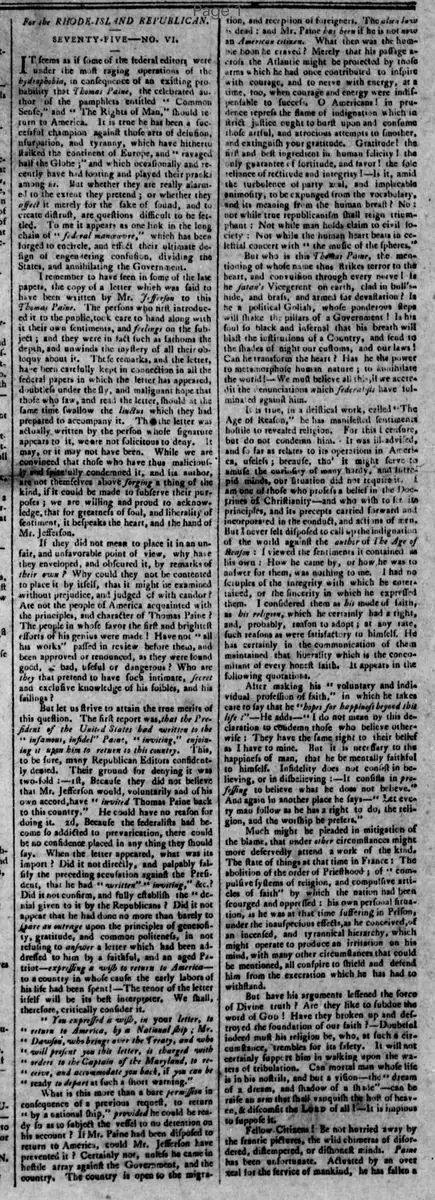
SEVENTY-FIVE-NO. VI
It seems as if Some of those federal editors were under the most raging operations of the hydrophobia, in consequence of an exciting probability that Thomas Paine, the celebrated author of the pamphlets entitled "Common Sense," and "The Rights of Man," should return to America. It is true he has been a successful champion against those arts of delusion, usurpation, and tyranny, which have hitherto stalked the continent of Europe, and "ravaged half the Globe ;" and which occasionally and recently have had footing and played their pranks among us. But whether they are really alarmed to the extent they pretend; or whether they affect it merely for the sake of sound, and to create distrust, are questions difficult to be settled. To me it appears as one link in the long chain of "federal manoeuvre," which has been forged to encircle, and effect their ultimate design of engendering confusion, dividing the States, and annihilating the Government.
I remember to have seen in some of the late papers, the copy of a letter which was said to have been written by Mr. Jefferson to this Thomas Paine. The persons who first introduced it to the public, took care to hand along with it their own sentiments, and feelings on the subject : and they were in fact such as at once shows the depth, and unwinds the mystery of all their obloquy about it. These remarks, and the letter, have been carefully kept in connection in all the federal papers in which the letter has appeared, doubtless under the sly, and malignant hope that those who saw, and read the letter, should at the same time swallow the linctus which they had prepared to accompany it. That the letter was actually written by the person whose signature appears to it, we are not solicitous to deny. It may, or it may not have been. While we are convinced that those who have thus maliciously and spitefully commented it, and its author are not themselves above forging a thing of the kind, if it could be made to subserve their purposes ; we are willing and proud to acknowledge, that for greatness of soul, and liberality of sentiment, it bespeaks the heart, and the hand of Mr. Jefferson.
If they did not mean to place it in an unfair, and unfavorable point of view, why have they enveloped, and obscured it, by remarks of their own ? Why could they not be contented to place it by itself, that it might be examined without prejudice, and judged of with candor? Are not the people of America acquainted with the principles, and character of Thomas Paine ? The people in whose favor the first and brightest efforts of his genius were made ! Have not "all his works" passed in review before them, and been approved or renounced, as they were found good, bad, useful or dangerous ? Who are they that pretend to have such intimate, secret and exclusive knowledge of his foibles, and his failings?
But let us strive to attain the true merits of this question. The first report was,that the President of the United States had written to the "infamous, infidel" Paine, "inviting," enjoining it upon him to return to this country. This, to be sure, many Republican Editors consistently denied. Their ground for denying it was two-fold :-1st, Because they did not believe that Mr. Jefferson would, voluntarily and of his own accord,have "invited Thomas Paine back to this country." He could have no reason for doing it. 2d, Because the federalists had become so addicted to prevarication, there could be no confidence placed in any thing they should say.: When the letter appeared, what was its import ? Did it not directly, and palpably falsify the preceding accusation against the President, that he had "written".inviting." &c.? Did it not confirm, and fully establish the "denial" given to it by the Republicans ? Did it not appear that he had done no more than barely to parry an outrage upon the principles of generosity, gratitude, and common politeness, in not refusing to answer a letter which had been addressed to him by a faithful, and an aged Patriot-expressing a wish to return to America- to a country in whose cause the early labors of his life had been spent!-The tenor of the letter itself will be its best interpreter. We shall, therefore, critically consider it.
"You expressed a wish, in your letter, to return to America, by a National ship ; Mr. Dawson, who brings over the Treaty, and who will present you this letter, is charged with orders to the Captain of the Maryland, to receive, and accommodate you back, if you can be ready to depart at such a short warning."
What is this more than a bare permission in consequence of a previous request, to return "by a national ship," provided he could be ready so as to subject the vessel to no detention on his account ? If Mr. Paine had been disposed to return to America, could Mr. Jefferson have prevented it ? Certainly not, unless he came in hostile array against the Government, and the country. The country is open to the migration, and reception of foreigners, The Alien law is dead : and Mr. Paine has been if he is not now an American citizen. What then was the homely boon he craved ? Merely that his passage across the Atlantic might be protected by those arms which he had once contributed to inspire with courage and to nerve with energy, at a time, too, when courage and energy were indispensable to Success. O Americans! in prudence repress the flame of indignation which in strict justice ought to burst upon and consume those artful, and atrocious attempts to smother, and extinguish your gratitude. Gratitude! the first and best ingredient in human felicity ! the only guarantee of fortitude, and favor ! the sole reliance of rectitude and integrity !--Is it, amid the turbulence of party zeal, and implacable animosity, to be expunged from the vocabulary, and its meaning from the human breast ? No : not while true republicanism shall reign triumphant : Not while man holds claim to civil society : Not while the human heart beats in celestial concert with "the music of the spheres."
But who is this Thomas Paine, the mentioning of whose name alone strikes terror to the heart, and convulsion through every nerve Is he Satan's Vicegerent on earth, clad in bull's-hide, and brass, and armed for devastation ? Is he a political Goliath, whose ponderous steps will shake the pillars of a Government I Is his soul so black and infernal that his breath will blast the institutions of a Country, and end to the shades of night our customs, and our laws ! Can he transform the heart ? Has he the power to metamorphose human nature ; to annihilate the world!- We must believe all this, if we accredit the denunciations which federalists have fulminated against him.
It is true, in a deistical work, called"The Age of Reason," he has manifested sentiments hostile to revealed religion. For this I censure, but do not condemn him. · It was ill-advised, and so far as relates to its operations in America, useless; because, tho' it might serve to amuse the curiosity of many hardy, and intrepid minds, our situation did not require it. I am one of those who profess a belief in the doctrines of Christianity-and who wish to see its principles, and its precepts carried forward and incorporated in the conduct, and actions of men. But I never felt disposed to call upthe indignation of the world against the author of the Age of Reason : I viewed the sentiments it contained as his own : How he came by, or how,he was to answer for them, was nothing to me. I had no scruples of the integrity with which be entertained, or the sincerity in which he expressed them. I considered them as his mode of faith, as his religion, which he certainly had a right, and, probably, reason to adopt ; at any rate, such reasons as were satisfactory to himself. He has certainly in the communication of them maintained that liberality which is the concomitant of every honest faith. it appears in the following quotations.
After making his "voluntary and individual profession of faith," in which he takes care to say that he "hopes for happiness beyond this life :"-He adds-"I do not mean by this declaration to condemn those who believe otherwise : They have the same right to their belief as I have to mine. But it is necessary to the happiness of man, that he be mentally faithful to himself. Infidelity does not consist in believing, or in disbelieving :-It consists in professing to believe -what he does not believe."
And again In another place he says-"Let every man follow as he has a right to do, the religion, and the worship he prefers.'"
Much might be pleaded in mitigation of the blame, that under other circumstances might more deservedly attend a work of the kind. The state of things at that time in France : The abolition of the order of Priesthood ; of "compulsive systems of religion, and compulsive articles of faith" by which the nation had been scourged and oppressed : his own personal situation, as he was at that time suffering in Prison, under the inauspicious effects,as he conceived,of an incensed, and tyrannical hierarchy, which might operate to produce an irritation on his mind, with many other circumstances that could be mentioned, all conspire to shield and defend him from the execration which he has had to withstand.
But have his arguments lessened the force of Divine truth ? Are they like to subdue the word of God ! Have they broken up and destroyed the foundation of our faith ?-Doubtless indeed must his religion be, who, at such circumstances, trembles for its safety. It will not certainly support him in walking upon the waters of tribulation. Can mortal man whose life is in his nostrils, and but a vision--the" dream of a dream, and shadow of a shade"can be raise an arm that shall vanquish the host of heaven, & discomfit the Lord of all l It is impious to suppose it.
Fellow Citizens !-Be not hurried away by the frantic pictures, the wild chimerae of disordered, distempered, or dishonest minds. Paine has been unfortunate. Actuated by an over zeal for the service of mankind, he has fallen a wretched victim to the machinations of his enemies. Destitute of resources; threatened on either hand by the keen vengeance of vanquished tyrants; and sighing to see once more, before he shuts his eyes in death, the happy country that knew his better days, he appeals to the beneficence of its Chief Magistrate, whom he justly considers as the friend of man. Could he—can we refuse him an asylum, where he can do no more than breathe his last, and go down to the grave in peace? Picture to yourselves his person, and condition. Neglected because he can no longer serve. Fast bending to the stroke of time: "Oppressed and wearied out with care:" His aged limbs just ready to hail their native dust: All he asks is once more to see his favorite clime. Rise then, ye hardened foes: Ye foes to every Christian sentiment of gratitude, forgiveness and charity: Rise, and say he shall not come. The paucity of your numbers would do honor to the American name.
SEVENTY-FIVE.
What sub-type of article is it?
What keywords are associated?
What entities or persons were involved?
Editorial Details
Primary Topic
Defense Of Thomas Paine And Jefferson Against Federalist Criticisms
Stance / Tone
Strongly Pro Republican, Supportive Of Paine's Return And Religious Tolerance
Key Figures
Key Arguments