Thank you for visiting SNEWPapers!
Sign up free
The Tri Weekly Standard
Raleigh, Wake County, North Carolina
What is this article about?
On December 13, 1866, Rep. Thaddeus Stevens introduced a bill in Congress to reinstate civil government in North Carolina, enabling its return to the Union. The bill outlines a convention of loyal citizens to form a new constitution, with voting rights for literate or property-owning males regardless of race. An amended version extends similar provisions to other former Confederate states, emphasizing loyalty oaths and equal rights.
Clipping
OCR Quality
Full Text
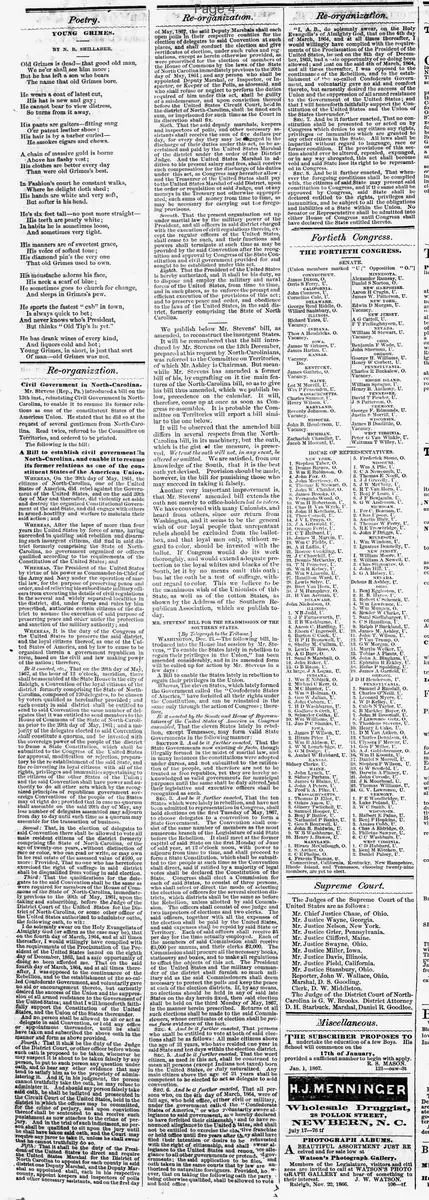
CIVIL GOVERNMENT IN NORTH-CAROLINA.
Mr. Stevens (Rep., Pa.) introduced a bill on the 13th inst., reinstating Civil Government in North-Carolina, to enable it to resume its former relations as one of the constituent States of the American Union. He stated that he did so at the request of several gentlemen from North-Carolina. Read twice, referred to the Committee on Territories, and ordered to be printed.
The following is the bill:
A BILL TO ESTABLISH CIVIL GOVERNMENT IN NORTH-CAROLINA, AND ENABLE IT TO RESUME ITS FORMER RELATIONS AS ONE OF THE CONSTITUENT STATES OF THE AMERICAN UNION.
WHEREAS, On the 20th day of May, 1861, the citizens of North-Carolina, one of the United States of America, did rebel against the Government of the United States, and on the said 20th day of May and thereafter, did violently set aside and destroy the organized Constitutional Government of the said State, and did engage with others in armed hostility and warfare to maintain their said action; and
WHEREAS, After the lapse of more than four years the United States by force of arms, having succeeded in quelling said rebellion and disarming such insurgent citizens, did find in said district formerly comprising the State of North-Carolina, no government organized or officers qualified according to the requirements of the Constitution of the United States; and
WHEREAS, The President of the United States by virtue of his power as Commander-in-Chief of the Army and Navy under the operation of martial law, for the purpose of preserving peace and order, and of relieving his subordinate military officers from executing the details of civil regulations in the several and widely separated localities in the district, did, under forms and rules by him prescribed, authorize certain citizens of the district to assume the execution of said purpose of preserving peace and order under the protection and sanction of the military authority; and
WHEREAS, It is the duty of the Congress of the United States to preserve the said district, and the loyal citizens thereof, as one of the United States of America, and by law to cause to be organized therein a government republican in form, based on the civil and law making power of the nation; therefore,
Be it enacted, etc., That on the 20th day of May, 1867, at the hour of 12 o'clock, meridian, there shall be assembled at the State House in the city of Raleigh, a Convention of the loyal citizens of the district formerly comprising the State of North-Carolina, composed of 120 delegates, to be chosen by voters qualified as hereinafter provided; and each county in said district shall be entitled to send to said Convention the same number of delegates that it was entitled to send members to the House of Commons of the State of North-Carolina prior to the 20th day of May, 1861; and a majority of the delegates elected to said Convention shall constitute a quorum, and be invested with the sovereign power of the people of the district to frame a State Constitution, which shall be submitted to the Congress of the United States for approval, modification or rejection, preparatory to the re-establishment of the said State, and the re-investing its loyal citizens with all of the rights, privileges and immunities appertaining to the citizens of the other States of the Union; and the said Convention shall have power and authority to do all other acts which by the recognized principles of republican government sovereign Conventions of the people of the States may of right do; provided that in case no quorum shall assemble on the said 20th day of May, any less number of delegates assembled may adjourn from day to day until such time as a quorum may assemble for the transaction of business.
Second: That, in the election of delegates to said Convention there shall be allowed to vote all male resident citizens of the district formerly comprising the State of North Carolina, of the age of twenty-one years, without distinction of race or color, who can read or write, or may own in fee real estate of the assessed value of $100, or more: Provided, That no one who has heretofore exercised the right of suffrage in said district shall be disqualified from voting in said election.
Third: That the qualifications for the delegates to the said Convention shall be the same as were required for members of the House of Commons of the State of North-Carolina, immediately previous to the 20th of May, 1861, upon the taking and subscribing, before the Judge of the District Court of the United States for the District of North-Carolina, or some other officer of the United States authorized to administer oaths, the following oath, to wit:
I do solemnly swear on the Holy Evangelists of Almighty God (or affirm as the case may be), that on the fourth day of March, 1864, and at all times thereafter, I would willingly have complied with the requirements of the Proclamation of the President of the United States issued on the eighth day of December, 1863, had a safe opportunity of doing so been afforded me. That on the said fourth day of March, 1864, and at all times thereafter, I was opposed to the continuance of the Rebellion, and to the establishment of the so-called Confederate Government, and voluntarily gave no aid or encouragement thereto, but earnestly desired the success of the Union and the suppression of all armed resistance to the Government of the United States; and that I will henceforth faithfully support the Constitution of the United States, and the Union of the States thereunder.
And no person shall be allowed to sit or act as delegate in said Convention, or hold any office or appointment thereunder, until he shall have taken and subscribed the above oath in the manner and form as above provided.
Fourth: That it shall be the duty of the Judge of the District Court, or other officer before whom such oath is proposed to be taken, whenever he may suspect it is about to be taken falsely by any person, to put to such person any question under oath, and to hear any other evidence that may tend to satisfy him as to the propriety of administering it. And if, in his judgment, the person cannot truthfully take the oath, he may refuse to administer it. And should any person falsely take said oath, he shall be indicted and prosecuted in the Circuit Court of the United States, held in the district in which the offense may be committed, for the crime of perjury, and upon conviction thereof shall be sentenced to and receive such punishment as now attaches to the crime of perjury. And in the trial of such indictment, no person shall be qualified to sit upon the jury until he shall have taken said oath, and the Court may require any juror to take it, unless he shall swear that he cannot truthfully do so.
Fifth: That it shall be the duty of the President of the United States to direct and require the United States Marshal for the District of North Carolina to appoint for each county in said district one Deputy Marshal, and the Deputy Marshal so appointed shall, each in his respective county, appoint keepers and inspectors of polls and other necessary assistants, and on the first day of May, 1867, the said Deputy Marshals shall each open polls in their respective counties for the election of delegates to said Convention at such places, and shall conduct the election and give certificates of election, under such rules and regulations, except as herein otherwise provided, as were prescribed for the election of members of the House of Commons by the laws of the State of North Carolina immediately previous to the 20th day of May, 1861; and any person who shall be appointed Deputy Marshal, or Inspector, or Keeper of the Polls, as aforesaid, and who shall refuse or neglect to perform the duties required of him under this act, shall be guilty of a misdemeanor, and upon conviction thereof before the United States Circuit Court, held in the district of North-Carolina, shall be fined such sum, or imprisoned for such time as the Court in its discretion shall fix.
Sixth. That the said deputy marshals, keepers and inspectors of polls, and other necessary assistants shall receive the sum of five dollars per day, for every day they may be engaged in the discharge of their duties under this act, to be ascertained and paid by the United States Marshal of the district under the order of the District Judge. And the United States Marshal in addition to his present salary and fees, shall receive such compensation for the discharge of his duties under this act, as Congress may hereafter allow; and the Treasurer of the United States shall pay to the United States Marshal of said District, upon the order or requisition of said Judge, out of any moneys in the Treasury not otherwise appropriated, such sums of money from time to time, as may be necessary for carrying out the foregoing provisions.
Seventh. That the present organization set up under martial law by the military power of the President, and all officers in said district charged with the execution of civil regulations therein, except the regular officers of the United States, shall cease to be such, and their functions and powers shall terminate at such time as may be provided by the said Convention after the recognition and approval by Congress of the State Constitution and civil government provided for and sought to be established under this act.
Eighth. That the President of the United States is hereby authorized, and it shall be his duty, so to dispose and employ the military and naval forces of the United States, from time to time, and in such places, as to enforce the prompt and efficient execution of the provisions of this act; and to preserve peace and order, and obedience to the laws of the United States, in the said district, formerly comprising the State of North Carolina.
We publish below Mr. Stevens' bill, as amended, to reconstruct the insurgent States. It will be remembered that the bill introduced by Mr. Stevens on the 13th December, prepared at his request by North-Carolinians was referred to the Committee on Territories, of which Mr. Ashley is Chairman. But meanwhile Mr. Stevens has amended a former bill of his, by engrafting on it the main features of the North-Carolina bill, so as to give his bill thus amended, which we publish below, precedence on the calendar. It will therefore, come up at once as soon as Congress re-assembles. It is probable the Committee on Territories will report a bill similar to the one below.
It will be observed that the amended bill differs in several respects from the North-Carolina bill, in its machinery, but the oath, which is the gist of the measure, is preserved. We trust the oath will not, in any event, be altered or omitted. We are satisfied, from our knowledge of the South, that it is the best oath yet devised. Provision should be made, however, in the bill for punishing those who may succeed in taking it falsely.
Another very important improvement is, that Mr. Stevens' amended bill extends the oath not merely to office-holders but to voters. We have conversed with many Unionists, and heard from others, since our return from Washington, and it seems to be the general wish of our loyal people that unrepentant rebels should be excluded from the ballot-box, and that loyal men only, without regard to color, should be invested with the ballot. If Congress would do its work thoroughly, and would extend adequate protection to the loyal whites and blacks of the South, let it by no means omit this oath: but let the oath be a test of suffrage, without regard to color. This we believe to be the unanimous wish of the Unionists of this State, as well as of the cotton States, as shown by the Address of the Southern Republican Association, which we publish to-day.
MR. STEVENS' BILL FOR THE READMISSION OF THE SOUTHERN STATES.
[By Telegraph to the Tribune.]
WASHINGTON, Dec. 21.—The following bill, introduced into the House last session by Mr. Stevens, "To enable the States lately in rebellion to regain their privileges in the Union," has been amended considerably, and in its amended form will be called up for action by Mr. Stevens in a few days:
A BILL TO ENABLE THE STATES LATELY IN REBELLION TO REGAIN THEIR PRIVILEGES IN THE UNION.
Whereas, The eleven States, which lately formed the Government called the "Confederate States of America," have forfeited all their rights under the Constitution, and can be reinstated in the same only through the action of Congress; therefore,
Be it enacted by the Senate and House of Representatives of the United States of America in Congress assembled, That the eleven States lately in rebellion, except Tennessee, may form valid State Governments in the following manner:
Section 2. And be it further enacted, That the State Governments now existing de facto, though illegally formed in the midst of martial law, and in many instances the constitutions were adopted under duress, and not submitted to the ratification of the people, and therefore are not to be treated as free republics, yet they are hereby acknowledged as valid governments for municipal purposes until the same shall be duly altered, and their legislative and executive officers shall be recognized as such.
Sec. 3. And be it further enacted, That the ten States which were lately in rebellion, and have not been admitted to representation in Congress, shall hold elections on the first Tuesday of May, 1867, to choose delegates to a convention to form a State Government. The Convention shall consist of the same number of members as the most numerous branch of the Legislature of said State before the Rebellion. It shall meet at the former capital of said State on the first Monday of June of said year, at 12 o'clock noon, with power to adjourn from time to time, and shall proceed to form a State Constitution, which shall be submitted to the people at such time as the Convention shall direct, and if ratified by a majority of legal votes shall be declared the Constitution of the State. Congress shall elect a Commission for each of said States, to consist of three persons, who shall select or direct the mode of selecting the election of officers for the several election districts, which districts shall be the same as before the Rebellion, unless allotted by said Commission. The officers shall consist of one judge and two inspectors of elections and two clerks. The said officers, together with all the expenses of the election shall be paid by the United States, and said expenses shall be repaid by said State or Territory. "Each of said officers shall receive $5 per day for the time actually employed. Each of the members of said Commission shall receive $3,000 per annum, and their clerks $2,000. The Commission shall procure all the necessary books, stationery and boxes, and to make all regulations to effect the objects of this act. The President of the United States and the military commander of the district shall furnish so much military aid as the said Commissioners shall deem necessary to protect the polls and keep the peace at each of the election districts. If, by any means, no elections should be held in any of said late States on the day herein fixed, then said election shall be held on the third Monday of May, 1867, in the manner herein prescribed. Returns of all such elections shall be made to the said Commissioners, whose certificates of election shall be prima facie evidence of the fact.
SEC. 4. And be it further enacted, That persons who shall be entitled to vote at both of said elections shall be as follows: All male citizens above the age of 21 years, who have resided one year in said State and ten days within the election district.
Sec. 5. And be it further enacted, That the word citizen, as used in this act, shall be construed to mean all persons (except Indians not taxed) born in the United States, or duly naturalized. Any male citizen above the age of 21 years shall be competent to be elected to act as delegate to said convention.
Sec. 6. And be it further enacted, That all persons who, on the 4th day of March, 1864, were of full age, who held office, either civil or military, under the government called the "Confederate States of America," or who voluntarily swore allegiance to said government, are hereby declared to have forfeited their citizenship and to have renounced allegiance to the United States, and shall not be entitled to exercise the elective franchise or hold office until five years after they shall have filed their intention or desire to be reinvested with the right of citizenship, and shall swear allegiance to the United States and renounce allegiance to all other governments or pretended governments; the said application to be filed and oath taken in the same courts that by law are authorized to naturalize foreigners. Provided, however, that on taking the following oath the party, being otherwise qualified, shall be allowed to vote and hold office:
"I, A. B., do solemnly swear, on the Holy Evangelists of Almighty God, that on the 4th day of March, 1864, and at all times thereafter, I would willingly have complied with the requirements of the Proclamation of the President of the United States, issued on the 8th day of December, 1863, had a safe opportunity of so doing been allowed: and that on the said 4th of March, 1864, and all times thereafter, I was opposed to the continuance of the Rebellion, and to the establishment of the so-called Confederate Government, and voluntarily gave no aid and comfort thereto, but earnestly desired the success of the Union and the suppression of all armed resistance to the Government of the United States; and that I will henceforth faithfully support the Constitution of the United States and the Union of the States thereunder."
Sec. 7. And be it further enacted. That no constitution shall be presented to or acted on by Congress which denies to any citizen any rights, privileges or immunities which are granted to any other citizen in the State. All laws shall be impartial without regard to language, race or former condition. If the provisions of this section should ever be altered, repealed, expunged, or in any way abrogated, this act shall become void and said State lose its right to be represented in Congress.
Sec. 8. And be it further enacted, That whenever the foregoing conditions shall be complied with, the citizens of said State may present said constitution to Congress, and if the same shall be approved by Congress, said State shall be declared entitled to the rights, privileges and immunities, and be subject to all the obligations and liabilities of a State within the Union. No Senator or Representative shall be admitted into either House of Congress until Congress shall have declared the State entitled thereto.
What sub-type of article is it?
What keywords are associated?
What entities or persons were involved?
Where did it happen?
Domestic News Details
Primary Location
North Carolina
Event Date
13th Inst.
Key Persons
Outcome
bill read twice, referred to the committee on territories, and ordered to be printed. amended bill to be called up soon for action.
Event Details
Mr. Stevens introduced a bill to establish civil government in North-Carolina via a convention of 120 loyal delegates to frame a new state constitution for congressional approval. Voting open to literate or property-owning males over 21 without race distinction, requiring a loyalty oath. An amended bill extends similar reconstruction to other former rebel states, excluding Tennessee, with commissions overseeing elections and equal rights protections.