Thank you for visiting SNEWPapers!
Sign up free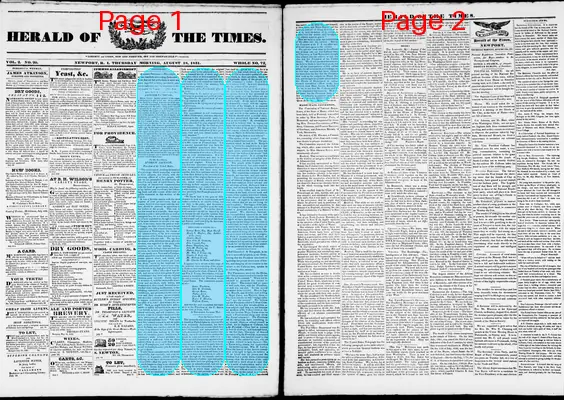
Herald Of The Times
Newport, Newport County, Rhode Island
What is this article about?
1831 political article reprints a manifesto from disaffected original Jackson supporters in Pennsylvania criticizing Jackson's administration for neglecting them in favor of former opponents, warning of lost support. Includes commentaries on its suppression, implications for re-election, and cabinet controversies involving Eaton.
Merged-components note: These components form a single continuous political story/article spanning pages 1 and 2, discussing protocols and Jackson administration critiques.
Clippings
1 of 2
OCR Quality
Full Text
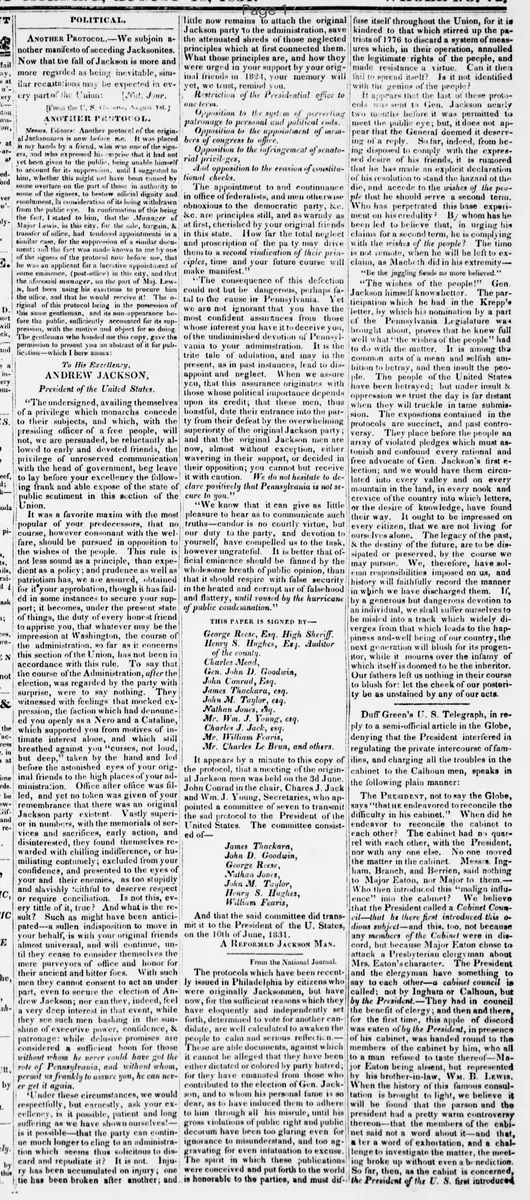
Another Protocol.—We subjoin another manifesto of seceding Jacksonites. Now that the fall of Jackson is more and more regarded as being inevitable, similar recantations may be expected in every part of the Union:
[Nat. Jour.
[From the U. S. Gaz. of Aug. 1st.]
ANOTHER PROTOCOL.
Messrs. Editors: Another protocol of the original Jacksonmen is now before me. It was placed in my hands by a friend, who was one of the signers, and who expressed his surprise that it had not yet been given to the public, being unable himself to account for its suppression, until I suggested to him, whether this might not have been caused by some overture on the part of those in authority to some of the signers, to bestow official dignity and emolument, in consideration of its being withdrawn from the public eye. In confirmation of this being the fact, I stated to him, that the Manager of Major Lewis, in this city, for the sale, bargain, & transfer of office, had tendered appointments in a similar case, for the suppression of a similar document; and the fact was made known to me by one of the signers of the protocol now before me, that he was an applicant for a lucrative appointment of some eminence, (post-office) in this city, and that the aforesaid manager, on the part of Maj. Lewis, had been using his exertions to procure him the office, and that he would receive it! The original of this protocol being in the possession of this same gentleman, and its non-appearance before the public, sufficiently accounted for its suppression, with the motive and object for so doing. The gentleman who handed me this copy, gave the permission to present you an abstract of it for publication—which I here annex:
To His Excellency,
ANDREW JACKSON,
President of the United States.
"The undersigned, availing themselves of a privilege which monarchs concede to their subjects, and which, with the presiding officer of a free people, will not, we are persuaded, be reluctantly allowed to early and devoted friends, the privilege of unreserved communication with the head of government, beg leave to lay before your excellency the following frank and able expose of the state of public sentiment in this section of the Union.
It was a favorite maxim with the most popular of your predecessors, that no course, however consonant with the welfare, should be pursued in opposition to the wishes of the people. This rule is not less sound as a principle, than expedient as a policy; and prudence as well as patriotism has, we are assured, obtained for it your approbation, though it has failed in some instances to secure your support; it becomes, under the present state of things, the duty of every honest friend to apprise you, that whatever may be the impression at Washington, the course of the administration, so far as it concerns this section of the Union, has not been in accordance with this rule. To say that the course of the Administration, after the election, was regarded by the party with surprise, were to say nothing. They witnessed with feelings that mocked expression, the faction which had denounced you openly as a Nero and a Cataline, which supported you from motives of intimate interest alone, and which still breathed against you "curses, not loud, but deep," taken by the hand and led before the astonished eyes of your original friends to the high places of your administration. Office after office was filled, and yet no token was given of your remembrance that there was an original Jackson party existent. Vastly superior in numbers, with the memorials of services and sacrifices, early action, and disinterested, they found themselves rewarded with chilling indifference, or humiliating contumely; excluded from your confidence, and presented to the eyes of your and their enemies, as too stupidly and slavishly faithful to deserve respect or require conciliation. Is not this, every tittle of it, true? And what is the result? Such as might have been anticipated—a sullen indisposition to move in your behalf, is with your original friends almost universal, and will continue, until they cease to consider themselves the mere purveyors of office and honor for their ancient and bitter foes. With such men they cannot consent to act an under part, even to secure the election of Andrew Jackson; nor can they, indeed, feel a very deep interest in that event, while they see such men basking in the sunshine of executive power, confidence, & patronage: while delusive promises are considered a sufficient boon for those without whom he never could have got the vote of Pennsylvania, and without whom, permit us frankly to assure you, he can never get it again.
Under these circumstances, we would respectfully, but earnestly, ask your excellency, is it possible, patient and long suffering as we have shown ourselves!—is it possible—that the party can continue much longer to cling to an administration which seems thus solicitous to discard and repudiate it? It is not. Injury has been accumulated on injury; one tie has been broken after another; and
little now remains to attach the original Jackson party to the administration, save the attenuated shreds of those neglected principles which at first connected them. What those principles are, and how they were urged in your support by your original friends in 1824, your memory will yet, we trust, remind you.
Restriction of the Presidential office to one term.
Opposition to the system of perverting patronage to personal and political ends.
Opposition to the appointment of members of congress to office.
Opposition to the infringement of senatorial privileges,
And opposition to the evasion of constitutional checks.
The appointment to and continuance in office of federalists, and men otherwise obnoxious to the democratic party, &c. &c. are principles still, and as warmly as at first, cherished by your original friends in this state. How far the total neglect and proscription of the party may drive them to a second vindication of their principles, time and your future course will make manifest."
"The consequence of this defection could not but be dangerous, perhaps fatal to the cause in Pennsylvania. Yet we are not ignorant that you have the most confident assurances from those whose interest it is to deceive you, of the undiminished devotion of Pennsylvania to your administration. It is the trite tale of adulation, and may in the present, as in past instances, lead to disappoint and neglect. When we assure you, that this assurance originates with those whose political importance depends upon its credit; that these men, thus boastful, date their entrance into the party from their defeat by the overwhelming superiority of the original Jackson party; and that the original Jackson men are now, almost without exception, either wavering in their support, or decided in their opposition; you cannot but receive it with caution. We do not hesitate to declare positively that Pennsylvania is not secure to you.
"We know that it can give as little pleasure to hear as to communicate such truths—candor is no courtly virtue, but our duty to the party, and devotion to yourself, have compelled us to the task, however ungrateful. It is better that official eminence should be fanned by the wholesome breath of public opinion, than that it should respire with false security in the heated and corrupt air of falsehood and flattery, until roused by the hurricane of public condemnation."
THIS PAPER IS SIGNED BY—
George Reese, Esq. High Sheriff
Henry S. Hughes, Esq. Auditor
of the county.
Charles Mead.
Gen. John D. Goodwin,
John Conrad, Esq.
James Thackara, esq.
John M. Taylor, esq.
Nathan Jones, esq.
Mr. Wm. J. Young, esq.
Charles J. Jack, esq
Mr. William Fearis,
Mr. Charles Le Brun, and others.
It appears by a minute to this copy of the protocol, that a meeting of the original Jackson men was held on the 3d June. John Conrad in the chair, Charles J. Jack and Wm. J. Young, Secretaries, who appointed a committee of seven to transmit the said protocol to the President of the United States. The committee consisted of
James Thackara,
John D. Goodwin,
George Reese,
Nathan Jones,
John M. Taylor,
Henry S. Hughes,
William Fearis,
And that the said committee did transmit it to the President of the U. States, on the 10th of June, 1831.
A Reformed Jackson Man.
From the National Journal.
The protocols which have been recently issued in Philadelphia by citizens who were originally Jacksonmen, but have now, for the sufficient reasons which they have eloquently and independently set forth, determined to vote for another candidate, are well calculated to awaken the people to calm and serious reflection.—These are able documents, against which it cannot be alleged that they have been either dictated or colored by party hatred; for they have emanated from those who contributed to the election of Gen. Jackson, and to whom his personal fame is so dear, as to have induced them to adhere to him through all his misrule, until his gross violations of public right and public decorum have been too glaring even for ignorance to misunderstand, and too aggravating for even infatuation to excuse. The spirit in which these publications were conceived and put forth to the world is honorable to the parties, and must diffuse itself throughout the Union, for it is
kindred to that which stirred up the patriots of 1776 to discard a system of measures which, in their operation, annulled the legitimate rights of the people, and made resistance a virtue. Can it then fail to spread itself? Is it not identified with the genius of the people?
It appears that the last of these protocols was sent to Gen. Jackson nearly two months before it was permitted to meet the public eye; but, it does not appear that the General deemed it deserving of a reply. So far, indeed, from being disposed to comply with the expressed desire of his friends, it is rumored that he has made an explicit declaration of his resolution to stand the hazard of the die, and accede to the wishes of the people that he should serve a second term. Who has perpetrated this base experiment on his credulity? By whom has he been led to believe that, in urging his claims for a second term, he is complying with the wishes of the people? The time is not remote, when he will be left to exclaim, as Macbeth did in his extremity—
"Be the juggling fiends no more believed."
"The wishes of the people!" Gen. Jackson himself knows better. The participation which he had in the Krepp's letter, by which his nomination by a part of the Pennsylvania Legislature was brought about, proves that he knew full well what "the wishes of the people" had to do with the matter. It is among the common arts of a mean and selfish ambition to betray, and then insult the people. The people of the United States have been betrayed; but under insult & oppression we trust the day is far distant when they will truckle in tame submission. The expositions contained in the protocols are succinct, and past controversy. They place before the people an array of violated pledges which must astonish and confound every rational and free advocate of Gen. Jackson's first election; and we would have them circulated into every valley and on every mountain in the land, in every nook and crevice of the country into which letters, or the desire of knowledge, have found their way. It ought to be impressed on every citizen, that we are not living for ourselves alone. The legacy of the past, & the destiny of the future, are to be dissipated or preserved, by the course we may pursue. We, therefore, have solemn responsibilities imposed on us, and history will faithfully record the manner in which we have discharged them. If, by a generous but dangerous devotion to an individual, we shall suffer ourselves to be misled into a track which widely diverges from that which leads to the happiness and well being of our country, the next generation will blush for its progenitor, while it mourns over the infamy of which itself is doomed to be the inheritor. Our fathers left us nothing in their course to blush for: let the cheek of our posterity be as unstained by any of our acts.
Duff Green's U. S. Telegraph, in reply to a semi-official article in the Globe, denying that the President interfered in regulating the private intercourse of families, and charging all the troubles in the cabinet to the Calhoun men, speaks in the following plain manner:
The President, not to say the Globe, says "that He endeavored to reconcile the difficulty in his cabinet." When did he endeavor to reconcile the cabinet to each other? The cabinet had no quarrel with each other, with the President, nor with any one else. No one moved the matter in the cabinet. Messrs. Ingham, Branch, and Berrien, said nothing to Major Eaton, nor Major to them.—
Who then introduced this "malign influence" into the cabinet? We believe that the President called a Cabinet Council—that he there first introduced this odious subject—and this, too, not because any members of the Cabinet were in discord, but because Major Eaton chose to attack a Presbyterian clergyman about Mrs. Eaton's character. The President and the clergyman have something to say to each other—a cabinet council is called; not by Ingham or Calhoun, but by the President.—They had in council the benefit of clergy; and then and there, for the first time, this apple of discord was eaten of by the President, in presence of his cabinet, was handed round to the members of the cabinet by him, who all to a man refused to taste thereof—Major Eaton being absent, but represented by his brother-in-law, WM. B. Lewis. When the history of this famous consultation is brought to light, we believe it will be found that the parson and the president had a pretty warm controversy thereon—that the members of the cabinet said not a word about it—and that, after a word of exhortation, and a challenge to investigate the matter, the meeting broke up without even a benediction. So far, then, as the cabinet is concerned, the President of the U. S. first introduced
this matter, as an affair between himself, a clergyman, and Major Eaton; and the cabinet, instead of being discordant about it, took no notice of it, except to ponder over the matter, and "in expressive silence muse its praise."
This we believe to be the introduction of the affair into the cabinet. But for the President of the U. S. the affair never would have gone to the cabinet.
We ask now what must be the effrontery of those who say that Calhoun men, or Clay men, or Van Buren men, brought this subject into the cabinet, or anyone else but the President of the United States. We do not question his motives; we believe them to have been good; but for all the consequences of this cabinet affair, for all subsequent proceedings, we do fear that sanction has been claimed for them from the fact that the President first took up the cudgels for Major Eaton, and brought his private affairs before the Heads of Department in cabinet council assembled.—How weak, how wicked, must Blair, Lewis, Kendall, & Co. be, to say that Mr. Calhoun and his party originated this business. How unfortunate has the President been, to allow his authority to sanction such an article as that in the Globe of the 11th.—Quem Deus, &c. More of this anon.
What sub-type of article is it?
What themes does it cover?
What keywords are associated?
What entities or persons were involved?
Where did it happen?
Story Details
Key Persons
Location
Philadelphia, Pennsylvania
Event Date
1831 06 03 To 1831 06 10
Story Details
Original Jackson supporters in Pennsylvania send a protocol to President Jackson on June 10, 1831, expressing betrayal over his administration favoring former opponents with offices, neglecting loyalists, and violating principles like one-term limit and patronage reform; warn of lost Pennsylvania support; document suppressed possibly via bribes; commentaries highlight implications for re-election and cabinet scandals involving Eaton.