Thank you for visiting SNEWPapers!
Sign up free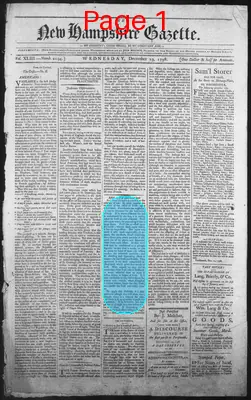
Domestic News
December 19, 1798
The New Hampshire Gazette
Portsmouth, Rockingham County, New Hampshire
What is this article about?
Discussion on how frost improves tilled land by expanding moisture to loosen soil particles, acting like a natural plough. Emphasizes benefits for clay soils and advises winter ploughing while cautioning against ploughing wet clay.
Clipping
OCR Quality
98%
Excellent
Full Text
Effects of frost upon tilled land.
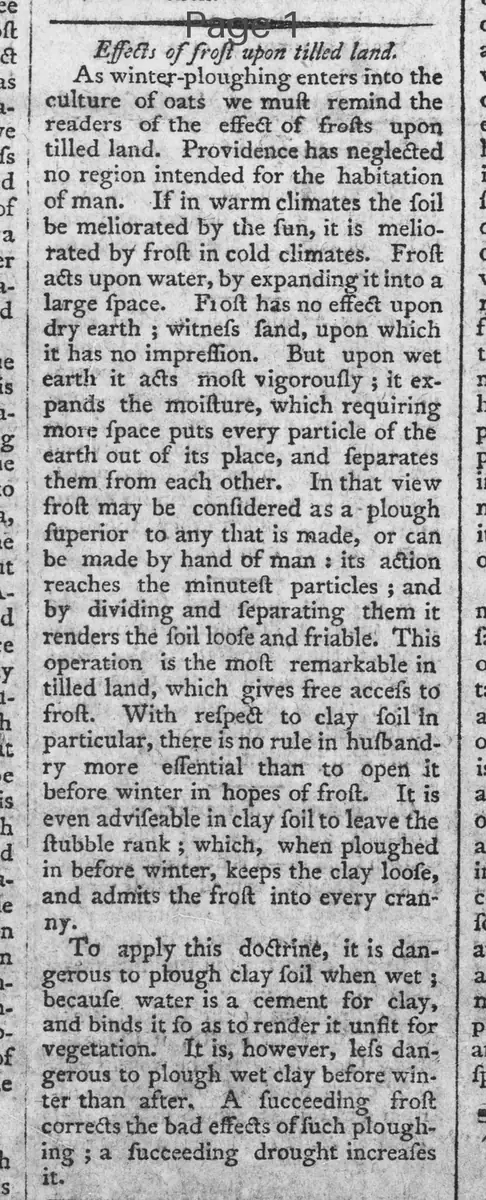
As winter-ploughing enters into the culture of oats we must remind the readers of the effect of frosts upon tilled land. Providence has neglected no region intended for the habitation of man. If in warm climates the soil be meliorated by the sun, it is meliorated by frost in cold climates. Frost acts upon water, by expanding it into a large space. Frost has no effect upon dry earth; witness sand, upon which it has no impression. But upon wet earth it acts most vigorously; it expands the moisture, which requiring more space puts every particle of the earth out of its place, and separates them from each other. In that view frost may be considered as a plough superior to any that is made, or can be made by hand of man: its action reaches the minutest particles; and by dividing and separating them it renders the soil loose and friable. This operation is the most remarkable in tilled land, which gives free access to frost. With respect to clay soil in particular, there is no rule in husbandry more essential than to open it before winter in hopes of frost. It is even advisable in clay soil to leave the stubble rank; which, when ploughed in before winter, keeps the clay loose, and admits the frost into every cranny. To apply this doctrine, it is dangerous to plough clay soil when wet; because water is a cement for clay, and binds it so as to render it unfit for vegetation. It is, however, less dangerous to plough wet clay before winter than after. A succeeding frost corrects the bad effects of such ploughing; a succeeding drought increases it.
As winter-ploughing enters into the culture of oats we must remind the readers of the effect of frosts upon tilled land. Providence has neglected no region intended for the habitation of man. If in warm climates the soil be meliorated by the sun, it is meliorated by frost in cold climates. Frost acts upon water, by expanding it into a large space. Frost has no effect upon dry earth; witness sand, upon which it has no impression. But upon wet earth it acts most vigorously; it expands the moisture, which requiring more space puts every particle of the earth out of its place, and separates them from each other. In that view frost may be considered as a plough superior to any that is made, or can be made by hand of man: its action reaches the minutest particles; and by dividing and separating them it renders the soil loose and friable. This operation is the most remarkable in tilled land, which gives free access to frost. With respect to clay soil in particular, there is no rule in husbandry more essential than to open it before winter in hopes of frost. It is even advisable in clay soil to leave the stubble rank; which, when ploughed in before winter, keeps the clay loose, and admits the frost into every cranny. To apply this doctrine, it is dangerous to plough clay soil when wet; because water is a cement for clay, and binds it so as to render it unfit for vegetation. It is, however, less dangerous to plough wet clay before winter than after. A succeeding frost corrects the bad effects of such ploughing; a succeeding drought increases it.
What sub-type of article is it?
Agriculture
What keywords are associated?
Frost Effects
Tilled Land
Winter Ploughing
Clay Soil
Soil Loosening
Agricultural Advice
Domestic News Details
Event Details
Frost expands water in wet tilled land, loosening soil particles and making it friable, superior to man-made ploughs. Most effective on tilled land, especially clay soils opened before winter. Advises leaving stubble to admit frost and warns against ploughing wet clay, though winter ploughing allows frost correction.