Thank you for visiting SNEWPapers!
Sign up free
Letter to Editor
August 4, 1829
Daily Richmond Whig
Richmond, Virginia
What is this article about?
A father provides detailed advice to his son on excelling as a bank keeper or first clerk, emphasizing diligence, accuracy in bookkeeping, moral habits, thrift, and avoiding procrastination and debt. References Benjamin Franklin's maxim on pence and pounds.
Clipping
OCR Quality
92%
Excellent
Full Text
In Recollections of Last Ten Years.
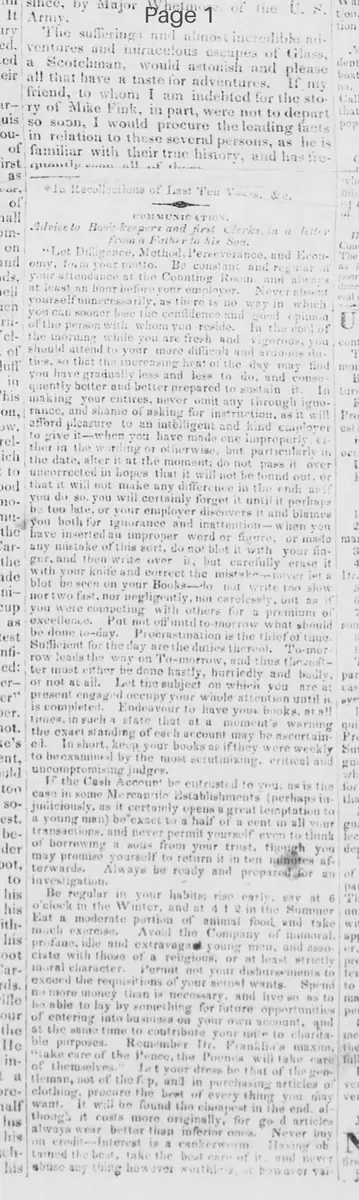
COMMUNICATION.
Advice to Bank keepers and first Clerks, in a letter,
From a Father to his Son.
"Let Diligence, Method, Perseverance, and Economy, form your motto. Be constant and regular in your attendance at the Counting Room and always at least an hour before your employer. Never absent yourself unnecessarily, as there is no way in which you can sooner lose the confidence and good opinion of the person with whom you reside. In the cool of the morning while you are fresh and vigorous, you should attend to your more difficult and arduous duties, so that the increasing heat of the day may find you have gradually less and less to do, and consequently better and better prepared to sustain it. In making your entries, never omit any through ignorance, and shame of asking for instruction, as it will afford pleasure to an intelligent and kind employer to give it—when you have made one improperly, either in the wording or otherwise, but particularly in the date, alter it at the moment, do not pass it over uncorrected in hopes that it will not be found out, or that it will not make any difference in the end, as you do so, you will certainly forget it until it perhaps be too late, or your employer discovers it and blames you both for ignorance and inattention—when you have inserted an improper word or figure, or made any mistake of this sort, do not blot it with your finger, and then write over it, but carefully erase it with your knife and correct the mistake—never let a blot be seen on your Books—do not write too slow nor too fast, nor negligently, nor carelessly, but as you were competing with others for a premium of excellence. Put not off until to-morrow what should be done to-day. Procrastination is the thief of time. Sufficient for the day are the duties thereof. To-morrow leads the way on To-morrow, and thus the adventure must either be done hastily, hurriedly and badly, or not at all. Let the subject on which you are at present engaged occupy your whole attention until it is completed." Endeavour to have your books, at all times, in such a state that at a moment's warning the exact standing of each account may be ascertained. In short, keep your books neat if they were weekly to be examined by the most scrutinizing, critical and uncompromising judges.
If the Cash Account be entrusted to you, as is the case in some Mercantile Establishments (perhaps in yours) judiciously, as it certainly opens a great temptation to a young man) balance it to a half of a cent in all your transactions, and never permit yourself even to think of borrowing a sous from your trust, though you may promise yourself to return it in ten minutes afterwards. Always be ready and prepared for an investigation.
Be regular in your habits, rise early, say at 6 o'clock in the Winter, and at 4½ in the Summer. Eat a moderate portion of animal food and take much exercise. Avoid the Company of immoral, profane, idle and extravagant young men, and associate with those of a religious, or at least strictly moral character. Permit not your disbursements to exceed the requisitions of your actual wants. Spend no more money than is necessary, and live so as to be able to lay by something for future opportunities of entering into business on your own account, and at the same time to contribute your mite to charitable purposes. Remember Dr. Franklin's maxim, "Take care of the Pence, the Pounds will take care of themselves." Let your dress be that of the gentleman, not of the fop, and in purchasing articles of clothing, procure the best of every thing you may want. "It will be found the cheapest in the end, although it costs more originally, for good articles always wear better than inferior ones." Never buy on credit—interest is a cankerworm having obtained the best, take the best care of it and never abuse any thing however worthless.
COMMUNICATION.
Advice to Bank keepers and first Clerks, in a letter,
From a Father to his Son.
"Let Diligence, Method, Perseverance, and Economy, form your motto. Be constant and regular in your attendance at the Counting Room and always at least an hour before your employer. Never absent yourself unnecessarily, as there is no way in which you can sooner lose the confidence and good opinion of the person with whom you reside. In the cool of the morning while you are fresh and vigorous, you should attend to your more difficult and arduous duties, so that the increasing heat of the day may find you have gradually less and less to do, and consequently better and better prepared to sustain it. In making your entries, never omit any through ignorance, and shame of asking for instruction, as it will afford pleasure to an intelligent and kind employer to give it—when you have made one improperly, either in the wording or otherwise, but particularly in the date, alter it at the moment, do not pass it over uncorrected in hopes that it will not be found out, or that it will not make any difference in the end, as you do so, you will certainly forget it until it perhaps be too late, or your employer discovers it and blames you both for ignorance and inattention—when you have inserted an improper word or figure, or made any mistake of this sort, do not blot it with your finger, and then write over it, but carefully erase it with your knife and correct the mistake—never let a blot be seen on your Books—do not write too slow nor too fast, nor negligently, nor carelessly, but as you were competing with others for a premium of excellence. Put not off until to-morrow what should be done to-day. Procrastination is the thief of time. Sufficient for the day are the duties thereof. To-morrow leads the way on To-morrow, and thus the adventure must either be done hastily, hurriedly and badly, or not at all. Let the subject on which you are at present engaged occupy your whole attention until it is completed." Endeavour to have your books, at all times, in such a state that at a moment's warning the exact standing of each account may be ascertained. In short, keep your books neat if they were weekly to be examined by the most scrutinizing, critical and uncompromising judges.
If the Cash Account be entrusted to you, as is the case in some Mercantile Establishments (perhaps in yours) judiciously, as it certainly opens a great temptation to a young man) balance it to a half of a cent in all your transactions, and never permit yourself even to think of borrowing a sous from your trust, though you may promise yourself to return it in ten minutes afterwards. Always be ready and prepared for an investigation.
Be regular in your habits, rise early, say at 6 o'clock in the Winter, and at 4½ in the Summer. Eat a moderate portion of animal food and take much exercise. Avoid the Company of immoral, profane, idle and extravagant young men, and associate with those of a religious, or at least strictly moral character. Permit not your disbursements to exceed the requisitions of your actual wants. Spend no more money than is necessary, and live so as to be able to lay by something for future opportunities of entering into business on your own account, and at the same time to contribute your mite to charitable purposes. Remember Dr. Franklin's maxim, "Take care of the Pence, the Pounds will take care of themselves." Let your dress be that of the gentleman, not of the fop, and in purchasing articles of clothing, procure the best of every thing you may want. "It will be found the cheapest in the end, although it costs more originally, for good articles always wear better than inferior ones." Never buy on credit—interest is a cankerworm having obtained the best, take the best care of it and never abuse any thing however worthless.
What sub-type of article is it?
Ethical Moral
Informative
Reflective
What themes does it cover?
Morality
Commerce Trade
Education
What keywords are associated?
Banking Advice
Work Ethic
Diligence
Bookkeeping Accuracy
Moral Habits
Thrift
Franklin Maxim
Procrastination
What entities or persons were involved?
A Father
His Son
Letter to Editor Details
Author
A Father
Recipient
His Son
Main Argument
a father advises his son to adopt diligence, method, perseverance, and economy in his role as a bank keeper or first clerk, stressing punctuality, accuracy in work, honest handling of cash, regular habits, moral associations, and thrift to build character and future success.
Notable Details
References Dr. Franklin's Maxim: 'Take Care Of The Pence, The Pounds Will Take Care Of Themselves.'
Emphasizes Erasing Mistakes Properly With A Knife Rather Than Blotting.
Warns Against Procrastination As 'The Thief Of Time.'
Advises Balancing Cash To A Half Cent And Never Borrowing From Trust.