Thank you for visiting SNEWPapers!
Sign up free
Literary
December 1, 1827
The Ladies' Garland
Harpers Ferry, Jefferson County, West Virginia
What is this article about?
A meditative prose essay describing a moonlight visit to a churchyard, reflecting on death's silence and equality, lessons in humility and virtue from the dead, and arguing that true virtue is joyful and lively, exemplified by Mrs. Barbauld's life.
Clipping
OCR Quality
95%
Excellent
Full Text
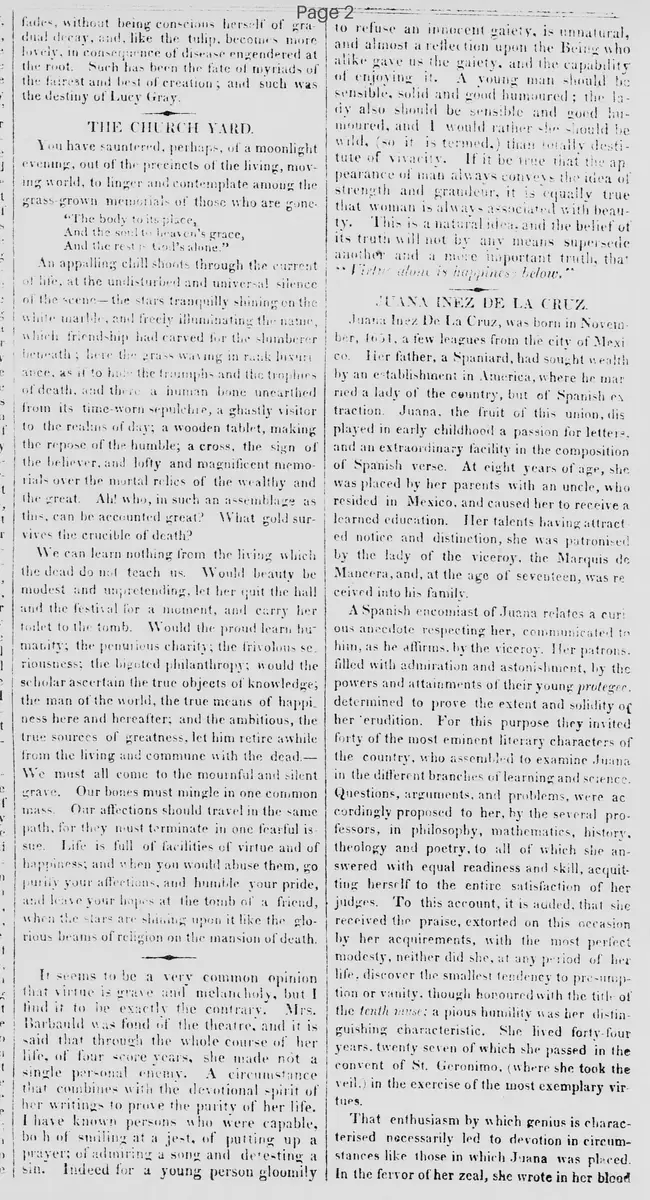
THE CHURCH YARD.
You have sauntered, perhaps, of a moonlight
evening, out of the precincts of the living, moving
world, to linger and contemplate among the
grass-grown memorials of those who are gone
"The body to its place,
And the soul to heaven's grace,
And the rest is God's alone."
An appalling chill shoots through the current
of life, at the undisturbed and universal silence
of the scene -- the stars tranquilly shining on the
white marble, and freely illuminating the names,
which friendship had carved for the slumberer
beneath: here the grass waving in rank luxuriance,
as if to hide the triumphs and the trophies
of death, and there a human bone unearthed
from its time-worn sepulchre, a ghastly visitor
to the realms of day; a wooden tablet, making
the repose of the humble; a cross, the sign of
the believer, and lofty and magnificent memorials
over the mortal relics of the wealthy and
the great. Ah! who, in such an assemblage as
this, can be accounted great? What gold survives
the crucible of death?
We can learn nothing from the living which
the dead do not teach us. Would beauty be
modest and unpretending, let her quit the hall
and the festival for a moment, and carry her
toilet to the tomb. Would the proud learn humanity;
the penurious charity; the frivolous seriousness;
the bigoted philanthropy; would the
scholar ascertain the true objects of knowledge;
the man of the world, the true means of happiness
here and hereafter; and the ambitious, the
true sources of greatness, let him retire awhile
from the living and commune with the dead. --
We must all come to the mournful and silent
grave. Our bones must mingle in one common
mass. Our affections should travel in the same
path, for they must terminate in one fearful issue.
Life is full of facilities of virtue and of
happiness; and when you would abuse them, go
purify your affections, and humble your pride,
and leave your hopes at the tomb of a friend,
when the stars are shining upon it like the glorious
beams of religion on the mansion of death.
It seems to be a very common opinion
that virtue is grave and melancholy, but I
find it to be exactly the contrary. Mrs.
Barbauld was fond of the theatre, and it is
said that through the whole course of her
life, of four score years, she made not a
single personal enemy. A circumstance
that combines with the devotional spirit of
her writings to prove the purity of her life.
I have known persons who were capable,
both of smiling at a jest, of putting up a
prayer; of admiring a song and detecting a
sin. Indeed for a young person gloomily
to refuse an innocent gaiety, is unnatural,
and almost a reflection upon the Being who
alike gave us the gaiety and the capability
of enjoying it. A young man should be
sensible, solid and good humoured: the lady
also should be sensible and good humoured,
and I would rather she should be
wild, (so it is termed.) than totally destitute
of vivacity. If it be true that the appearance
of man always conveys the idea of
strength and grandeur, it is equally true
that woman is always associated with beauty.
This is a natural idea, and the belief of
its truth will not by any means supersede
another and a more important truth, that
Virtue alone is happiness below.
You have sauntered, perhaps, of a moonlight
evening, out of the precincts of the living, moving
world, to linger and contemplate among the
grass-grown memorials of those who are gone
"The body to its place,
And the soul to heaven's grace,
And the rest is God's alone."
An appalling chill shoots through the current
of life, at the undisturbed and universal silence
of the scene -- the stars tranquilly shining on the
white marble, and freely illuminating the names,
which friendship had carved for the slumberer
beneath: here the grass waving in rank luxuriance,
as if to hide the triumphs and the trophies
of death, and there a human bone unearthed
from its time-worn sepulchre, a ghastly visitor
to the realms of day; a wooden tablet, making
the repose of the humble; a cross, the sign of
the believer, and lofty and magnificent memorials
over the mortal relics of the wealthy and
the great. Ah! who, in such an assemblage as
this, can be accounted great? What gold survives
the crucible of death?
We can learn nothing from the living which
the dead do not teach us. Would beauty be
modest and unpretending, let her quit the hall
and the festival for a moment, and carry her
toilet to the tomb. Would the proud learn humanity;
the penurious charity; the frivolous seriousness;
the bigoted philanthropy; would the
scholar ascertain the true objects of knowledge;
the man of the world, the true means of happiness
here and hereafter; and the ambitious, the
true sources of greatness, let him retire awhile
from the living and commune with the dead. --
We must all come to the mournful and silent
grave. Our bones must mingle in one common
mass. Our affections should travel in the same
path, for they must terminate in one fearful issue.
Life is full of facilities of virtue and of
happiness; and when you would abuse them, go
purify your affections, and humble your pride,
and leave your hopes at the tomb of a friend,
when the stars are shining upon it like the glorious
beams of religion on the mansion of death.
It seems to be a very common opinion
that virtue is grave and melancholy, but I
find it to be exactly the contrary. Mrs.
Barbauld was fond of the theatre, and it is
said that through the whole course of her
life, of four score years, she made not a
single personal enemy. A circumstance
that combines with the devotional spirit of
her writings to prove the purity of her life.
I have known persons who were capable,
both of smiling at a jest, of putting up a
prayer; of admiring a song and detecting a
sin. Indeed for a young person gloomily
to refuse an innocent gaiety, is unnatural,
and almost a reflection upon the Being who
alike gave us the gaiety and the capability
of enjoying it. A young man should be
sensible, solid and good humoured: the lady
also should be sensible and good humoured,
and I would rather she should be
wild, (so it is termed.) than totally destitute
of vivacity. If it be true that the appearance
of man always conveys the idea of
strength and grandeur, it is equally true
that woman is always associated with beauty.
This is a natural idea, and the belief of
its truth will not by any means supersede
another and a more important truth, that
Virtue alone is happiness below.
What sub-type of article is it?
Essay
What themes does it cover?
Death Mortality
Moral Virtue
Religious
What keywords are associated?
Churchyard
Mortality
Virtue
Happiness
Humility
Barbauld
Death
Religion
Literary Details
Title
The Church Yard.
Key Lines
"The Body To Its Place, And The Soul To Heaven's Grace, And The Rest Is God's Alone."
We Can Learn Nothing From The Living Which The Dead Do Not Teach Us.
We Must All Come To The Mournful And Silent Grave.
Virtue Alone Is Happiness Below.
Mrs. Barbauld Was Fond Of The Theatre, And It Is Said That Through The Whole Course Of Her Life, Of Four Score Years, She Made Not A Single Personal Enemy.